
![The Time Mussolini Went SCORCHED EARTH on the FREEMASONS [WWII Part 8]](https://dropinblog.net/cdn-cgi/image/fit=scale-down,format=auto,width=700/34264201/files/featured/mussolini.png)

This article is part of a series; be sure to read The History Heist PART 1 first. Click here to go to Part 1.
NEXT READ: Hitler Family Secrets [Part 9]
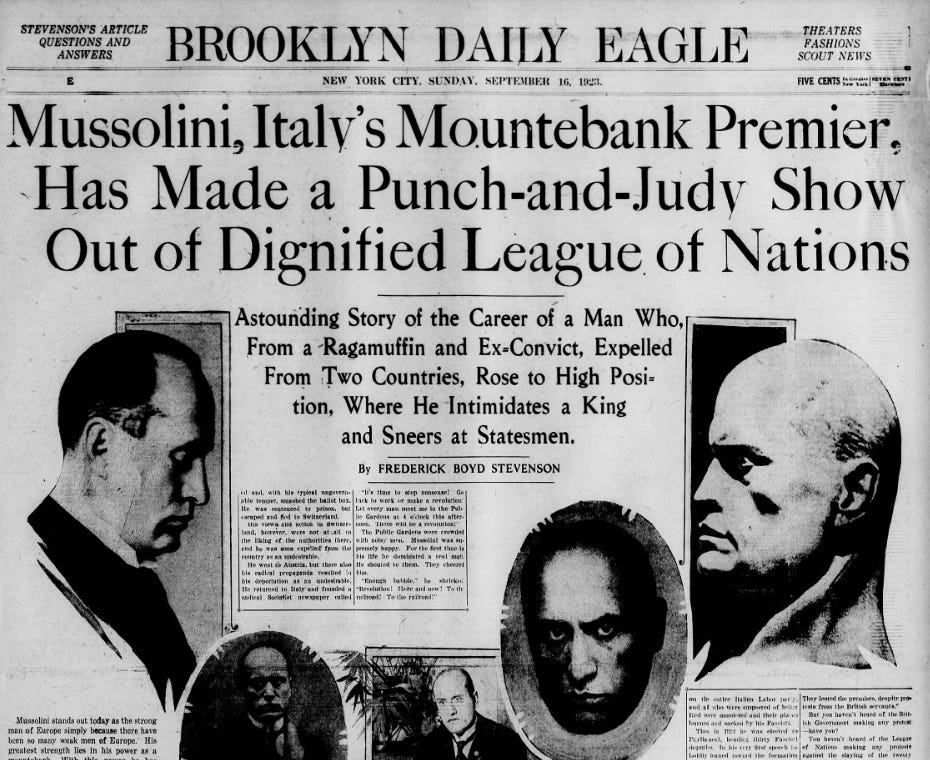
Although the presses were reporting Mussolini wasn’t good for Italy, as far back as 1926, the Financial News reported that a committee of British residents in Florence announced, "We wish to state most clearly and emphatically that there exists here today nothing that can be justly termed either tyranny or suppression of personal freedom as guaranteed by constitutional law in any civilized land. We believe that Mussolini enjoys the enthusiastic support and admiration of the Italian people who are contented, orderly and prosperous to a degree hitherto unknown in Italy, and probably without parallel at the present time among other great European nations still suffering from the war."
If Mussolini was great to the people of his nation, why did the presses dislike him? Well, for starters, he disliked the League of Nations.
But the League wasn’t the only entity the new dictator had a problem with…
THE DECREE
Rumor quickly spread that Mussolini was planning to, by decree, abolish all secret society organizations. This was no surprise. A decade prior, before becoming ruler, Benito stated that being in government and being a Freemason is “incompatible.” A spokesman for Mussolini stated, “… Our [Italy’s] Masonry is the secret enemy of the government; it is a plot against the government…” Although Benito was not personally a Christian, he knew his nation was heavily Christian, and the Freemasons despised Christianity, which was a constant source of upheaval.
The decree went into effect in 1925. This new law did not specifically name Masons; it was instead all-encompassing to also include the Italian mafia and all other covert brotherhoods or organizations. But decreeing that there could no longer be secret societies was relatively worthless because Freemasonry was deeply entrenched in Italy. The first lodge had been opened back in the late 1700s by the Duke of Middlesex. Come the 1860s, it was a powerhouse, struggling for control over the nation. By the time of Mussolini, the situation in Italy was no different from the rest of the world: the Freemasons controlled the presses and therefore had control over a brainwashing program that was able to shift the opinions of the populace. These papers were used to cause division, distrust, and rebellion. These publications were a plague to Italy.
When the Masons were hit with the decree, as expected, they wielded their papers like weapons and began “a violent campaign” against the dictator. Benito, unwilling to play their games, quickly seized their Florence Press Club. The Freemasons expected as much, so it was of no surprise. They also expected some of their lodges to be shut down and possibly even vandalized, but they saw this as nothing more than a temporary headache. After all, the Masons were accustomed to being banned from nations and having to relocate or meet in secrecy. They figured that even if Mussolini did bust up their lodges, no power would be truly lost. But if the Masons thought this was the end of it, they thought wrong because when it comes to the brotherhood, Benito Mussolini had officially run out of fucks to give. The secret society never could have prepared for what was about to happen…
THE BLACKOUT
On September 26th, 1925, the whispers started. Some feared Mussolini was plotting against the brotherhood, but the vast majority were quick to dismiss it. After all, they had been operating in Italy for over 150 years. Whatever the dictator had up his sleeve, it wouldn’t be anything the fraternity hadn’t dealt with before. But what they didn’t know was that Benito was not like the rulers who had come before him.
“We must do all the good we can to our friends and must inflict all the harm possible on our enemies,” said Mussolini. “Now as Masonry has fought us, as it has given us trouble, as it has attempted to split and divide us, and as it has, in certain cities, succeeded in creating dissensions, more than usually idiotic, because of their underground origins, for all these reasons, even if there were no others, we are within our plain and sacrosanct right to defend ourselves and to proceed to the attack, because, as you are teaching me, the best defense consists in an attack... The fight against Masonry continues with a great intensity. The enemy is more ready, more prepared than before. The fight against Masonry is a fight to a finish, and there is only one possible program…
Masonry must be destroyed, and Masons should have no right to citizenship in Italy. To reach this end, all means are good, from the club to the gun, from the breaking of windows to the purifying fire. In one word, no avenue of escape should be left open to Masonry… The Masons must be ostracized. Each and every one of their acts or movements must be stopped. Their very life must be made impossible.”
It all began with a covert military plan in which the name of every Freemason in Italy was obtained from Masonic Lodge registries. When it was go time, the Italian military acted swiftly. To create a blackout, at the same exact moment, all remaining Freemasonic presses were seized, cables were halted in post offices, telegrams to Paris were shut down, and outgoing mail was frozen. This brilliant planning was necessary for what was to come.
When given the signal, the troops went out with names in hand. These military men knew what their mission was, and they were prepared to accomplish it. Quickly, thirteen Freemasonic lawyers, notaries, and a doctor had their offices demolished. Meanwhile, apartments belonging to Masons were burned to the ground. In Rome, while a meeting of the lodge was in progress, the military, armed with clubs, broke down the doors, beat the members of the lodge, and then set fire to the premises.
The brotherhood’s cafes were looted, and so much wine and spirits were dumped out that the alcohol literally flowed in the streets. Freemasonic judges, and officials were forced to resign; their time ruling over Italian cases was over. Bankers belonging to the brotherhood were overthrown, to be later replaced with enemies of Masonry. But vandalism and job terminations never were the goal; these were just a part of the bigger task, the fight to the finish.
The editors of Freemasonic presses were beaten to a pulp. Their businesses were to be liquidated. The homes of members of the brotherhood were forcefully entered, and the Masons were shot on sight or lynched. The lynched men were used to set an example; their dead bodies were dragged to the public square and exposed as a warning. There were at least 300 casualties, and the number of dead has been estimated between 50 and 137.
Within a matter of days, the military had destroyed 1,000 Freemasonic lodges and clubs, raiding each and throwing their precious emblems and other insignia into the street or auctioning them off. What they could not otherwise liquidate was burned out of existence. Commendatore Raoul Palermi, the Grand Master of the Scottish Rite, was able to escape the massacre because he had been tipped off by someone close to the government. Although he managed to flee the execution, not long after, he was found stabbed and unconscious in his writing room. The seized presses were forbidden from mentioning this story. Police instead gave a statement to the Grand Master’s friends, claiming that the stab wounds were self-inflicted.
The Grand Master of the Grand Orient, Domizio Torrigiani, and General Roberto Bencivenga, former chief of the general staff of Mussolini’s General Luigi Cadorna, were deported to the isle of Ponza. Freemasonic General Luigi Capello, once commander of the Italian Second Army, was sentenced to thirty years imprisonment.
Because the presses had been seized, outside of Italy, few knew what was taking place, but as the massacre continued, word spread, and on Sunday, October 4th, nationals and diplomats (likely Freemasons / Judeo-Masons) poured into diplomatic buildings in Italy, seeking protection. American, British, and Swiss consuls rushed to raise their flags. The raising of these flags only meant one of two things: it was either a holiday or war, and in this case, it was war. The consuls telegraphed their protests directly to Mussolini, demanding he cease hostilities.
As word of the massacre traveled, the American and British presses inquired as to the reason for the bloodbath. With complete control over all outgoing media, Mussolini told them that the Masons and the Socialists had attacked a Fascist and killed him, and that this action led the mob to demand vengeance. The mob, he said, acted without authority, and the government was pacifying the city.
Soon, word leaked, and the true reason for the slaughter was discovered. A correspondent was invited to ask Mussolini questions about the massacre of the Freemasons. “Could your Excellency explain the reason for the Fascist war on Masonry?” Mussolini replied,
“I am very glad you asked that question because there is a lot of misunderstanding in Anglo-Saxon countries over this question… The sect must be absolutely abolished because its influence is deleterious to discipline in the army, to the impartiality of the courts, and a subversion of order that should obtain in all public offices. Masonry has overturned all regulations… Fortunately, Fascism has struck Italian Masonry such a blow that it will be difficult for it to regain its legs again for some time… The grave attempt on my life on the anniversary of our glorious victory, and the plot to throw the whole nation into disorder, show what a sinister influence the Masonic sect — which undoubtedly inspired the criminal attempt on my life — has on the minds even of Italians who, because of their social position and past military experience, ought to be better able to understand the folly and shame of this latest exploit.”
“This shady institution with its secret nature has always had in Italy a character typical of the briber and the blackmailer… The Masons of Italy have always represented a distortion, not only in political life, but in spiritual concepts. ... Its secret character throughout the twentieth century, its mysterious meetings, abhorrent to our beautiful communities with their sunlight and their love of truth, gave to the sect the character of corruption, a crooked concept of life, without program, without soul, without moral value… For my direct, methodical, consistent course of policy, the hate of the Masonic sect persecutes me even now. … This is a war without quarter, a war of which I am a veteran. ... I have always had against me our Masonry. But that organization, which in other times was very powerful, has been beaten by me. Against me it did not and cannot win. Italians won this battle for me. They found the cure for this leprosy. ... I obeyed the positive command of my conscience, and not any opportunism.”
When what was now being referred to as “the Bloodbath in Italy” came to an end, the Supreme Council 33° Ancient and Accepted Scottish Rite of Freemasonry in America published a response to it in the newspapers:
“The millions of Masons throughout the world at the present can only look on, impotent for the time being, to help their oppressed brethren in Italy, but their distress awakens the deepest sympathy. Masons of the world, especially the three million of the Craft in this country, are well aware of the issues involved, and their hearts vibrate with compassion for their suffering brethren overseas… There can be no doubt of the ultimate result. For the time the tyrant prospers… The despot must fall, the wrong be dethroned and righteousness come to victory. In that day Freemasonry in Italy will be vindicated…”
But the war against secret societies was not only about ending the reign of the Italian Freemasons…
MUSSOLINI vs THE MAFIA
In the 1920s, the Mafia was becoming a global entity. Many of these mafioso came from Italy because Italian judges, instead of filling their jails with these criminals, robbers, racketeers, and cutthroat murderers, encouraged them to emigrate to America. At this time in Italy, there was no capital punishment, so it was less expensive for Italy to ship them to America than to indefinitely confine them. So, when one of these fellows appeared before a Sicilian judge, the judge would sentence them to life imprisonment, which was to begin the following Thursday, or, alternatively, they could catch the Wednesday boat to New York. Guess which option they chose?
At this time, in America, the Jewish-Italian mafia was making a fortune on illegal alcohol sales during prohibition. This huge injection of funds catapulted the mob to unimaginable heights. They now had the funding they needed to expand across the nation and soon began infiltrating other nations aside from Italy. Only a few years from now, mafia families would unite to create the Syndicate, and control over the crime empire would be given to Jewish Meyer Lansky, who would work on behalf of Israel. [Learn about the American Mafia in my Pizzagate eBook.]
When Mussolini came to power, he discovered his country wasn’t overrun by one mafia; there were actually two, and both were “big secret terror organizations.” The first mafia controlled the countryside, extorting farmers. The other controlled the city and forced urban merchants to pay them. In Italy, all businesses were under the control of the mobs, from alcohol to movies to the clothing industry; even the banks and construction companies were forced to pay the crime empire. It was so bad that even the mayor of Piana dei Greci, Italy (now known as Piana degli Albanesi), was a mafia boss named Francesco Cuccia.
In June 1924, Mussolini instructed his right-hand man, Cesare Mori, to eradicate the Mafia from Sicily, and on October 25, 1925, which was only weeks after the assassination of the Freemasons had ended, the plan to incarcerate every last mafioso began.
Mori formed a small army of policemen and militiamen, which went from town to town, rounding up suspects. Like with the Masons, arresting the mafia was no holds barred. To force suspects to surrender, the military would take the men’s families hostage, confiscate their property, and publicly slaughter their livestock. Although brutal, these tactics worked, and within a short matter of time, over 11,000 mafioso and their affiliates were arrested. In court, these crooks were tried en masse.
Once the mafia was off the streets, the murder and crime rate sharply dropped. Businesses, no longer being forced to give away their earnings, prospered. Mussolini had made it clear; the criminal racket and its Bolshevism were no longer welcomed in Italy.
THE MOST HATED MAN
As you could have guessed, demolishing both the Mafia and the Freemasons made the ruler a target. And, as the Freemasons said, he will be dethroned… and they meant it. But, despite many assassination attempts, as of this time, Benito Mussolini was still alive…
NEXT READ: HITLER FAMILY SECRETS [Part 9]
___________________________________________________
Did you see that I am headlining a big event on September 17th, 2026? Five of your favorite authors will be giving one-hour presentations. Be sure to grab your ticket! You can learn more about Truth Be Told: The Mega Event and each presentation here. BE SURE TO USE COUPON CODE "AGENT" TO GET $5 OFF!

Be sure to subscribe so my articles get sent to your email!
Want to support my work? Buy Me a Coffee or Make a Ko-Fi Donation:
If you want to make sure you are updated when new articles, eBooks, events, and podcasts are released, be sure to sign up for WhatsApp notifications:
![The History Heist PART 2: Creating the Imperative Narrative [WWII Part 7 by Agent131711]](https://dropinblog.net/cdn-cgi/image/fit=scale-down,format=auto,width=700/34264201/files/featured/histoy-heist-part-2.jpg)
![Hitler Family Secrets & The Little Servant Girl [WWII Part 9 by Agent131711]](https://dropinblog.net/cdn-cgi/image/fit=scale-down,format=auto,width=700/34264201/files/featured/hitler-family-secrets.png)
![The History Heist: How They STOLE History & REWROTE IT [WWII Part 6 by Agent131711]](https://dropinblog.net/cdn-cgi/image/fit=scale-down,format=auto,width=700/34264201/files/featured/history-heist.png)
![Adolf Hitler: Good? Bad? OR A PSYOP? History Caught in a Lie [WWII Part 10]](https://dropinblog.net/cdn-cgi/image/fit=scale-down,format=auto,width=700/34264201/files/featured/hit.png)
![Germany is CAPTURED: The Secret Plot to Steal the Kingdom [WWII Part 5 by Agent131711]](https://dropinblog.net/cdn-cgi/image/fit=scale-down,format=auto,width=700/34264201/files/featured/germany-is-captured.png)
![All Hell Broke Loose: The Secret History of WWII [Part 4 by Agent131711]](https://dropinblog.net/cdn-cgi/image/fit=scale-down,format=auto,width=700/34264201/files/featured/wwii-part-4.png)
![Choosing the Chosen People [WWII Part 11 by Agent131711]](https://dropinblog.net/cdn-cgi/image/fit=scale-down,format=auto,width=700/34264201/files/featured/chosen.png)
![Hidden History: King Edward & The Cabal: Operation Destroy Germany [WWII Part 3 by Agent131711]](https://dropinblog.net/cdn-cgi/image/fit=scale-down,format=auto,width=700/34264201/files/featured/wwii-part-3.png)
![How The Nazis Hoaxed Germany [WWII Part 12 by Agent131711]](https://dropinblog.net/cdn-cgi/image/fit=scale-down,format=auto,width=700/34264201/files/featured/how-the-nazis-hoaxed.png)
![WWII Part 2: The Secret Pact You Never Knew About [WWII Part 2 Agent131711]](https://dropinblog.net/cdn-cgi/image/fit=scale-down,format=auto,width=700/34264201/files/featured/42323fe6-68eb-489e-b3fd-3d58661edd7d-1.png)
![Introduction to WWII: Laying the Foundation for What Is to Come [WW2 Part 1 by Agent131711]](https://dropinblog.net/cdn-cgi/image/fit=scale-down,format=auto,width=700/34264201/files/featured/40313432-85c6-4c51-9ab3-b94a534b1804.png)