

![The History Heist: How They STOLE History & REWROTE IT [WWII Part 6 by Agent131711]](https://dropinblog.net/cdn-cgi/image/fit=scale-down,format=auto,width=700/34264201/files/featured/history-heist.png)
This article is part of my WWII series, but you don't have to read the series to enjoy this piece. If you do want to start from the beginning, click here to go to Part 1.
NEXT READ: The News Archive Search
The other day I became aware of yet another issue regarding history, and this one is a really big deal. You know how there are old documents and archives that the government owns? How do those materials get there? Well, the government collects all the originals. They then promise to keep them safe. Since letting the public touch them could lead to them being ruined, the government releases an “official copy.” It turns out that the official copy isn’t actually a copy, because the word copy means to exactly duplicate, and that is not what is happening. The government is allowed to redact and remove content; they can even outright edit it so that it says something other than what it actually said. Through this method, the government is removing anything damning about the heroes and darkening up the profiles of the villains. One fantastic example of this is Winston Churchill, who was a raging alcoholic. The guy was such an alcoholic that coworkers would find him at his desk, incapacitated—and there are tons of records of this! But, when it came time for governments to release their “official copies” of original documents, every sentence, paragraph, page, and even entire letters that made reference to Churchill’s horrific behavior and inability to function due to intoxication had been stripped. When sentences were removed from Churchill files, they were replaced with “…” (three dots that adjoined the prior sentence and the latter sentence together). When entire pages were removed, they were often replaced with blank paper. The end result was that Winston was a hero.
This made me realize why I keep running into this bizarre issue where I will be reading something that provides a book as a source, I locate a digital version of the book, and discover that it jumps from page 30 to page 48, with everything in between having been removed. I kept chalking it up to whoever digitalized the book doing a terrible job, but now I’m not so sure, because it turns out that the source material is always on the pages that are not present. This leads to another massive problem, which is that with everything being digital, history can be controlled so easily.
In regard to stopping the flow of information, these days search engines ensure it never sees the light of day, websites ban the accounts of authors they dislike, and online marketplaces won’t allow the listing of material that they claim goes against their vague terms of service—terms that have been written to be intentionally vague so that anything and everything can be banned when the time comes to do so. But this issue extends far beyond the internet and directly into schools. As I wrote in The Evolution Hoax, students who didn’t want to agree with the evolution theory were denied degrees. Meanwhile, libraries removed books that did not promote the newfound theories. The empty shelf space was filled with pro-evolution material. Simultaneously, textbooks that questioned evolution theory in any way were entirely boycotted. You can see how, very quickly, a new idea can become the only idea when, in fact, it is not. There is a stranglehold applied to other ideas, which gives the illusion of everyone in society believing in one specific thing. But the aforementioned issues are not the only problems with the skewing of true history—no, sir. This issue runs much, much deeper.
Below I will share with you an absolutely outstanding article written by two World War I researchers. Although this valuable piece of content was scrubbed from the internet, I was able to recall it and preserve it. I have made slight edits (spelling and grammar) and added on my own research, which perfectly aligns with their work. Please pay close attention here because this is some of the most important untold history that you will ever read:
This story begins many years before the first war, in Britain. It was here that in 1891, a not-so-secret secret society was formed to oversee history. Technically, there is no way of knowing if this was the original intention of the society, but the society became the arbiters of British history. From its inception, members of the secret society have taken exceptional care to remove traces of the conspiracy. Letters to and from its leader Alfred Milner were culled, removed, burned, or otherwise destroyed. Milner was a frequent guest of Rothschild.
In 2013 authors Jim MacGregor and Gerry Docherty “closely examined many of Milner’s remaining papers, which are held in the Bodleian Library at Oxford University. They bear witness to the zeal with which much evidence of wrongdoing has been obliterated. Secret dispatches that we know from other sources that he sent have disappeared. Incriminating letters penned by King Edward VII—a leading secret cabal player in the genesis of WW1 before his death in 1910 - were subject to an order that they must be destroyed immediately on his death. Admiral Jacky Fisher, a royal favorite, noted in his memoirs that he had been advised by Lord Knollys, the king’s private secretary, to burn all letters sent to him by the king. Fisher consequently burned much of his royal correspondence but couldn’t bear to part with it all. Lord Nathaniel Rothschild, member of the cabal and by far the richest man in the world, likewise ordered that his papers and correspondence be burned posthumously lest his political influence and connections become known. As his official biographer commented, one can but ‘wonder how much of the Rothschilds political role remains irrevocably hidden from posterity.’
In Britain, crucial primary documents about the lies and deceit surrounding the First World War through diaries, memoirs, and important letters were censored and altered, evidence sifted, removed, burned, carefully ‘selected’ and falsified. Bad as that may be, it is of relatively minor importance compared to the outrageous theft of crucial papers from across Europe. In the immediate post-war years, hundreds of thousands of important documents pertaining to the origins of the First World War were taken from their countries of origin to the west coast of America and concealed in locked vaults at Stanford University. The documents, which would doubtless have exposed the men who were truly responsible for the war, had to be removed to a secure location and hidden from prying eyes. It was the greatest heist of history that the world has ever known.
Herbert Clark Hoover, a nasty, corrupt, and dishonest ‘mining engineer’ reinvented as a munificent humanitarian and international relief organizer, was the Secret Elite agent charged with the mammoth job of stealing the European documents. In modern-day parlance, had it all been recorded on a computer, he was the one who pressed the delete button.”
Remember Hoover’s “humanitarian aid” program? “His American-based organization raised millions of dollars through loans and public donations, shipped vast quantities of food and necessities to war-torn Europe, and made obscene profits for his backers, yet no documentary evidence of this enormous enterprise could be found at the end of the war. It had disappeared. All of it. Impossible, surely?”
The theft of Europe’s historical documents was dressed in a cloak of respectability and represented as a philanthropic act of preservation. These documents, it was claimed, would be properly archived for the use of future historians. The official line was that if not removed from government agencies in France, Russia, Germany, and elsewhere, the papers detailing the extent of Hoover’s work would ‘easily deteriorate and disappear.’ It was no chance decision that only documents relating to the war’s origins and ‘Belgian relief’ were taken. No official British, French, or American government approval was sought or given. Indeed, like the thief in the night, stealth was the rule of thumb. On the basis that it was kept ‘entirely confidential,’ Ephraim Adams, professor of history at Stanford University and a close friend of Hoover’s from their student days there, was called to Paris to coordinate the great heist and give it academic credence.
HOW THEY DID IT
In 1919, Hoover recruited a management team of ‘young scholars’ from the American army and secured their release from military service. They were primarily interested in material relating to the war’s true origins and the sham Commission for Relief of Belgium. Other documents concerning the conduct of the war itself were ignored. His team used letters of introduction and logistical support to collect import / export bills, sales and distribution records, insurance documents, and local customs permits amongst a plethora of incriminating evidence. He established a network of representatives throughout Europe and persuaded General John Pershing to release fifteen history professors and students serving in various ranks of the American Expeditionary Force in Europe. He sent them, in uniform, to the countries his agency was feeding. With food in one hand and reassurance in the other, they visited nations on the brink of starvation and faced little resistance in their quest. They made the right local contacts, ‘snooped’ around for archives, and found so many that Hoover ‘was soon shipping them back to the US as ballast in the empty food boats.’ Hoover recruited an additional 1,000 agents whose first haul amounted to 375,000 volumes of the ‘Secret War Documents’ from European governments. It has not been possible for us to discover who actually funded this gargantuan, massively expensive venture.
The removal and disposal of incriminatory British and French material posed little or no problem, and with the Bolsheviks in control, access to Russian documents from the Czarist regime proved straightforward. They undoubtedly contained hugely damaging information on how the assassination of Franz Ferdinand in Sarajevo on 28 June 1914 had been orchestrated through Petrograd, and how Russia’s general mobilization on Germany’s eastern border had been the real reason for the war starting. It might appear strange that the Bolsheviks cooperated so willingly by allowing Hoover’s agents to remove twenty-five carloads of material from Petrograd, but when one realizes that the international bankers in the secret society had financed and facilitated Lenin and Trotsky’s return to Russia and the Bolshevik Revolution itself, it becomes clear. The Americans could have what they wanted. This surprising event was reported in The New York Times, which claimed that Hoover’s team bought the documents from a ‘doorkeeper’ for $200 cash. And some people think that fake news is a twenty-first-century concept.
Removal of documents from Germany presented few problems. Fifteen carloads of material were taken, including ‘the complete secret minutes of the German Supreme War Council’—a ‘gift’ from Friedrich Ebert, first president of the post-war German Republic. Hoover explained this away with the comment that Ebert was ‘a radical with no interest in the work of his predecessors.’ [Remember, my friends, Ebert was in on the entire scheme, and it was Ebert, with Maximilian, who overthrew the monarchy. So this gift of all the remaining evidence of the war was not so much a gift and more so just part of the plan to clean up what traces of the massive conspiracy remained.]
Hoover’s men also acquired 6,000 volumes of German documents covering the complete official proceedings of the Kaiser’s pre-war activities and his wartime conduct of the German empire. If Germany had been guilty of planning and starting the war - as decreed by court historians ever since - these documents would have proved it. Strange that none have ever been released. Had there been incriminating documents, it is certain that copies would have been sent out immediately to every press and news agency throughout the world, proving Germany was to blame. The removal and concealment of the German archives by the Secret Elite was crucial because they would have proved the opposite: Germany had no interest in war and most certainly did not start it.
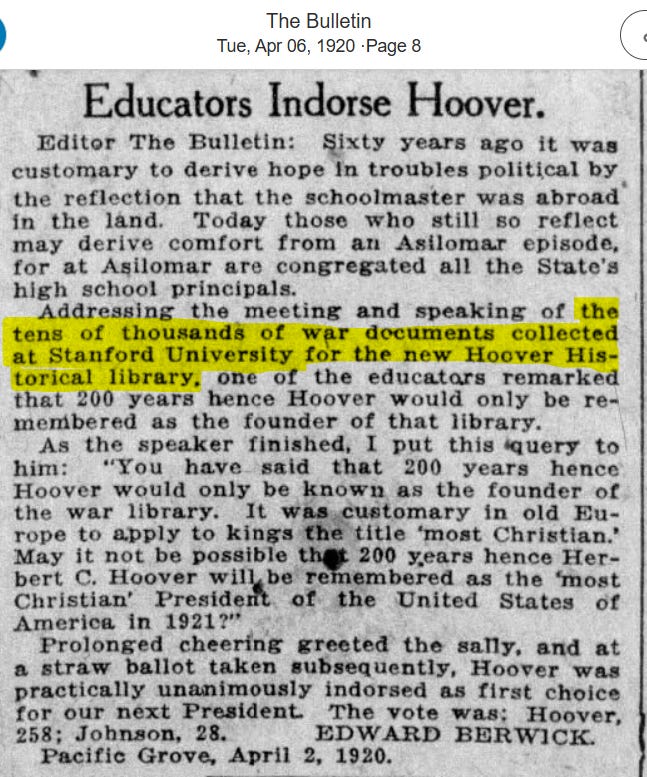
By 1926, the ‘Hoover War Library’ at Stanford University was so packed with archived material that it was legitimately described as the world’s largest collection of First World War documentation.” If you are thinking this write-up by the researchers is too far-fetched to possibly be true, I was able to verify exactly what they documented. The news article below was published in The Bulletin in 1920. It is titled “Educators Indorce Hoover.” The piece says, ”…the tens of thousands of war documents collected at Stanford University for the new Hoover Historical Library.” Yes, folks, tens of thousands of war documents.
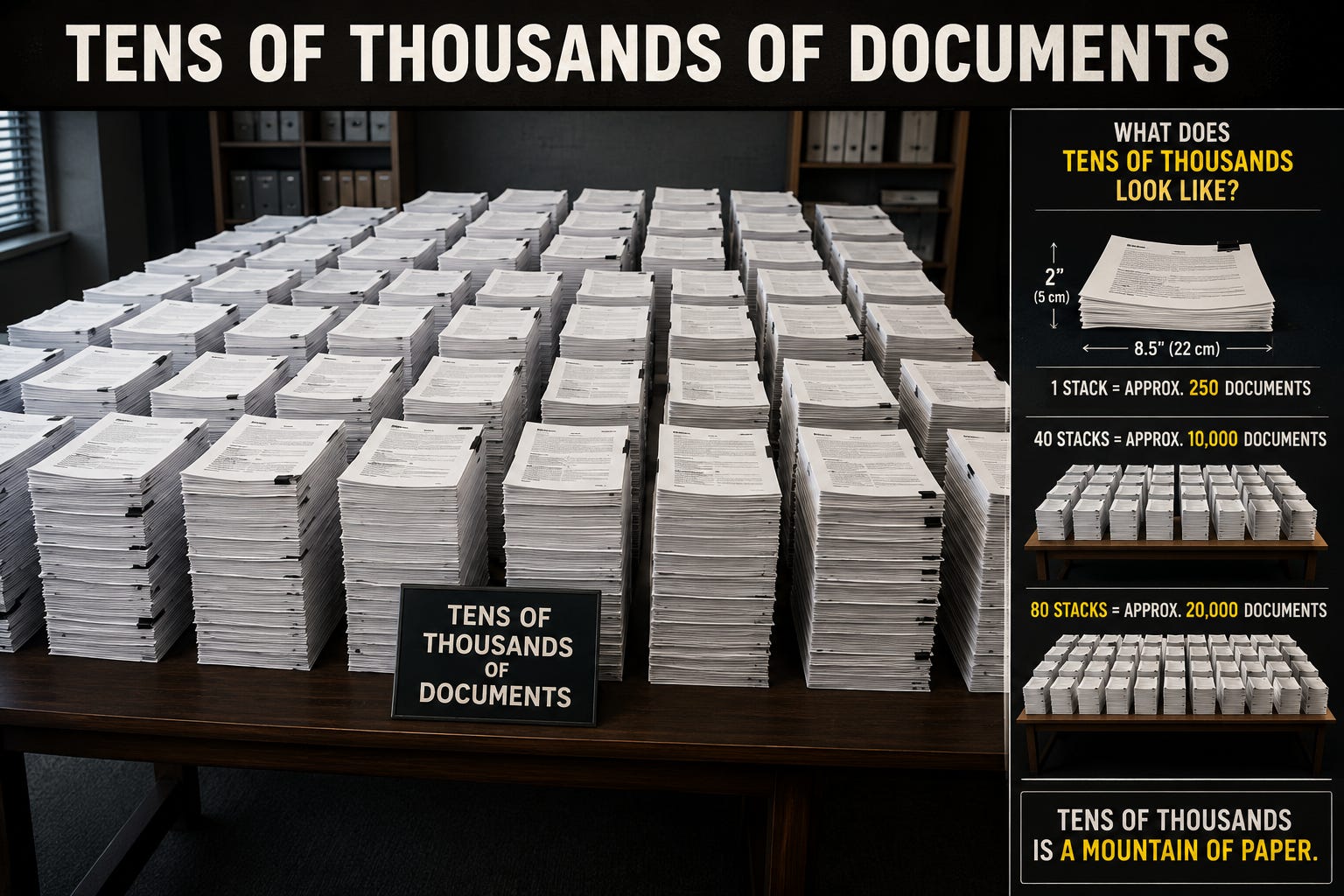
Can you even comprehend what tens of thousands of documents look like? I can’t.
MacGregor and Docherty continue, “In reality, this was no library. While the documents were physically housed within Stanford, the collection was kept separate, and only individuals with the highest authority had keys to the padlocked gates. It was the Fort Knox of historical evidence, a closely guarded establishment for items too sensitive to share.
In 1941 only carefully selected archives were made available to genuine researchers. Over the previous two decades, the unaccountable ruling cabal—the very men responsible for WWI - had unfettered control over them. What they withheld from view, shredded, or put in the Stanford furnace will never be known. Suffice to say that no First World War historian has ever reproduced or quoted any controversial material housed in what is now known as the Hoover Institution on War, Revolution, and Peace. Indeed, it is a startling fact that no war historian has ever written about this utterly astonishing theft of the European war documents and their shipment to America…
CONCEALMENT
The Hoover Institution at Stanford was not the sole depository for the concealment and sifting of incriminatory documents. In his book The History Thieves, Ian Cobain, an investigative journalist with The Guardian newspaper in London, reveals a secret facility just an hour’s drive north of the city. Concealed in dense woodland near the tiny hamlet of Hanslope, lies ‘one of the most secure facilities operated by any government, anywhere in the world.’ An outpost of Britain’s domestic and foreign spy agencies, MI5 and MI6, which are based in London, Hanslope Park is guarded by a seven-foot-high chain-link fence, just beyond which is a ten-foot-high fence topped with coils of razor wire. Every few yards between the fences are closed-circuit television cameras and floodlights. Cobain writes, ‘only from the air can the enormous scale of the compound be comprehended; it measures almost half a mile across … It is a perfect place to bury difficult secrets.’
Wow. What an outstanding piece by MacGregor and Docherty. Hats off to these gentlemen. Their work motivated me to build upon it by running some keyword searches in newspaper archives to see if I could find any reports of interest. More specifically, I had a sneaking suspicion that there was more document chaos than the fabulous researchers outlined, so I went hunting for articles about stolen or missing war documents, and to my complete and total shock, I found a whole new story that fits like a glove with the history heist we just discussed.
COMING NEXT: THE HISTORY HEIST - The Newspaper Archive Search [Part 7]
___________________________________________________
Did you see that I am headlining a big event on September 17th, 2026? Five of your favorite authors will be giving one-hour presentations. Be sure to grab your ticket! You can learn more about Truth Be Told: The Mega Event and each presentation here.
Be sure to subscribe so my articles get sent to your email!
Want to support my work? Buy Me a Coffee or Make a Ko-Fi Donation:
If you want to make sure you are updated when new articles, eBooks, events, and podcasts are released, be sure to sign up for WhatsApp notifications:
![Germany is CAPTURED: The Secret Plot to Steal the Kingdom [WWII Part 5 by Agent131711]](https://dropinblog.net/cdn-cgi/image/fit=scale-down,format=auto,width=700/34264201/files/featured/germany-is-captured.png)
![The History Heist PART 2: Creating the Imperative Narrative [WWII Part 7 by Agent131711]](https://dropinblog.net/cdn-cgi/image/fit=scale-down,format=auto,width=700/34264201/files/featured/histoy-heist-part-2.jpg)
![All Hell Broke Loose: The Secret History of WWII [Part 4 by Agent131711]](https://dropinblog.net/cdn-cgi/image/fit=scale-down,format=auto,width=700/34264201/files/featured/wwii-part-4.png)
![The Time Mussolini Went SCORCHED EARTH on the FREEMASONS [WWII Part 8]](https://dropinblog.net/cdn-cgi/image/fit=scale-down,format=auto,width=700/34264201/files/featured/mussolini.png)
![Hitler Family Secrets & The Little Servant Girl [WWII Part 9 by Agent131711]](https://dropinblog.net/cdn-cgi/image/fit=scale-down,format=auto,width=700/34264201/files/featured/hitler-family-secrets.png)
![Adolf Hitler: Good? Bad? OR A PSYOP? History Caught in a Lie [WWII Part 10]](https://dropinblog.net/cdn-cgi/image/fit=scale-down,format=auto,width=700/34264201/files/featured/hit.png)
![Hidden History: King Edward & The Cabal: Operation Destroy Germany [WWII Part 3 by Agent131711]](https://dropinblog.net/cdn-cgi/image/fit=scale-down,format=auto,width=700/34264201/files/featured/wwii-part-3.png)
![Hedonism: Brainwashing the Children [Planned Obsolescence Part 3 by Agent131711]](https://dropinblog.net/cdn-cgi/image/fit=scale-down,format=auto,width=700/34264201/files/featured/hedonism-brainwashing-children.png)
![WWII Part 2: The Secret Pact You Never Knew About [WWII Part 2 Agent131711]](https://dropinblog.net/cdn-cgi/image/fit=scale-down,format=auto,width=700/34264201/files/featured/42323fe6-68eb-489e-b3fd-3d58661edd7d-1.png)
![Choosing the Chosen People [WWII Part 11 by Agent131711]](https://dropinblog.net/cdn-cgi/image/fit=scale-down,format=auto,width=700/34264201/files/featured/chosen.png)
![How The Nazis Hoaxed Germany [WWII Part 12 by Agent131711]](https://dropinblog.net/cdn-cgi/image/fit=scale-down,format=auto,width=700/34264201/files/featured/how-the-nazis-hoaxed.png)
![Introduction to WWII: Laying the Foundation for What Is to Come [WW2 Part 1 by Agent131711]](https://dropinblog.net/cdn-cgi/image/fit=scale-down,format=auto,width=700/34264201/files/featured/40313432-85c6-4c51-9ab3-b94a534b1804.png)

