

![Blackrock & Wall Street NEED Mass Incarcerations [Prison Profits Part 2 by Agent131711]](https://dropinblog.net/cdn-cgi/image/fit=scale-down,format=auto,width=700/34264201/files/featured/prison-profits-part-2.png)

This is a series, be sure to read Part 1 first. (Click here to read Part 1)
THE PRISON INDUSTRY
Prison profits begin with Wall Street firms, which profit significantly from prison-construction bonds. The bonds that underwrite US prison construction exceed $2.3 billion annually. “Investment firms such as Morgan Stanley and Goldman Sachs form syndicates to buy the prison bonds at a discount, then resell them. Retailers market the bonds as safe long-term investments to consumers.” Forbes magazine touts prison bonds as a smart and safe investment for investors looking for long-term financial security and excellent profit potential. Wall Street also rakes in dough by providing financing for the construction of the prison at inflated prices.
Once the prisons are built, it is the American Correctional Association (ACA) that accredits them, thus ensuring they are safe. The accreditation cost is expensive. Although the internet claims it is up to $19,500 per three-year cycle, representatives for South Carolina said that, on average, it costs the state $140,000 to accredit each prison. And what does the state get in exchange for these expenses? Reduce liability insurance premiums, and, in some cases, being accredited may help corrections departments defend against some lawsuits, but it by no means prevents lawsuits, nor does being accredited guarantee a legal victory. So aside from reduced insurance premiums, it seems they receive nothing.
Speaking of insurance, just how much are these prisons shelling out to the insurance companies? Risk Underwriters, one of the nation's largest private underwriters, as of 2003, manages $19 million in annual premiums. Who do you think is paying this bill?
Back to the American Correctional Association: This entity generated over $21.9 million from fees between 2014 and 2018. But the money flow doesn’t stop there. Because these prisons are businesses, they must contract out each service. For example, a company will be hired to provide food, another hired to provide healthcare, and so on. This means there are fortunes to be made in contracts.
The ACA doesn’t just check prisons to see if they are safe; they also have a financial stake in the prison industry. In fact, the ACA hosts trade shows at which companies that build prisons and those who sell construction materials (concrete, bricks, windows, premade cells, bars, etc.) mingle with those who build and sell security fencing, surveillance cameras, firearms, tear gas, uniforms and clothing, blankets, beds, riot gear, tables and chairs, restraint devices and shackles, wall padding for ‘suicide cells,’ high-tech door locks and ID machines, human tracking devices, office materials and furniture, medical services, and food. Remember, each service and item offered by the prison comes with a lucrative contract. At stake is no less than $25,000 to $80,000 per prisoner, per year. As other authors have noted, “a prison is like a small city because when the state cuts someone off from the rest of the world and revokes their freedom, it is obligated by law to provide all the basic, essential elements of life that the prisoner needs. Just like the citizens of a town, the ‘residents’ of a prison need electricity, heat, water, food, shelter and clothing, medical care, a bed, and the chance to exercise…” Now think about this: one inmate can generate $80,000 in services, meaning a single inmate is worth more than most Americans gross in an entire year. How is that possible? How can a man who has been stripped of everything cost more in prison than he would make if he was in the outside world?
But the money train doesn’t stop at $80,000 per inmate; there are seemingly endless other needs, from uniforms for the guards to paper towels and hand soap in the restrooms. It is through these annual events that the ACA functions as a trade association. That said, when it comes to the ACA and accreditation, how skeptical do you think the company is when they themselves have a financial stake in the success and expansion of the prison industrial complex? Imagine if it was your job to sort oranges. Each orange that you mark “good,” you receive a dollar. Each orange you mark “bad,” you get nothing. When a load of rotten oranges comes in, you just might find a lot that aren’t really that bad and, in fact, are okay enough to be stamped good, right?
Because the commercialization of the prison system is a bad look, these events are intentionally mislabeled as “conferences.” The attendees of the so-called “conferences” are investors, businesspeople, and “industry professionals,” which include prison guards as well as prison and jail officials. There is no one present to represent the taxpaying public, let alone the detained.
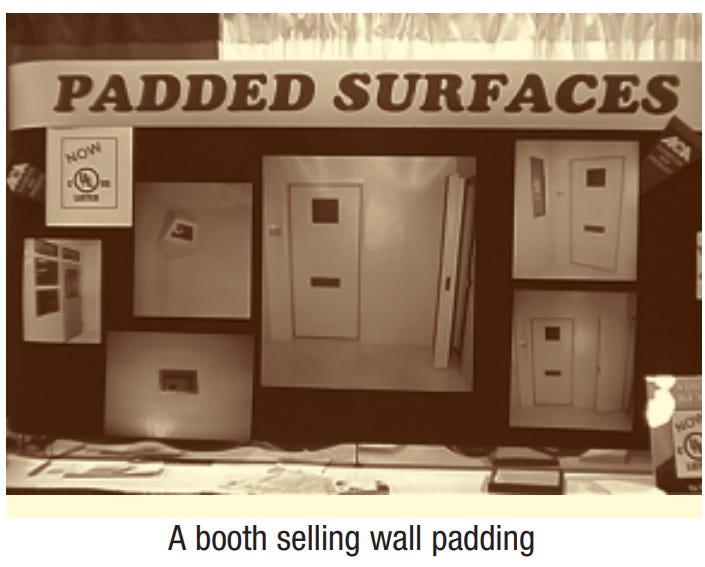
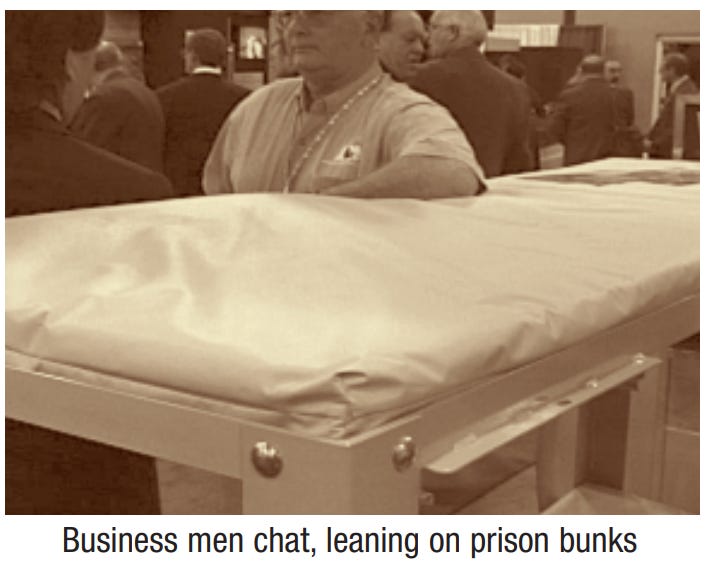
A salesman at the ACA Trade Show said to an undercover journalist, “It’s not the best thing to say that there are more and more prisons being built...but that’s what keeps us in business. This was one of our best years, and things are only getting better!” And he’s right. The prison industry is, and has been, on a steep financial incline.
In addition to building the prison, certifying it as safe, and covering the costs of each inmate’s needs, money is also pumped into prison guard unions, sheriff’s departments, police departments, departments of corrections, and more. Each entity along the money trail gets a cut of the prison profits pie. We have already discussed the profitability of the contracts, but what about the prison itself? If all of the profits are in contracts, how would the actual prison make money?
PRISON PROFITS
The media is wielded like a weapon to convince the population that their fellow man is naturally evil; there is a bad guy hiding behind every corner waiting to harm them. In reality, the vast majority of what the government labels crimes are committed by average Joes or poor people, such as in the case of the soccer mom with the pain pills, the Army vet with a little pot, or the homeless on the rough streets of Baltimore. These people committing what the government calls crimes are not typically doing it for “fun”; it is often due to stress, loneliness or boredom, addiction, or, in the case of the poor, it is necessity. High-crime areas are also low-unemployment areas in which factories have downsized or relocated entirely. Due to this, people go from worker to unemployed to criminal to incarcerated. The irony is that when they are incarcerated, they can then be used as laborers, but unlike when they were punching a time clock for a paycheck, they will now be working for pennies for the prison system.
You may be shocked to learn exactly how this system is functioning. New prisons were built with thousands of acres of factories inside their walls. Companies like Chevron then contract the prison to use its inmates to provide data entry services. Trans World Airlines, American Airlines, and Avis Car Rental also use or have used prisons for telephone reservation scheduling. Some prisoners were manufacturing lingerie for CIA associate and criminal Les Wexner’s Victoria’s Secret. In Wexner’s case, inmates reportedly have been used to replace “made in [China]” tags with “Made in USA” tags. Meanwhile, McDonald’s uses inmates to produce frozen foods. They process beef for patties. They may also process bread, milk, and chicken products. Wendy’s has been reported to do the same. Remember the buzz about Wal-Mart destroying small towns with its tax incentives and ultra-cheap products? It, too, uses prisoners to help with the creation of sellable products. Starbucks subcontractor, Signature Packaging Solutions, hired Washington state prisoners to package holiday coffees. Sprint and Verizon mobile phone services use or have used inmates in their call centers. IBM, Compaq, Microsoft, Boeing, and JC Penney—they all use or have utilized prison labor.
According to the Left Business Observer, “the federal prison industry produces 100 percent of all military helmets, war supplies, and other equipment.” And while we were all concerned with what China is doing to America with its cheap exports, listen to these shocking figures:
The prison laborers also supply:
98% of the entire market for equipment assembly services.
93% of paints and paintbrushes.
92% of stove assembly.
46% of body armor.
36% of home appliances.
30% of headphones/microphones/speakers.
and 21% of office furniture.
As well as airplane parts.
and medical supplies.
Amid the COVID-19 pandemic, prison laborers in over 40 states were used to make hand sanitizer and protective equipment.
And much more: prisoners are even raising seeing-eye dogs for blind people.
Every state, except for Alaska, has a state-governed prison industries initiative, and the federal government runs a separate program, Federal Prison Industries, which, as unbelievable as it may sound, is on the stock market, trading as UNICOR. Through UNICOR, inmates put in 40 hours a week producing recycled furniture. Their pay? 23 cents per hour. Meanwhile, China’s minimum wage per hour in USD ranges from approximately $1.68 to $3.72.
While UNICOR is profiting off prison labor, the entity itself is funded by government contracts and operates within the walls of the prisons, which we, taxpayers, along with private investors, cover the cost of, so there is no cost and only profits for the entity. What a windfall. But this isn’t just a UNICOR thing.
Oregon Prison Industries manufactures its own line of blue jeans called “Prison Blues.” The Prison Blues jean line is then sold through assorted sellers for approximately $60 per piece. Belts, which are also a part of the Prison Blues product line, sell for $99.99. Other items include logo jackets, work shirts, sweatshirts, T-shirts, hats, and more. On the website CorrectionsConnection.com, they boast that the inmates who manufacture Prison Blues “earn a competitive industry wage, retaining around 20% post-tax deductions.” You are thinking, “This sounds great!” but if you keep reading, you learn that this amounts to approximately $120 - $150 monthly. Further, “A significant portion of their earnings goes towards their incarceration costs, victim restitution, family support, and taxes…” I’d like to point out that $150 a month is $33 per week. This is equal to 82 cents per hour, providing they work only 40 hours per week. Sure, it is higher than UNICOR, but it is nonetheless all slavery. And keep in mind, these employees cannot form unions; they don’t ask for health care; they don’t need maternity leave, or even a day off to attend their sister’s wedding.
While the Prison Blues inmates are being used as slaves, others are raising hogs, assembling circuit boards, building water beds, and even making limousines. And all of this is a windfall for the company because these inmates are paid the same or less than what factory workers in Sri Lanka make—and this is occurring in a nation with minimum wage laws, which every other business has to comply with. And if this whole scheme really was to help inmates rehabilitate themselves and pay off costs and nobody was raking in profits off their labor, perhaps this scheme would be fine providing the inmates want to work these positions and they are paid a legal wage so that they can indeed repay their debts, but this is not what is happening.
As of 2020, over 4,100 corporations were profiting from mass incarceration in the United States. Because there is so much money to be made, Fidelity, Merrill Lynch, Wall Street, and other investment companies invest in prison labor or other operations related to the prison industrial complex. The investment firm, Fidelity, funds the American Legislative Exchange Council, which has created laws authorizing and increasing the use of inmates in manufacturing. So as you can see, these entities rely upon incarcerations to appease their shareholders.
And what really is the end result of all these goods produced dirt cheap and call centers being run for pennies on the dollar inside prison walls? Answer: Chaos for small businesses. Small furniture manufacturers across our nation have been driven into bankruptcy and forced to close their doors forever because they cannot compete financially with a competitor who doesn’t have to pay labor costs and is being funded by the government. In another example, US Technologies sold its electronics plant in Austin, Texas, leaving 150 workers unemployed. Less than two months later, the electronics plant reopened in a nearby prison. So, while 150 citizens were jobless, their positions were filled by inmates who work for pennies per hour.
In addition to nearly eliminating the cost of employees and employee benefits, when prisons are used to manufacture goods, the company hiring the prison doesn’t have to worry about a pricey lease because the jail acts as the manufacturing facility. Having no warehouse means no utility bills, no insurance, no manager paid to oversee a team of 20 assemblers, and they don’t even need to purchase an assembly line, providing the prison already has the machinery required to manufacture products for them. There is literally no way a normal business can compete with this.
To make the whole issue even crazier, there are contracts that require entities, such as the University of Virginia, George Mason University, and the University of Mary Washington, to purchase their furniture from Virginia Correctional Enterprises, which is a state-owned company that employs inmates in state prisons. And this isn’t just a Virginia thing. As InsideHigherEd wrote, “All campuses of the University of Wisconsin system are required to purchase products from Badger State Industries, Wisconsin’s prison-labor company. The University System of Maryland and the State University of New York system are required to use their state’s correctional enterprise as a preferred source…” Should the state’s prison system not be able to produce the product the schools need, then and only then can they go outside of the contract to buy the item elsewhere, but this requires a signed waiver.
Some still argue that this whole thing is a net positive because the prisoners are at least getting some money, but to offset the pennies they are earning, the inmates are financially raped at every opportunity. A 15-minute phone call costs nearly a dollar. Commissary food costs are significantly higher than market prices, with markups ranging from 100% to 600% depending on the facility and state. A ramen noodle that costs 69 cents or less elsewhere is priced over $1. A $3 can of chili is $4.50. A bar of soap is $2 or more. If a prisoner works for UNICOR and needs the $2 bar of soap, he will have to work over eight and a half hours to afford it! Prisons in Iowa add a 6% “Pay for Stay” fee to most commissary items. In Florida, the Department of Corrections receives a massive 35% commission on all marked-up items from the for-profit company Keefe Group. Then, tragically, even the prisoners are subjected to the illegal “income tax” scheme. In prison, they are forced to turn over a percentage of the money they acquired through a trade for their time because Uncle Sam wants a cut of that 23 cents per hour—and yes, we are literally taxing modern-day slaves in America.
If what you have heard thus far isn’t alarming enough, wait until you hear this next part…
THE SECRET PRISON BED SCANDAL
To quote from the publication Criminal,
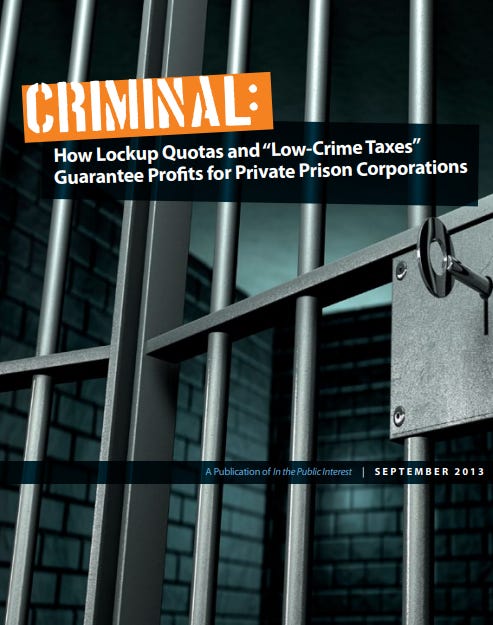
65% of private prison contracts “included occupancy guarantees in the form of quotas or required payments for empty prison cells (a ‘low-crime tax’). These quotas and low-crime taxes put taxpayers on the hook for guaranteeing profits for private prison corporations. Occupancy guarantee clauses in private prison contracts range between 80% and 100%, with 90% as the most frequent occupancy guarantee requirement.”
When Criminal was published, Arizona, Louisiana, Oklahoma, and Virginia were locked in contracts with the highest occupancy guarantee requirements, with all quotas requiring between 95% and 100% occupancy. The authors wrote, “Three privately run prisons, just in Arizona, are governed by contracts that contain 100 percent inmate quotas. This means the state of Arizona is contractually obligated to keep these prisons filled to 100 percent capacity or pay the private company for any unused beds.”
When crime rates are low, these bed guarantees are incredibly costly for state and local governments. These clauses can force corrections departments to pay thousands, sometimes millions, for unused beds. Although the private prison industry claims that prison privatization saves states money, numerous studies and audits have shown these claims of cost savings to be illusory. For example, in Colorado, although crime had dropped by a third, an occupancy requirement covering three for-profit prisons forced taxpayers to pay an additional $2 million. Is this not the most bat shit crazy thing you have heard all month?! An inmate quota?! And if that quota is not met, we taxpayers have to pony up funds for these insane prison contracts! And all major prison companies, including GEO Group and Management and Training Corporation (MTC), have successfully negotiated these insane contracts. Sometimes they even add in the bed guarantee quota after the contract is signed! How the hell does that happen? Corruption, that’s how!
Because they have to fill beds, legislation like the “three strikes policy” is passed, police are incentivized to make arrests, and judges are encouraged to assign longer, harsher sentences. The judge knows if she hands down a ten-year sentence instead of a six-year, that is one less bed to worry about for a full decade. Wilder yet, the judge can see this as her civic duty because she is saving the town money by ensuring quota penalties are avoided.
In Grafton, Ohio, the 700-bed North Coast Correctional Treatment Facility was intended to be used primarily for drunk-driving and non-violent drug offenders, but then the occupancy guarantee came along. With the new agreement, the state of Ohio had to convict 665 persons of felony drunk driving offenses or pay CiviGenics for that level of operation.
Because there were not enough felonious drunk drivers to meet the contractual demand, in an effort to fill beds, the state sent inmates who had been convicted of more serious crimes. These crimes included sexual battery, assault, arson, manslaughter, and robbery. Although the beds were now filled, the facility itself was never designed to incarcerate violent offenders, so it was not properly equipped to handle its new population of inmates. The facility quickly began suffering from serious safety issues, including riots, thus putting all of the nonviolent offenders lives at risk.
In another Ohio example, a 20-year deal to privately operate the Lake Erie Correctional Institution included a 90% quota. Because prisoners come and go, to ensure the prison quota is met, the prisons have engaged in overcrowding. Overcrowding leads to already miserable, privacy-stricken prisoners becoming incredibly violent as they have no room to breathe.
Now let’s discuss a couple of the big earners in the for-profit prison scheme.
The main three companies running over 200 private prisons in America are CoreCivic (formerly CCA), the Geo Group, and Management and Training Corporation, which have reported a total annual profit of close to five billion dollars.
GEO GROUP
Per Wikipedia, GEO’s “facilities include immigration detention centers, minimum security detention centers, and mental-health and residential-treatment facilities in the United States, Australia, South Africa, and the United Kingdom… As of September 30, 2024, the company owned or managed 80,000 beds at 99 facilities, making it the largest prison operator in the United States. In 2019, agencies of the federal government of the United States generated 53% of the company's revenues.”
Now, if you want an interesting random fact, GEO Group was formed as a subsidiary of G4S, an American/British-based security services company. G4S is partners with a company called Crisis Cast. What is Crisis Cast? A business that brings professional actors all over the world to play roles in staged tragedies. To quote from their website, “We simulate crisis incidents across multiple platforms for emerging security needs in the UK, Middle East and worldwide. Our specialist teams – many with security clearance – are trained by behavioural psychologists and rigorously rehearsed in criminal and victim behaviour to help police, the army and the emergency services, hospitals, schools, local authorities, government, private security firms, shopping centres, airports, big business, criminal justice departments, media and the military.”

Why am I telling you this? Because G4S, who is partners with Crisis Cast, had an employee who happened to be the infamous “Pulse Nightclub Shooter.” And if you’re not familiar with that tragedy, it is incredibly sketchy. As far as I am aware, I am the only person who has done a deep dive into it. It is well worth your time. You can read my multipart series unraveling the Pulse shooting here.
Anyway, it is quite interesting that the shooter happened to work for G4S, which is also the for-profit prison system and also a partner of the crisis actor network.
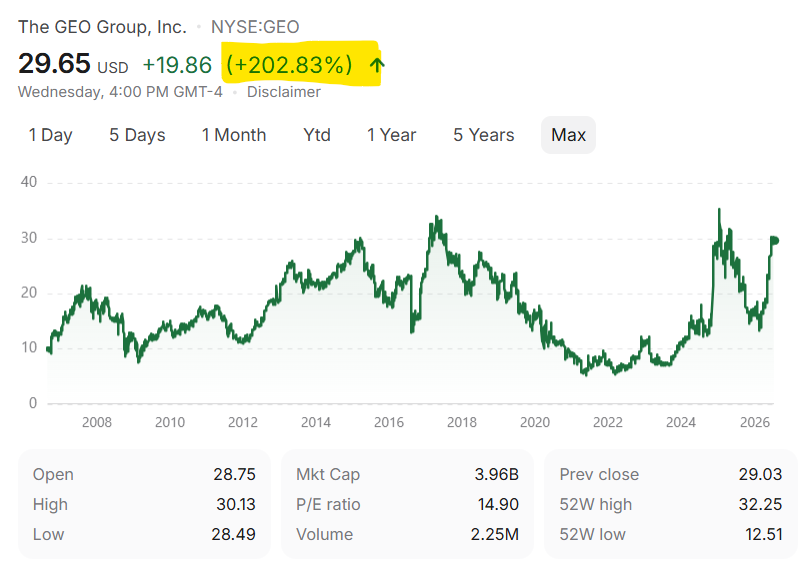
I guess it’s a small world after all. Back to GEO Group, which is a publicly traded stock that is currently experiencing over 200% growth.
In January of 2021, United States President Joe Biden signed Executive Order 14006 directing the United States Department of Justice to cease the renewal of federal contracts with private prisons. It was at this time that GEO, along with the other private prison entities, got into the market of immigrants. They won contracts from the US Immigration and Customs Enforcement (ICE) and state governments. These contracts provide a windfall to keep detention centers up and running like a well-oiled, highly profitable machine.
Then, in February of 2025, GEO, a large donor to the Trump campaign and Republican causes in general, “got lucky” under Trump’s second term in office. Trump not only reversed former President Biden’s executive order banning Department of Justice contracts with private prisons, but a one billion dollar, 15-year contract was signed between GEO and Trump’s federal government. But this issue is not a Republican versus Democrat thing. Both sides of the aisle have eagerly funded the prison system through which they personally profit.
Because there is so much money to be made at every step of the incarceration system, GEO Group, along with another leading private prison system provider, MTC, was caught funneling money to Christopher Epps, the former commissioner of the Mississippi Department of Corrections, in exchange for lucrative contracts. In this case, Epps signed more than $800 million in state prison contracts while receiving at least $1.4 million in bribes and kickbacks. To make matters worse, the majority of the money was funneled through a former state lawmaker. This lawmaker arranged contracts both for his own companies and for other corporations that hired him as a “consultant.”
In addition to the contract scheme, Epps was caught fabricating “ghost inmates” to meet bed-capacity requirements.
When the scandal was investigated, it was discovered that this corruption spanned far beyond GEO, MTC, and Epps. It included Global TelLink, Wexford Health Sources, Keefe Commissary Network, and Sentinel Offender Services—all of which are major national providers of prison phone services, medical care, commissary management, and electronic monitoring. Men associated with prison phone and commissary companies were arrested for trying to bribe Epps and an undercover sheriff with a combination of cash, promises, and $500 in poker chips. Folks, this is just one example of corruption because one prison commissioner was caught.
CoreCivic
CCA rebranded as CoreCivic and became the nation's largest owner of partnership correctional, detention, and residential reentry facilities. As of 2025, CoreCivic had 492 institutional owners and shareholders on file with the Securities Exchange Commission. Of the 492, two of the largest shareholders were BlackRock, and Vanguard Group, as well as many companies that invest public pension funds. Can you really wrap your mind around this? Our pension funds are being invested in a system that incarcerates our fellow man and forces them into slavery—a system which our tax dollars pay for.
Remember, before President Trump reversed President Biden’s ban on these prisons, CivicCore got involved in immigration detention and private for-profit prisons. When Trump reversed the ban, CivicCore was now back in prisons and also in immigrant detention. And, to make the immigration facilities successful, arrests were required. In 2025, new ICE contracts under the Trump administration planned to incarcerate 100,000 new immigrant detainees. In the first 50 days of the program, over 32,000 people had been arrested in raids on cities, schools, hospitals, and places of worship, often conducted by agents in plain clothes and unmarked vehicles.
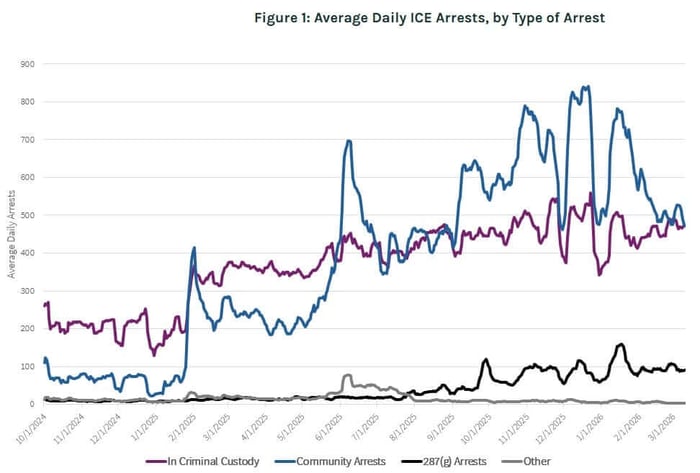
And, just like with the siege mentality arrests discussed previously, innocent people were harassed without merit and swept up in the chaos. In December of 2025, ICE was arresting over 800 people a day on the streets of American communities, of which the vast majority had no criminal record. And these arrests are very necessary to the profiteers because, just like the prison system, the detention facilities also have bed quotas! Now the internet will tell you that in 2017 the quotas were eliminated, but what actually happened was congressional appropriations for bed quotas were removed from the budget at the federal level; meanwhile, local contractual quotas remained active. But regardless of a bed quota or no quota, under President Trump, detainments have far exceeded the number of available beds, so there is nothing for those who profit off the system to fear. Investigative website TracReports, through research and FOIA requests, discovered that it wasn’t uncommon for ICE to arrest more people than available beds, sometimes exceeding the number of beds by 100 people. Of course, county jails are more than happy to subcontract their beds to ICE, and when ICE needs more beds, the jails cash registers start ringing. You had no idea that there is so much money to be made in a prison bed, did you? I sure didn’t.
Through the psychological dehumanization of people, ICE agents, US Immigration and Customs Enforcement employees, and contractors who bought into the “us vs. them” were trained to use “aggressive tactics” and given sweeping power to, amongst other things, forcibly enter people’s homes without a judge’s warrant, and, when you make government officials above the law, lawlessness and corruption ensue. Dozens of ICE officers were arrested for pedophilia-related crimes, others for drunk driving, numerous were involved in violent acts, and many high-ups were caught taking bribes. In Utah, ICE officers were caught stealing drugs from government custody and using government informants to sell them.
MTC
Management & Training Corporation, better known as MTC, is the third-largest private prison operator in the U.S. with the capacity to detain more than 31,000 people. Just in Texas, MTC is contracted to operate 17 state prisons and jails. These agreements are worth more than $100 million in total. Aside from being a part of the Epps scandal, in Texas in 2022, MTC was accused of defrauding the state of over $5 million by billing for inmate treatment and parole programs that were either not provided or were instead facilitated by other inmates rather than qualified staff. Prisoners were then forced to sign off, claiming they had received the services so that the state could be billed for them and we taxpayers could pay it. Some of the fraudulent billing involved classes and counseling, which the prisoners signed up to receive. Instead, they were handed packets of paper and told to sign off. And these insane issues aren’t just in America. MTC also operates prisons and other facilities abroad. In the UK, they run youth jails, of which a single Ministry of Justice contract raked in 50 million pounds. When MTC began being investigated, it was discovered that children as young as 15 were being locked up for more than 23 hours a day with “no justifiable rationale.”
THE GROWTH MUST CONTINUE
CCA summarized the for-profit prison industry’s reliance on a harsh criminal justice system in their 2010 annual report, which read as follows,
“The demand for our facilities and services could be adversely affected by the relaxation of enforcement efforts, leniency in conviction or parole standards, and sentencing practices or through the decriminalization of certain activities that are currently proscribed by our criminal laws.”
And there you have it.
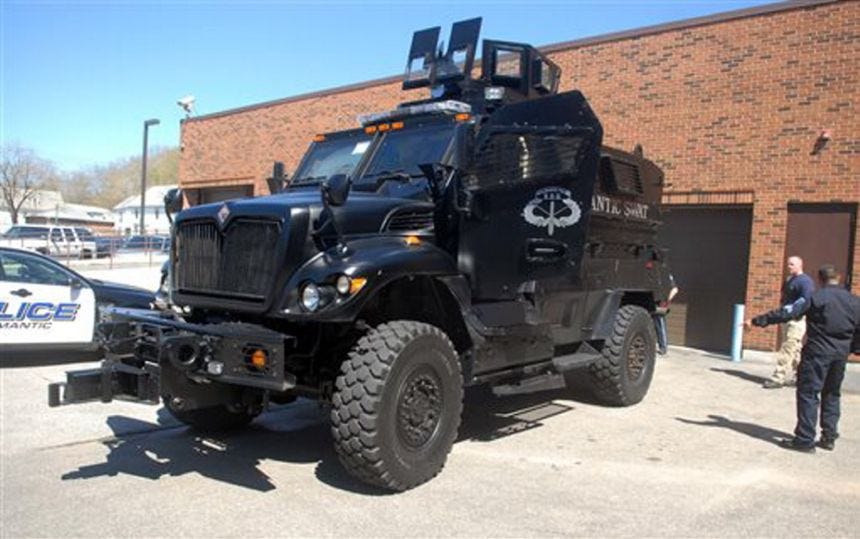
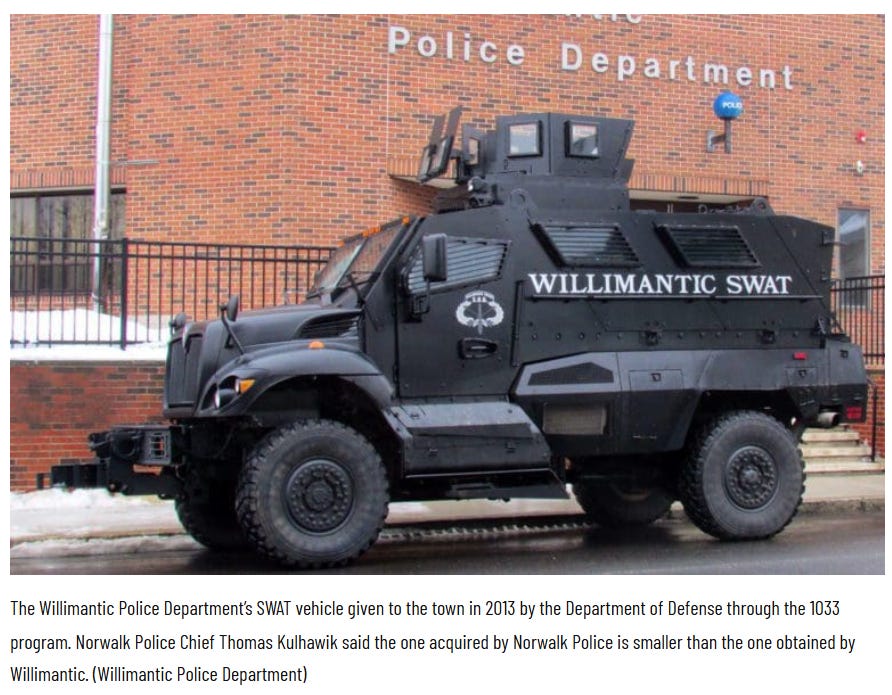
The Brennan Center wrote, “Today, Washington spends billions of dollars each year subsidizing state and local criminal justice agencies. The Justice Department by itself distributes more than $5 billion in federal grants to state and local governments annually, not including the funding that law enforcement agencies across the nation get from the Department of Homeland Security. Hundreds of millions more come through the Department of Defense, which facilitates the transfer of military-grade weapons and armored vehicles to police departments—for instance, a $705,000 armored mine-resistant vehicle for Bridgeport, Connecticut. Even the Department of Agriculture has gotten involved, providing $360 million to build jails in rural communities since 1996.” But that’s not all. Through the Pentagon’s 1033 program, police departments received more than $2 million in excess military gear between 2015 and 2018. Look at this stuff, folks. Is this really “protect and serve” or is this “siege mentality”?


We taxpayers currently spend over $70 billion annually on corrections and incarceration for drug offenders, and all of this lines the pockets of the prison industrial complex, but in order to make this happen, arrests in record numbers must occur. And, to keep shareholders happy, new laws must be passed that create stricter, longer sentences. The end result of all of this is that, unless you are a high-income earner who financially feeds the illegal taxation system, you are worth more behind bars.
___________________________________________________
Did you see that I am headlining a big event on September 17th, 2026? Five of your favorite authors will be giving one-hour presentations. Be sure to grab your ticket! You can learn more about Truth Be Told: The Mega Event and each presentation here. Check out the commercial below!
Want to support my work? Buy Me a Coffee or Make a Ko-Fi Donation:
If you want to make sure you are updated when new articles, eBooks, events, and podcasts are released, be sure to sign up for WhatsApp notifications:
![What You Never Knew About The Prison Industrial Complex [Part 1 by Agent131711]](https://dropinblog.net/cdn-cgi/image/fit=scale-down,format=auto,width=700/34264201/files/featured/prison-profits-thumbail.png)
![Adolf Hitler: Good? Bad? OR A PSYOP? History Caught in a Lie [WWII Part 10]](https://dropinblog.net/cdn-cgi/image/fit=scale-down,format=auto,width=700/34264201/files/featured/hit.png)
![Flock: The Secret Warehouse & Front Companies [Part 2 by Agent131711]](https://dropinblog.net/cdn-cgi/image/fit=scale-down,format=auto,width=700/34264201/files/featured/flock-2.png)
![The Shadow Conspiracy to Make Us Pay 3x for EVERY Item [Part 1 by Agent131711]](https://dropinblog.net/cdn-cgi/image/fit=scale-down,format=auto,width=700/34264201/files/featured/54df78ba-d6cf-4a1f-9456-8c25628f3105.png)
![Introduction to WWII: Laying the Foundation for What Is to Come [WW2 Part 1 by Agent131711]](https://dropinblog.net/cdn-cgi/image/fit=scale-down,format=auto,width=700/34264201/files/featured/40313432-85c6-4c51-9ab3-b94a534b1804.png)
![Donald Trump Exposed: The Judge, The Helicopters & The Shell Companies [Trump Part 1 by Agent131711]](https://dropinblog.net/cdn-cgi/image/fit=scale-down,format=auto,width=700/34264201/files/featured/trump-1-2.png)
![Introduction to THE EVOLUTION HOAX [Part 1 by Agent131711]](https://dropinblog.net/cdn-cgi/image/fit=scale-down,format=auto,width=700/34264201/files/featured/evo-1.png)

![The UN's CHLD PRN0GRAPHY Ring [Pizzagate Part 17]](https://dropinblog.net/cdn-cgi/image/fit=scale-down,format=auto,width=700/34264201/files/featured/un-child-1.jpg)
![What You Never Knew About the JFK Assassination & Operation Northwoods [Pizzagate Part 13 by Agent131711]](https://dropinblog.net/cdn-cgi/image/fit=scale-down,format=auto,width=700/34264201/files/featured/jfk.png)
![Hidden in Plain Sight - How is This Legal? Art, Crime & The NEA [Part 1 by Agent131711]](https://dropinblog.net/cdn-cgi/image/fit=scale-down,format=auto,width=700/34264201/files/featured/2f562c5d-6f1b-4add-a25c-49a377922e7e-1400x788.webp)
![FAKE AND GAY: The Pedophile Takeover of US Government - a scandalous true story [Part 1]](https://dropinblog.net/cdn-cgi/image/fit=scale-down,format=auto,width=700/34264201/files/featured/9f581d16-2ca3-452e-b8c9-3848784309ea-1400x788.webp)

