

![The Shadow Conspiracy to Make Us Pay 3x for EVERY Item [Part 1 by Agent131711]](https://dropinblog.net/cdn-cgi/image/fit=scale-down,format=auto,width=700/34264201/files/featured/54df78ba-d6cf-4a1f-9456-8c25628f3105.png)

What if I told you there was a massive conspiracy to make us pay three times over for every item? What if I told you there was another conspiracy to make volunteers pay additional times? You’d say I’m crazy, right? After all, it sounds pretty ridiculous when you hear it, yet this conspiracy is the truest definition of the word conspiracy, and these conspiracies, combined with some well-schemed psychological operations, have driven up the cost of living to the point where most Americans now live paycheck to paycheck—all by design. Let’s begin…
Before we can get to those conspiracies regarding our products, we have to discuss the products that make it to market in the first place because there is outright suppression of information and technology, which I would call yet another conspiracy. If you try to research suppression of technology, the internet will tell you there is no such thing; it’s all tinfoil hat nonsense. “The government would never do such a thing,” they say.
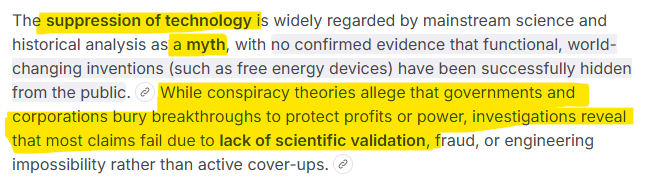
However, factually, technology is silenced through the Inventions Secrecy Act. The Invention Secrecy Act allows the United States government to classify ideas and patents under “secrecy orders,” which indefinitely block the public from ever learning of them. The way this act was written, anything that could disrupt society can be forever gagged. When someone invents something of greatness that could actually help us, it is slapped with secrecy orders or sabotaged.
Back in 2010, the Federation of American Scientists expressed their concern regarding the suppression of technology, stating that in this year alone, 5,135 inventions had secrecy orders. What was being silenced? According to the internet, they’re super dangerous things, like weapons of war, but according to the Federation of American Scientists, most of the suppressed inventions had to do with clean energy and methods of propulsion.
As of 2022, there were said to be around 6,500 silenced inventions—and this is what we know of. I remember writing an article on the topic and showing the government documents in which they ordered that high-output solar panels and other useful inventions be gagged because, should someone invent a vehicle that doesn’t require gasoline, a free electricity generator, or a solar oven that is capable of providing heat for an entire town at no cost, it would indeed disrupt society because it would harm the monopolies on these commodities…

… and this is why we have shitty solar panels and are stuck paying for expensive gasoline and utilities. So, how is history altered? By withholding technology, thus making it appear that no such tech exists because it hasn’t been invented yet. Then, whenever the overlords of society decide we are allowed to own a device that heats our homes for free, the silenced patent will be given to one of their patent pools or CIA affiliates, like General Electric. GE will then produce it and sell it to us at a high cost, or better yet, lease it to us so that we can never own it and get out from under payments. History will then broadcast that GE invented the cutting-edge tech when, in reality, it has been suppressed for over 120 years.
That said, we have no way of knowing if the products we are allowed to have are the best version of the items because nobody knows what specifically is being gagged, but, out of the products we are allowed access to comes the first conspiracy…
THE PLOT
A worldwide plot to downgrade products began on December 23rd, 1924, when a group of leading international businessmen gathered in Geneva, Switzerland, for a meeting that would forever alter the world. Present were top representatives from all the major lightbulb manufacturers. Together they founded the Phoebus Cartel. Phoebus, meaning “the bright” or “radiant,” is the most famous epithet for the Greek god Apollo. The Phoebus Cartel was a supervisory body that would carve up the worldwide incandescent lightbulb market. [Note: the actual incorporation date of the cartel was January 15th, 1925.]
While a lightbulb cartel may sound like a sketch comedy bit, this is no laughing matter. This mafia’s goal was to reduce the efficiency of lightbulbs. Yes, they wanted to engineer a shorter life span for the incandescent lightbulb. At the time, the bulbs were averaging a whopping 2,500 hours each. The goal was to reduce their lifespan down to only 1,000 hours for a pear-shaped household bulb while increasing prices. And, to ensure compliance, any company that deviated from the plan was to suffer hefty penalties. This scheme was “planned obsolescence,” also referred to as “hidden quality debasement” by Colston Warne, who was the president of the Consumers Union.
This information about the secret meeting only came to light (pun intended) later in time because of a United States government lawsuit involving General Electric’s international agreements. It happened that GE was the key player in the cartel. And yes, it is indeed GE again. It seems every time I investigate anything, General Electric is a part of it.
In memorandums produced for the lawsuit, it was discovered that GE engineers did indeed increase sales by intentionally shortening the lifespan of their products. In one instance, the debased bulb was in a flashlight. The memo stated great progress had been made because the original flashlight outlasted three batteries, but after the engineers downgraded it, it could only last through two. The engineer was writing to say that he believed, with more effort, the lifespan could be again decreased down to lasting only a single battery. He wrote, “If this is done, we estimate that it would result in increasing our flashlight business approximately 60 per cent.”
Remember how the original plan back in the 1920s was to make the lightbulb only last 1,000 hours? Another memo that surfaced during the lawsuit stated GE had degraded their light bulbs so drastically that what once lasted 2,500 hours now only lasted 750 hours. The document noted that no mention of the reduction should be made to the public. I just checked the lightbulbs in my storage area. Guess how many hours they last? 750.
Now, if you ask Google why light bulbs don’t last long, you are told it’s your fault because the light bulbs likely suffered from electrical issues or physical damage. There is no mention of a diabolical plot 102 years ago that shortened the lifespan down to as little as 93 days of use (8 hours a day of use for a 750-hour bulb.)

The same year the cartel rolled out their scheme, planned obsolescence began being implemented by automobile manufacturers to supposedly “help control over-saturation of the vehicle market.” Basically, “There are too many cars in production, so let’s make them fail so people have to buy another one sooner.” In The Journal of the Society of Automotive Engineers, 1934, downgrading the quality of vehicles was referred to as “controllable wear.”
A decade after the cartel was formed, the concept had become so common that it wasn’t even a secret anymore. In 1936, in the magazine Printers’ Ink, an article called “Outmoded Durability” appeared. This article bluntly stated, “If merchandise does not wear out faster, factories will be idle, people unemployed.” So, in only a decade, what was a scheme to maximize profits had now found justification: they are doing this to help us; it is their patriotic duty to shorten the lifespan of our products to ensure factory workers can clock in every day.
Before 1940, the plan was in full effect across the nation and gaining steam around the world. Manufacturers were downgrading their goods to force us to buy them over and over because they stopped functioning. The other day I was thinking about how, when I was a kid, I don’t recall my mother ever replacing our garden hose. It was one of those heavy-duty green hoses, and it lasted my whole childhood. Fast forward to current times: my spouse and I buy a new hose nearly every year! They all split, leak at the connectors, or otherwise become unusable within 12 months. No matter which style or brand you buy, they all fail. If that’s not an example of planned obsolescence, I don’t know what is.


(By the way, we ended up finding an “old school” green hose at Costco, but it is nowhere near the quality hoses used to be, and it constantly kinks. It’s as if it was designed to kink with no way to make it stop.)
As planned obsolescence began permeating all industries, companies stopped standing behind their craftsmanship. “Lifetime guarantees” vanished entirely or became something customers now needed to pay extra to purchase, like an insurance policy, and people needed to purchase these because, by 1960, if you owned a washing machine, dishwasher, and refrigerator, chances are you needed at least one service call within the first year after purchase, and the manufacturers knew that the more features they added, the more things that could go wrong, thus ultimately leading to replacement. Parts and accessory dealers loved it, and the purchase of replacement parts ultimately enriched the manufacturers, so it was a win for everyone except the consumer. And it was these same manufacturers that controlled when they would choose to make the replacement parts scarce or unavailable entirely, and when the parts were no longer available, the only option was to buy a new unit. How genius is this? Sell a fantastic-looking item that you know is guaranteed to break after a summer of use. Ensure the part that breaks is a proprietary spring that has been designed to be just a millimeter shorter and fatter than any other spring. Then, when the calls come flooding in from buyers who need to order a replacement spring, tell them they are on backorder with no specific ETA. Meanwhile, release the new version of the item, the new version that is just a hair more stylish than last year’s model, and refer the people who need springs to it. It’s horrible, but it’s nonetheless brilliant.
Additionally, proprietary screws and other parts were designed to only be removed using proprietary tools. Although Henry Ford I intentionally manufactured vehicles so that they were easy to repair, by the late 1950s, a Ford dealer complained to a US Senate subcommittee that he often had to purchase up to three hundred dollars worth of special tools every time a new model vehicle came out—all by design, meaning a design that makes it so you cannot fix it at home. Fast forward to today, and every new vehicle is nonstop recalls and problems, often with no way to fix anything in your garage. Ford Motor has been so overwhelmed with recalls that they now send a mobile repairman to customers to fix the recall at their house instead of having the customers fill up Ford’s service centers.
In addition to proprietary parts, there’s the inability to DIY fix things. It was back in the 1950s that a new trend came to be: products that were not designed to be serviced. Irons, toasters, and other electronics that were manufactured so that if you wanted to fix them, you would have to, quite literally, break them more. They accomplished this through carefully choosing where to place rivets, screws, and welds.
“Once in my life I would like to own something outright before it’s broken! I’m always in a race with the junkyard! I just finished paying for the car and it’s on its last legs. The refrigerator consumes belts like a goddam maniac. They time those things. They time them so when you’ve finally paid for them, they’re used up.” - Willy Loman, Death of a Salesman.
Now here’s one you’re going to laugh at because I guarantee you can relate to it: planned obsolescence through the user manual! Did you know that making the manual difficult to understand is not by accident? Whether it’s written in a different language, in microscopic print, completely confusing, the wrong directions entirely, or not even included with the product, it is all by design, and this has been going on for over 70 years! Additionally, companies intentionally hide or otherwise obscure the model number so that replacement parts, even if they are available, cannot be ordered. Then, through releasing lots of similar model numbers with very minor visual changes, the only difference being the parts that are designed to break, the purchaser becomes uncertain of specifically which parts he needs to order and instead buys a new unit.
Another method of planned obsolescence along those lines is rapidly changing technology, thus forcing everyone to have to purchase the newer version. When I was in elementary school, everyone listened to tapes, then it became CDs, then MP3s, all very rapidly. This forced most people to have to purchase a tape player, a CD player, and then an MP3 player, not to mention rebuying their favorite music for each because an MP3 player doesn’t take tapes. And before my time, it was 45s, and before that, it was records. Imagine the windfall for electronics manufacturers. Speaking of this, did you know manufacturers intentionally hold back releasing the better model? They do this on purpose so that there is always a reason to buy another. So let’s say they have an MP3 player that they know the main button will break on. That product is pushed to market. The next version, which will be released a year or so later, has a button that won’t break right away, but instead the headphone jack will only work for six months, and so on.
Another example of planned obsolescence is expiration dates, which are intentionally set to a short lifespan—much shorter than the actual usability of the item. One phenomenal example of this is toothpaste. The tube will tell you it expires in a year, but if you dig deep on the manufacturer’s website, you will see the stuff, which is all chemicals, lasts many, many years. The reality is, there is no reason to throw out the gallon of milk unless it smells or tastes off. If you take a second to reflect on this, although it sounds relatively harmless, it is senselessly filling landfills and driving up the cost of living because people see the sour cream expired three days ago and pitch it immediately.
And if that’s not bad enough, there are products designed to go bad as soon as possible because once opened, there is no way to actually reseal them, such as in the case of potato chips. Would it kill them to put a Ziplock style top on the bag? Answer: yes, it actually would. They need them to become stale as soon as possible. Another example of this was when Lipton tea removed the individual gold foil wrappers that kept tea fresh.
Product developers soon found another brilliant trick: creating product containers designed to be impossible to use 25% or more of the product: the brush isn’t long enough to reach the paint in the lower quarter of the container; the jar is too narrow to fit your hand in and it is too difficult to scoop the remaining portion of the product out; squeeze tubes that are impossible to squeeze the bottom portion up, and so on. It was soon discovered that each year millions of tubes of lipstick were being thrown away with a half inch of lipstick in the bottom of the tube because the mechanism will not lift it up, so unless you jam your finger inside the product, there is no way to access it. I should mention that there are no legal regulations mandating that containers be designed for complete emptying.
In 1958 an article appeared in Design News (a journal for product designers and engineers). It was called “Product Death Dates—A Desirable Concept?” It asked, “Is purposeful design for product failure unethical?” It concluded that, before the 1960s had arrived, consumers were spending three times the amount they would on products had they been able to obtain a product that wasn’t designed to fail. It also concluded that planned obsolescence is a good thing because it forces people to buy over and over. The author went on to rally his readers (the engineers of our products) to do the economy a favor by downgrading the products they develop to ensure they do not last forever and instead work properly, but only for a short time.
Now think about this, folks: we are paying at least three times over for damn near every tangible item! This is in addition to inflation and manipulation of currency. People scream minimum wage is too low, but the reality is that the cost of living is too high because of bullshit like having to rebuy every item thrice over, and each time we purchase it, we are also paying for it to be certified kosher, which, as of the 1960s, was increasing the cost of meat by 7%—and that’s just meat! The kosher certification extends to electronics, appliances, dish soap, toiletries, everything! And it’s not just kosher certification driving up costs, although nearly all products in America, including the steel and screws used to make appliances, have been stamped kosher; it is all of the certifications—organic, halal, the NSF racket—there are so many of these things, each adding more and more cost. [Learn more in my eBook The Kosher Mafia]. So, in addition to manufacturing products to fail so we have to purchase them an average of three times each, we are also greatly overpaying for each of those purchases!
The same year, Design News tossed out the suggestion that engineers downgrade their creations; furniture quality had become so poor that new items were arriving to dealers with defects, but instead of taking measures to produce better products, the industry found ways to hide the problems. Beautiful hardwood was replaced by knotty scraps, and, for the first time ever, issues like broken bedframes and chair legs that snap or split became a thing. Outdoor aluminum furniture manufacturers lowered the gauge of aluminum by 50% and narrowed the tubes, yet the price did not decrease. Fabric factories began producing material that had printing defects, and the fabric itself was blended to create a low-end synthetic. These new blends were so poor that they often couldn’t withstand being laundered.
Of course, sites like Reddit (which are fully controlled) will tell you there is no such thing as planned obsolescence.

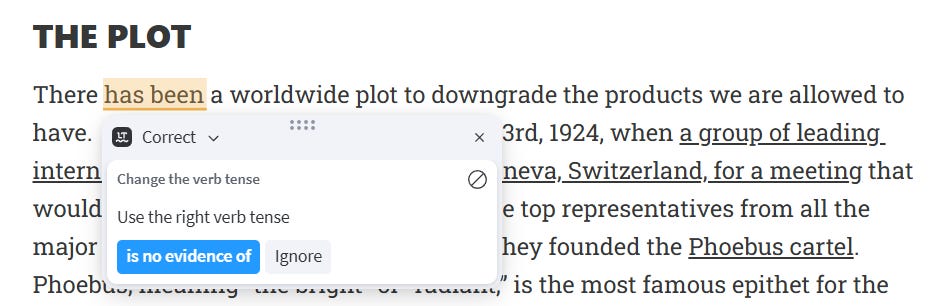
Even my spelling and grammar computer program is urging me to change the sentence I wrote which said “There has been a worldwide plot to downgrade the products we are allowed to have.” According to the grammar program, the correct sentence should read as, “There is no evidence of a worldwide plot to downgrade the products we are allowed to have…”
Perhaps the Reddit author and the grammar program, before making such claims, should have taken the time to read Vance Packard’s book called The Waste Makers.
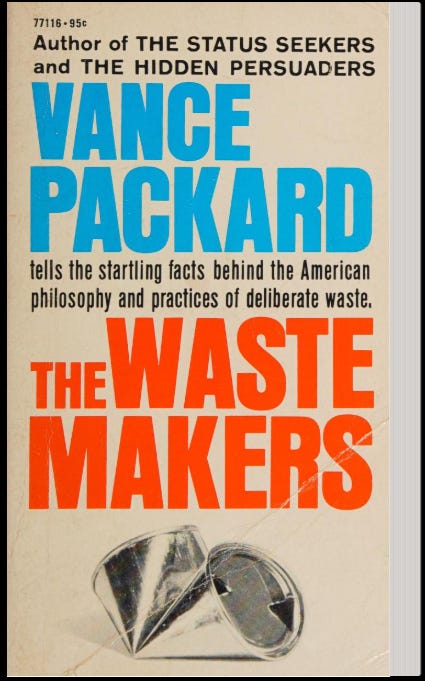
Being that this book was published in 1960, they have had ample time to read it. Isn’t it interesting when the ones calling you a conspiracy theorist are actually the theorist espousing lies?
Tragically, this scheme was not the only one being pulled on consumers; it was run in conjunction with a mass psychological operation, compliments of worldwide advertising agents and the industries they represent colluding to drive their profits up. The second part of this massive conspiracy was getting us to volunteer to pay for every item even more times…
NEXT READ: The Real Reasons We Live Paycheck-to-Paycheck and the Psychological Operation that Made it Happen [Part 2]
________________________________________________________________
Did you know that we have a massive announcement coming July 4th?!

I have been trying to figure out where people can subscribe to get this announcement, meaning which platforms are most-to-least likely to ban me, and I have concluded the safest bets are here or WhatsApp.
No, I don’t like WhatsApp either, but until we have a solution that people will actually use (keywords: actually use), we have to work within the system that is available to us. That said, our WhatsApp channel is just for information. It’s not a chat channel. We will be releasing a huge chat community very soon. More on that shortly. If you would like to contribute to the costs to establish a massive community, you can donate on Ko-Fi or Buy Me a Coffee.
![The Real Reasons We Live Paycheck-to-Paycheck & The PSYOP Behind It All [Planned Obsolescence Part 2 Agent131711]](https://dropinblog.net/cdn-cgi/image/fit=scale-down,format=auto,width=700/34264201/files/featured/0573e31b-ff1a-4ed9-ab55-dd72cfda033f.png)
![Blackrock & Wall Street NEED Mass Incarcerations [Prison Profits Part 2 by Agent131711]](https://dropinblog.net/cdn-cgi/image/fit=scale-down,format=auto,width=700/34264201/files/featured/prison-profits-part-2.png)
![The Mind-Blowing 1917 Cancer Journal - Tumors and More [Cancer Part 2 by Agent131711]](https://dropinblog.net/cdn-cgi/image/fit=scale-down,format=auto,width=700/34264201/files/featured/cancer-2.png)
![HELP! I'm Being STALKED! [Flock Part 1 by Agent131711]](https://dropinblog.net/cdn-cgi/image/fit=scale-down,format=auto,width=700/34264201/files/featured/flock-1.png)
![Epstein, Ring Doorbells & Axon: Israel Controls America's National Security [Flock Part 3 by Agent131711]](https://dropinblog.net/cdn-cgi/image/fit=scale-down,format=auto,width=700/34264201/files/featured/epstein-ring-axon.png)
![WWII Part 2: The Secret Pact You Never Knew About [WWII Part 2 Agent131711]](https://dropinblog.net/cdn-cgi/image/fit=scale-down,format=auto,width=700/34264201/files/featured/42323fe6-68eb-489e-b3fd-3d58661edd7d-1.png)

![Hedonism: Brainwashing the Children [Planned Obsolescence Part 3 by Agent131711]](https://dropinblog.net/cdn-cgi/image/fit=scale-down,format=auto,width=700/34264201/files/featured/hedonism-brainwashing-children.png)
![Introduction to WWII: Laying the Foundation for What Is to Come [WW2 Part 1 by Agent131711]](https://dropinblog.net/cdn-cgi/image/fit=scale-down,format=auto,width=700/34264201/files/featured/40313432-85c6-4c51-9ab3-b94a534b1804.png)
![Hidden History: King Edward & The Cabal: Operation Destroy Germany [WWII Part 3 by Agent131711]](https://dropinblog.net/cdn-cgi/image/fit=scale-down,format=auto,width=700/34264201/files/featured/wwii-part-3.png)

![The Secret Door in the Clean Juice Factory [By Agent131711]](https://dropinblog.net/cdn-cgi/image/fit=scale-down,format=auto,width=700/34264201/files/featured/the-secret-door-in-the-clean-juice-factory.webp)

