

This is part of a series. Be sure to start at Part 1
Before exploring how occult themes appear in society, it is important to recognize that Hollywood and similar groups are motivated by material gains rather than spiritual salvation. Symbolic or ritualistic actions serve specific purposes, often using allegories such as Jesus and Satan to illustrate how power and energy are extracted through ritual and consumption. Ultimately, these acts are about control and material benefit, not spiritual belief.
Whether it is from something like adrenochrome, a chemical released in the body when you have so much fear, you know you are going to die. This is allegedly extracted and consumed by the elite to garner youth, beauty, and vitality. I will say it even more plainly, if you couldn’t tell if adrenochrome really worked on those crows’ feet or not, and spirit dinners were sensational, but your bank account stayed the same, and the multi-million dollar acting gigs didn’t ever pan out, you wouldn’t keep going. Somehow, someway, it is working well on the earthly plains.
Spirit Cooking
Before we begin, I need to explain how the internet has scrubbed clean anything negative about M Ablamović. By the way, in the rest of the article, I will refer to her as MA; don’t say her name out loud, and I misspell it for a reason. This circus clown doesn’t deserve our respect. She is a worthless garbage-level witch that feeds on attention, so I will give her the minimal information, and then we will finish the series with solutions. It says she is a performance artist, and the claims she was anything but are simply conspiracies. Story after story on the regular internet was almost glowingly protective of the self-proclaimed witch and obvious satanist. Page after page recounting dozens of different websites, each saying the identical thing, thinking she is a witch or satanist or occult leader, is a conspiracy and a laughable one at that. I am not laughing. Never mind that she actually admits it, and even though the term gaslighting has become so overused, this is gaslighting on steroids with a match. Which, of course, makes me just want to dig further. Hollywood loves her, as you will see from the photo ops performed with everyone from Jay Z/Beyonce, Lady Gaga (obviously), Will Ferrell, and all the rest of the talentless losers. M.a was born in 1946 in Belgrade, Yugoslavia. Her parents were Communist Partisans during World War II and later held positions in the Yugoslav government. She grew up in a strict household and later studied fine art in Belgrade. In the early 1970s, she began working in performance art, using her own body as the main medium.
Her early work focused on endurance, pain, vulnerability, and control. She became known for putting herself in physically and psychologically extreme situations. One of her most famous early works was Rhythm 0 (1974), in which she stood still for six hours in a Naples gallery while the audience was allowed to use 72 objects on her body. These objects ranged from feathers and roses to razors, knives, and a loaded gun. Over the course of the performance, audience members cut her, stripped her, and caused her to bleed. At one point, someone aimed the gun at her head. Another participant tried to rape her.
M.A has also developed a body of work she refers to as Spirit Cooking, which includes written phrases, performances, and ritual-themed dinners. These texts contain references to blood, semen, breast milk, cutting, spinning until unconsciousness, and symbolic consumption. In some performances, she writes these phrases on walls using pig's blood. These works have been presented publicly in thousands of galleries and videos.
WIKI Leaks
In 2016, WikiLeaks released emails belonging to John Podesta, who served as President Barack Obama’s Chief of Staff. In these emails, MA invited Tony Podesta—John Podesta’s brother—to a “Spirit Cooking” dinner, and Tony, in turn, invited John. Many interpret Spirit Cooking events as literal occult rituals rather than performance art. Videos show MA writing Spirit Cooking phrases on walls with pig’s blood, as well as giving instructions that involve bodily fluids, blood, cutting the body, and spinning until unconsciousness. The assertion that this is nearly identical to MK Ultra programming will be explored in the final article, along with an explanation of its significance.
A specific claim connects the date of the Podesta dinner invitation—July 9, 2015—to earthquake activity in California that night. This idea is partly based on a phrase from 'Spirit Cooking' that, according to some commentators, references a ritual performed on an 'earthquake night' to supposedly activate spells.
The same sources describe the self-proclaimed witch’s career using language associated with ritual, witchcraft, and occult power, rather than performance art, as a spiritual figure rather than an artist, and portray her long history of extreme body-based performances as evidence of occult practice.
Subscribe to Medicine Girl to Receive Articles By Email
- indicates required
Email Address *
Such claims often use religious framing, calling her work spiritually dangerous or satanic. This narrative situates her within a broader system of alleged elite spiritual corruption, highlighting the intersections among political power, ritual, and spiritual themes.
The Alchemy of the Body: Life Fluids, Symbolism, and Ancient Memory
In many ancient cultures, the body was not viewed as a mechanical object but as a vessel of sacred forces. Its fluids, such as blood, milk, breath, and semen, were believed to serve functions beyond mere biological functions. They were understood as expressions of spirit itself, material manifestations of invisible powers. Long before modern science reduced these substances to chemical components, civilizations such as the Egyptians saw them as carriers of divine essence.
Semen was not just reproductive. It symbolized the universe’s generative force, where spirit becomes form. In Egyptian cosmology, the gods’ creative acts were described in bodily terms. Creation was sensual and alive. The god Atum was said to create existence through self-creation, showing life emerged from sacred substance with intention.
Breast milk, likewise, was not seen as simple nourishment. It was divine sustenance. Goddesses such as Isis were depicted nursing both gods and pharaohs, reinforcing the idea that milk transmitted wisdom, legitimacy, and divine authority. To drink milk was not only to be fed; it was to be nourished. It was to be initiated into continuity, lineage, and sacred belonging.
These substances embodied opposing yet unified forces: creation and sustenance, beginning and preservation, emergence and continuity. In ancient thought, nothing sacred was sterile. Life itself was ritual.
Modern symbolic traditions echo this ancient language as metaphor, not literal practice. Referring to bodily substances poetically or ritually, artists and storytellers tap into humanity’s oldest symbolic memory, reminding us that the body is a threshold between worlds. This language unsettles because it reminds us we are not separate from the forces that made us.
In ancient civilization, ritual was never a mere spectacle. Yet again, nothing was done without effect. Ritual was about transformation. Egyptians believed words, gestures, and symbolic action shaped reality. Naming created form. Repeating the myth kept the cosmos going. Every ceremony was a reenactment of creation itself.
This is why ritual language feels powerful even today. It bypasses logic and speaks directly to the subconscious. It does not ask to be understood; it asks to be felt and incorporated into the whole being.
In fantasy worlds, symbolic memory is powerful. Fluids become elixirs of lineage. Bloodlines are literal magic. Milk is ancestral memory. Semen is prophecy. Words reshape flesh. Such systems don't require belief in real rituals; they require only that meaning is alive. Take a brief look at the so-called spiritual communities and the cult of self-improvement on every feed and channel. Manifest your dreams, use magik to bring desires into the physical. Not all of it is bad, but you'll see the trap as I do in the final installment.
Ritual language goes beyond occultism or superstition; it’s the earliest form of storytelling, helping make sense of existence before science replaced myth. In the past, power was transformation, not just dominance. Watch this video: The Cannibal Obsession?
Hollywood’s recurring fascination with cannibalism reveals a deeper obsession with taboo, intimacy, and the spectacle of transgression. A recent addition, Bones and All, exemplifies this fixation with unsettling clarity. Within the first eight minutes of the film, a casual teenage moment is abruptly ruptured by an act of shocking violence—Maren bites off her friend’s finger and consumes it, establishing a tone that blends tenderness with visceral horror. Throughout the movie, Guadagnino lingers on blood, bodily consumption, and the physical aftermath of these acts, framing them not only as grotesque but disturbingly loving and intimate. The camera often treats cannibalism less like an act of survival and more like a form of forbidden closeness, emphasizing mouths, skin, and touch in ways that purposefully blur the line between affection and violence. This aesthetic choice reflects a broader cultural pattern in which Hollywood uses cannibalism not merely for shock value, but as an invocation for earthly desire, alienation, and emotional consumption, turning the body itself into both an object of love and a site of destruction. The fixation on gore becomes less about horror and more about voyeurism, forcing audiences to confront the uncomfortable reality that what repulses us can also mesmerize and transfix us to what they have designed for us to become.
The menu below, sourced from an actual website and a supposed restaurant, is described by its creators as a performance and a parody. The key question: at what point does it become clear that it is meant to be funny?
This is the demon who performs at the Cannibal Club, which allegedly houses some rather prominent Hollywood A-listers and political actors like Chelsea Clinton. From the website “Diamanda Galas, famed avant-garde performance artist, composer, keyboardist, and vocalist has been described as “capable of the most unnerving vocal terror.” Musicologist Susan McClary writes that Galas “heralds a new moment in the history of musical representation.” Focusing on themes of suffering, injustice and despair, her works are characterized by visceral shrieks and wails reminiscent of glossolalia, or “tongues.” She has collaborated with Led Zeppelin bassist John Paul Jones, and her work has appeared in such mainstream films as Natural Born Killers and Francis Ford Coppola’s Dracula.”
This month, Galas is performing at Cannibal Club on Friday and Saturday nights.
Allegedly, this restaurant is a Hollywood hotspot, as leaked documents below reveal. Whether it is true or not, we will hopefully never know, but the underlying premise is important to understand. We can see the obvious monsters and demons like that thing above and Doja cat, but your next-door neighbor bringing you a fresh batch of Nestle cookies seems the opposite. The shock and awe are on purpose, so the natural flavors in cookies and packaged foods seem acceptable.
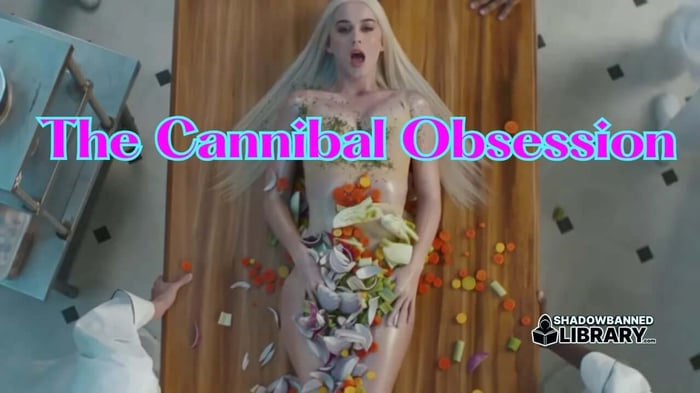
Katy Perry's Bon Appétit video is getting buttered and basted. She sacrifices her hair as well. I’ll spare the details of the ridiculous song.
Katy Perry's Bon Appétit video, where she is buttered and basted. She shaves her hair as part of the public ritual as well. I will spare you the details of the ridiculous song. But the entire music industry is designed for one thing, and one thing only. To incarnate themselves into you.
Soylent Green didn’t invent the idea, but it industrialized it. People are reduced to a product. Bodies turned into supply. Since then, Hollywood has returned to the same image over and over: The Silence of the Lambs, Ravenous, Raw, Bones and All, The Road, The Platform, American Psycho, The Texas Chainsaw Massacre, Snowpiercer. Sometimes it’s literal. Sometimes it’s a metaphor. Sometimes it’s dressed up as horror, sometimes as romance, sometimes as satire. But the core image stays the same: people feeding on people. Just like the clowns above, music does the same thing. Rappers talk about eating rivals, drinking blood, devouring competition, being hungry, starving, consuming, chewing, biting, swallowing the world. It’s not subtle. It’s everywhere. Cannibalism has become a language, not a crime. A shorthand for power, dominance, survival, and status. And they are infusing it into the culture at an alarming rate. Yes, there is a method to their madness, but do not mistake it for intelligence or cleverness. They are simply demonic with one purpose and one purpose only. To Consume.
Don’t believe me, this is the short list. The long list would take a day to read, covering every reference and connotation of cannibalism in the Hollywood spell-casting industry.
1593 | Play | Titus Andronicus → Enemies baked into a pie and served to their mother as revenge.
1846→ | Folklore/Book/Film | Sweeney Todd → Victims murdered, baked into meat pies, sold publicly.
1973 | Film | Soylent Green → Humanity unknowingly eats processed human remains.
1974 | Film | The Texas Chain Saw Massacre → Family treats travelers as livestock.
1975 | Film | The Rocky Horror Picture Show → Guests realize they’ve eaten a murdered man.
1977 | Film | The Hills Have Eyes → Mutant desert clan hunts humans for food.
1980 | Film | Cannibal Holocaust → Explicit human butchery and consumption.
1980 | Film | Motel Hell → Victims “harvested” into smoked meats.
1982 | Film | Eating Raoul → Murder becomes a business model.
1989 | Film | Parents → Suburban family implied to serve human flesh.
1989 | Film | The Cook, the Thief, His Wife & Her Lover → Man forced to eat cooked lover.
1991 | Film | The Silence of the Lambs → Introduces refined, intellectualized cannibal villain.
1991 | Film | Fried Green Tomatoes → Abusive husband barbecued, unknowingly eaten.
1993 | Film | Alive → Plane crash survivors eat the dead to live.
1993 | Film | Cannibal! The Musical → Frontier cannibal legend turned satire.
1999 | Film | Ravenous → Cannibalism portrayed as addictive and empowering.
1999 | Film | Titus → Pie revenge dramatized visually.
2001 | Film | Hannibal → Man fed his own brain while alive.
2003 | Film | Wrong Turn → Inbred cannibal hunters stalk travelers.
2007 | Film | Hannibal Rising → Cannibalism tied to childhood trauma.
2007 | Film | Sweeney Todd → Murdered bodies baked into pies.
2009 | Film | The Road → Humans farm other humans for meat.
2013 | Film | The Green Inferno → Tourists captured and eaten.
2015 | Film | Bone Tomahawk → Graphic human butchery scenes.
2016 | Film | Raw → Young woman develops a craving for human flesh.
2017 | Film | Kingsman: The Golden Circle → Man forced to eat coworker-burger.
2022 | Film | Fresh → Human body parts sold as gourmet food.
2022 | Film | The Menu → Symbolic cannibalism through elite dining ritual.
2022 | Film | Bones and All → Girl bites off and eats a finger in first 8 minutes; cannibalism = intimacy.
2023 | Film | Society of the Snow → Survival cannibalism portrayed solemnly.
––––––––––––––––––––––––––––––––––––––––––
TV | Dexter → Cannibal killers appear as escalation shock cases.
TV | The Walking Dead → Communities lure people as meat.
TV | Hannibal → Cannibalism plated like art; eroticized.
TV | Santa Clarita Diet → Suburban mom eats people; body parts as props.
TV | Yellowjackets → Starvation → ritualized cannibalism.
TV | American Horror Story → Repeated cannibal arcs.
TV | Criminal Minds → Cannibal killers recur.
TV | iZombie → Brains eaten to absorb memories.
TV | Tokyo Ghoul → Cannibalism as biological destiny.
TV | Attack on Titan → Cannibal metaphysics.
TV | DAHMER – Monster → Dramatization of real-life cannibal crimes.
––––––––––––––––––––––––––––––––––––––––––
Books | Titus Andronicus → Pie-revenge as moral theater.
Books | Sweeney Todd → Cannibal commerce myth.
Books | Red Dragon → Cannibal intellect archetype.
Books | The Silence of the Lambs → Cultured predator villain.
Books | Hannibal → Elite sadistic consumption.
Books | The Road → Cannibal gangs as end-stage society.
Books | Tender Is the Flesh → Human meat legalized and industrialized.
Books | American Psycho → Cannibalism implied through capitalist identity erasure.
––––––––––––––––––––––––––––––––––––––––––
Music | Kesha – Cannibal → “I’ll pull a Jeffrey Dahmer”; erotic predation.
Music | Doja Cat → Predatory persona; devouring as dominance.
Music | Eminem – 3 a.m., Framed, Stay Wide Awake → Cannibal imagery = madness & violence.
Music | Nicki Minaj – Monster → Devouring rivals metaphor.
Music | Katy Perry – Bon Appétit → Sexual consumption metaphor.
Music | Lady Gaga – Monster, Teeth, Bad Romance → Love as predation.
Music | Melanie Martinez – Tag, You’re It, Milk and Cookies → Fairy-tale predation.
Music | Marilyn Manson → Flesh, domination, taboo sexuality.
Music | Slipknot → Dehumanization via flesh imagery.
Music | Cannibal Corpse → Literal gore-cannibal metal.
Music | Tyler, The Creator → Shock-rap taboo metaphors.
Music | Azealia Banks → Devouring as dominance.
Music | Billie Eilish – Bury a Friend → Body-horror metaphor.
Music | Lana Del Rey – Serial Killer → Eroticized violence.
Music | Rihanna – Disturbia, S&M → Predation framing.
Music | Ashnikko – Daisy → Monstrous feminine devouring.
Music | Poppy → Cute-gore identity consumption.
Music | Ghostemane → Flesh, decay, self-erasure.
Music | Nine Inch Nails – Closer → Erotic bodily domination.
Music | Tool → Ritualized bodily metaphors.
And lastly, a symbol that appears over and over in the spirit dinners, a spoon in the mouth. Because spoons are associated with feeding, care, and sustenance, their ritualized use often flips that meaning. Instead of nourishment, they can symbolize domination, silencing, forced intake, or the absorption of power. We see it many times in movies and music. The infusion and normalization of the underworld.
Some interpretations link this to religious imagery, such as the seraph touching Isaiah’s lips with a burning coal to purify him, a concept that can be inverted in darker traditions to represent compelled consecration or the intake of forbidden knowledge. In folk magic, spoons sometimes appear in binding or protective spells, and in more transgressive contexts, that symbolism can shift toward trapping, controlling, or sealing energy.
This effect relies on reversal: an everyday object associated with care becomes a symbol of spiritual hunger, submission, or consumption. We will examine the black goo, and I will give you all the pieces of the puzzle in our final article.
In examining the rituals and practices that span from ancient Egypt to modern biomedical science, one pattern emerges: the persistent human urge to control, preserve, and even consume life as a means of transcending mortality. Whether justified as progress, science, or tradition, these acts reveal more about our collective anxieties and desires than we often admit. The boundaries we cross—between reverence and exploitation, healing and harm—are not new. They are echoes of old stories dressed in contemporary language.
Ultimately, the recurring symbols and behaviors within medicine, culture, and ritual invite us to question not just what we do, but why we do it. Are we truly advancing, or are we repeating ancient cycles under different names? By recognizing these patterns, perhaps we can approach the future with greater intention, humility, and care for both the living and the dead.
On that Note
Why are we meant to see the images? Why are we meant to repeat what we see, and imagine inside our bodies? What is the purpose of the infusion of cannibalism and the addictive nature? I will spell it out in plain English in the last in our series, where I not only answer the why, but also how you can avoid being an unwitting participant and leave yourself open to the forces they are conjuring.
Disclaimer
The information shared here reflects my personal research, study, and lived experience. Sources include historical archives, scientific literature, and public records wherever possible. It is intended for educational and discussion purposes, not as medical or legal advice.
I am a Registered Nurse, no longer practicing, and am not acting as a healthcare professional while writing for Substack. Every reader should use their own discernment and consult qualified professionals for personal decisions. My goal is to help people think critically, question openly, and restore their relationship with truth and nature.
![Bringing Up The Underworld: Vivisection and Organ Donation [Cannibals Part 4]](https://dropinblog.net/cdn-cgi/image/fit=scale-down,format=auto,width=700/34264201/files/featured/4aad8890-f8f1-4198-910c-e85a0171247c-1280x720.webp)

![BLOOD PRESSURED TO DEATH: How to DESTROY Your Kidneys in 5 Easy Steps [Part 1 of 3]](https://dropinblog.net/cdn-cgi/image/fit=scale-down,format=auto,width=700/34264201/files/featured/bce83ada-f4c0-4cdb-a4e7-bf4eab08bb07-1280x720.webp)