

![Your Credit Card Is Spying: We are being Tracked Like Deer [Flock Part 8 by Agent1317111]](https://dropinblog.net/img/t9ev8ipw/700/credit-card)

*THIS IS A SERIES! BE SURE TO START AT PART 1! [Click Here]*
WHERE THE DATA GOES AFTER IT IS COLLECTED
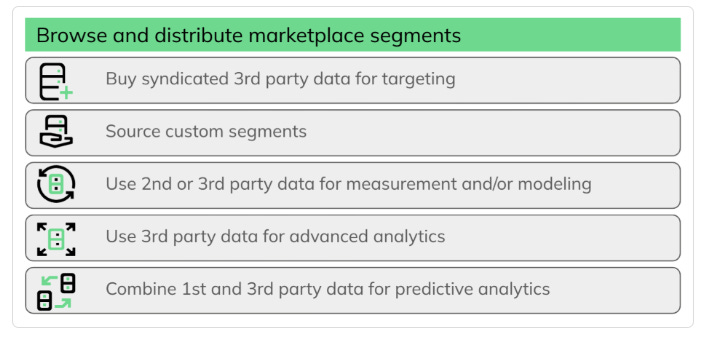
Assuming you have read the prior chapters in this series, once the data has been harvested, it goes to a company like LiveRamp. LiveRamp says it works with mobile app developers to obtain mobile device advertising IDs—Apple IDFAs and Android Advertising IDs. Those IDs are then added to its lists available in its Data Marketplace, which allows companies to buy and sell marketing data.
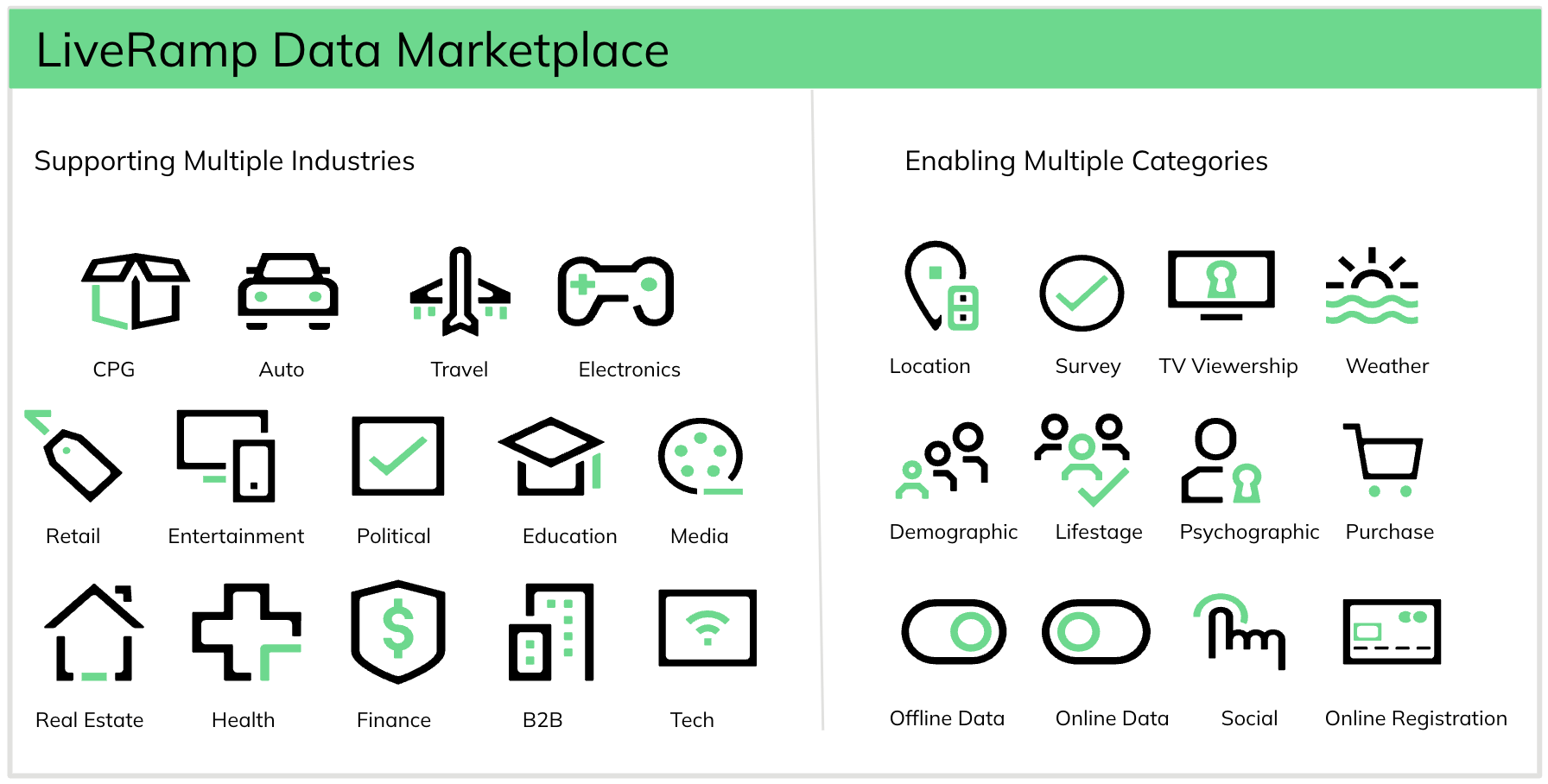
As you can see below, LiveRamp’s Data Marketplace sells data to a huge variety of industries. These industries can purchase location data, survey data, TV viewership records, demographic data, life-stage data, and data involving attitudes, values, interests, opinions, and lifestyle choices). But that’s not all, they can also buy records related to our purchases, friends and family, online registration information, and even offline data. Did you hear that? I just said “offline data.” More on this momentarily.
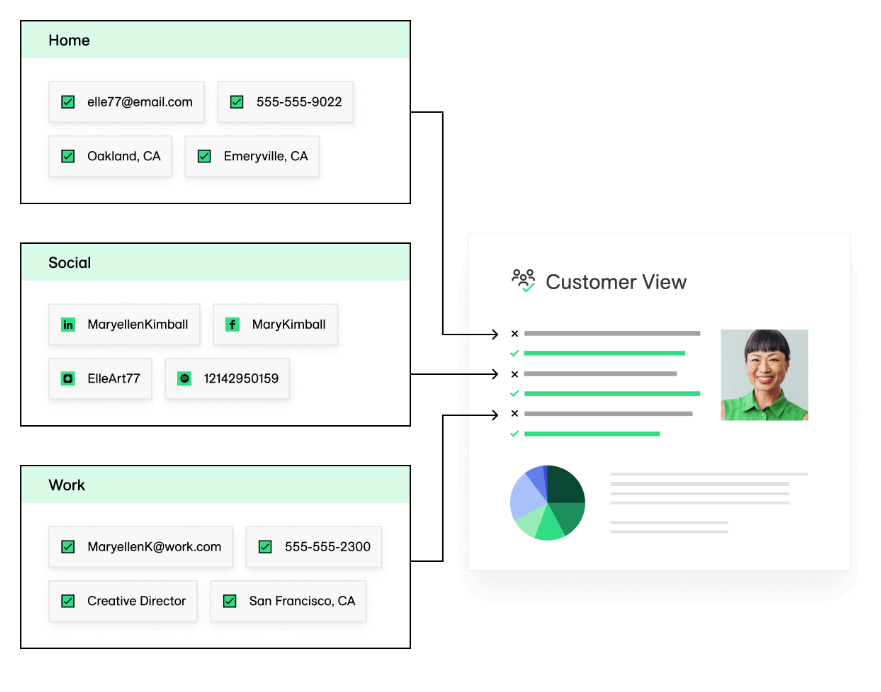
LiveRamp claims its marketplace currently has 200+ data sellers and 650+ partners, with audiences capable of being activated across hundreds of destinations.
When going through the LiveRamp partners page on their site, I found some of the partners to be of interest. For example, Edmunds.
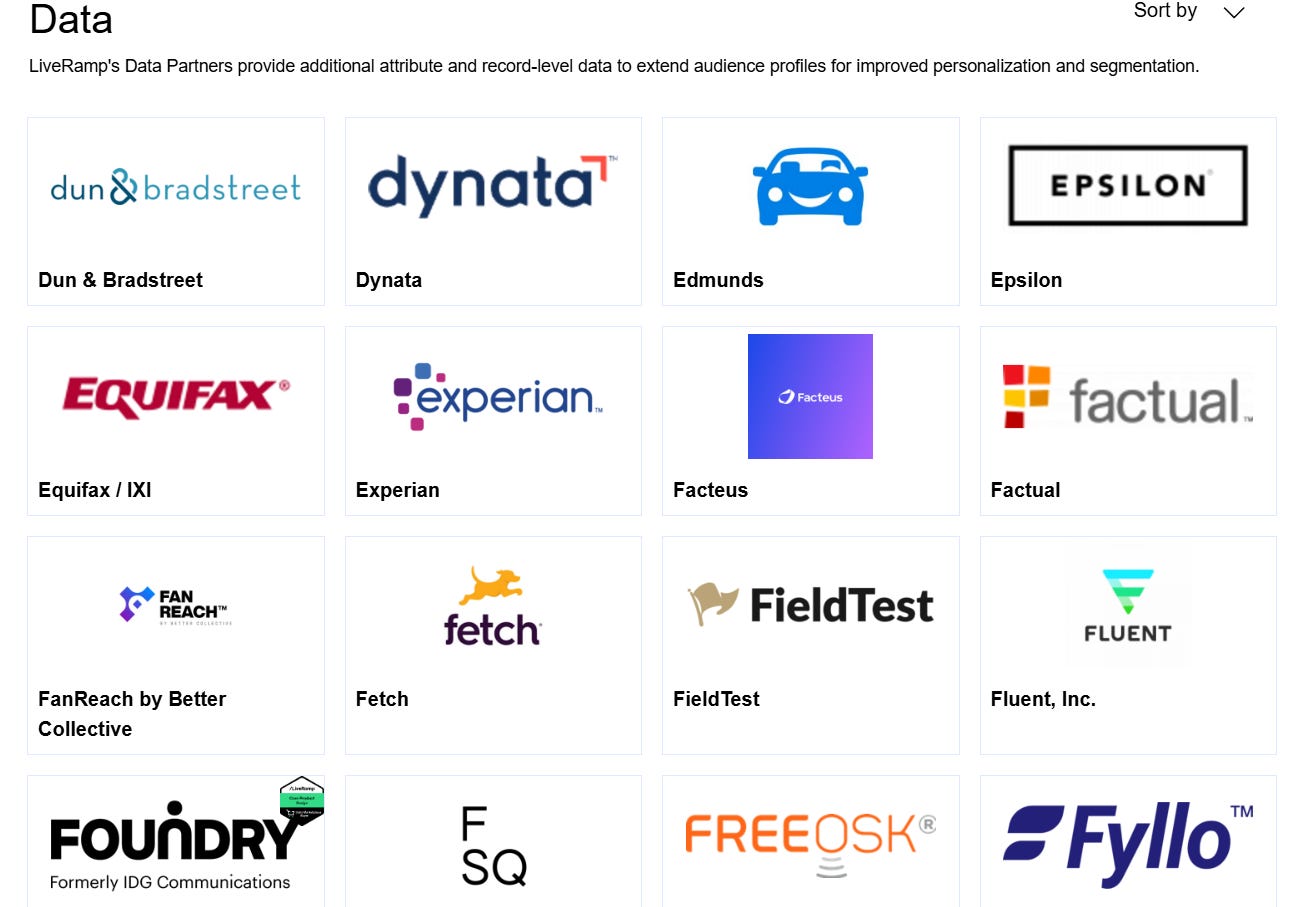
Chances are, if you are in America and you have hunted for a new vehicle in the past decade, you have ended up on Edmunds’ site.
Who knew they were partnered with a company harvesting every last speck of information we provide in hopes of finding a new vehicle that fits our needs?
What about Fetch?
Fetch is a site that gives you points for every receipt you scan. You then convert those points into gift cards.
According to LiveRamp, Fetch currently has over 11 million receipts captured daily from over 12 million monthly active users, representing 179 billion dollars in annual sales data. And anyone can buy all of these records.
Our purchase data is so incredibly valuable that businesses, from the corner gas station to Amazon to a clothing retailer, all offer cash back or assorted loyalty programs if we just grant them access to track everything we purchase. It all becomes even more valuable when we give the retailer our phone number and email address to tie it to. Once they layer that information, they have a giant database on everything about us, including if we prefer T-bones or New York strips.
Ibotta, another app that does the same thing as Fetch, is also a LiveRamp partner.
And you can purchase all of their data too.
What about Duns & Bradstreet? Duns tries to push every business into claiming a free “D & B” number, which will act like a social security number for the business. In return, the business can build credit and apply for loans. Without a D & B number, the business cannot bid on government contracts and will be restricted from other opportunities.
In turn, all of the data harvested is being sold on LiveRamp. Just how much data is D & B producing? According to the listing, the Dun & Bradstreet Data Cloud is comprised of 455 million business records and 350 million cookies [installed trackers] and mobile device IDs.
Here’s a partner you might be familiar with: MasterCard.
The listing for MasterCard is tight-lipped about what data they are selling, but according to a quick internet search, there are 1.12 billion active MasterCard credit cards and 1.83 billion debit cards in circulation worldwide, totaling approximately 2.95 billion cards. Did you know your credit card records were being prostituted?
There are so many publicly named partners that I can’t possibly cover them all.
And right about now you’re thinking, “This is supposed to be about Flock cameras. This has literally nothing to do with the topic,” but very soon you will see how this all links together…
OFFLINE DATA
Even if you throw away every electronic in your possession, you still cannot dodge this mass harvesting of human activity. Aside from credit card purchases, offline data harvesting includes:
- Warranty registrations.
- Magazine subscriptions.
- Addresses and household information.
- Property ownership.
- Vehicle registrations.
- Public records.
- Our physical movements.
- Places we visit.
- Whether we live near a particular business.
- Demographic and household information.
- Sometimes information about health-related purchases or interests.
And let me point out, you don’t ever have to tell one of these entities you are pregnant. In fact, you and your spouse can believe you are keeping it a secret for the time being, but it’s only a secret to the people in your circle of life because your devices already know, and they are already selling that data on you. This is why these companies sell lists titled “Pregnancy” or “George Floyd Protests.” Yes, people who attended protests were turned into sellable audiences despite never checking a box agreeing to have their information whored out. Along those lines, the company, Gravy Analytics, was selling location data that pinned people to specific churches. This means the advertiser not only knows you are Protestant but also knows you worship at Willow Creek Community Church at 67 Algonquin Rd, South Barrington, Illinois. Gravy Analytics then sold this information to the US government (which means we, the taxpayer, purchased location data on our fellow man for our government to use however they pleased.)
Recall how I said earlier that the stores themselves were pimping us out. The major retailers also own advertising companies. Let me tell you about a few of them so you can try to grasp how expansive this truly is.
- Walmart owns Walmart Connect, which uses Walmart customer/transaction data to sell advertising and then measure the success of the advertising against purchases. The Walmart Connect partner directory is huge. Sam’s Club benefits from Walmart Connect.
- Target operates Roundel, which, like Walmart Connect, uses Target shopper data for advertising and measurements. Target’s pregnancy-prediction program analyzed customers’ purchasing behavior and developed a pregnancy prediction score based on combinations of seemingly ordinary purchases. I don’t know what the accuracy of this program is, but the fact that it exists is enough on its own to raise an eyebrow.
- Kroger owns Kroger Precision Marketing, built around Kroger’s shopper and transaction data.
- Albertsons has Albertsons Media Collective, which does the same.
- CVS operates CVS Media Exchange, also known as the CMX Network.
- Walgreens has Walgreens Advertising Group, which it describes as, “real people, real purchases.”
- Amazon combines enormous amounts of purchase, browsing, and behavioral data through Amazon Ads.
- Home Depot operates a retail-media business using customer/shopping data, Orange Apron Media.
- Lowe’s operates Lowe’s Media Network.
- Best Buy has Best Buy Ads.
- Dollar General operates DG Media Network.
- Instacart announced that its first-party retail-media data could be used directly within TikTok Ads Manager, including audience targeting based on purchase behavior and closed-loop measurement. But that’s not all. Pinterest advertisers can target Instacart audiences based on actual purchase behavior, and Instacart said in 2026 that retailers can use its off-platform advertising capabilities through partnerships with Meta and others to reach consumers beyond Instacart. What a web they have woven.
THE MIDDLEMAN
Not every big store owns its own media group. For those that need a middleman, companies like Catalina are available. Catalina is a data harvesting and advertising company that sits between retailers, brands, and advertisers.
Catalina says it has purchase data covering 130 million households, $600 billion in annual spending, 11 billion annual shopping trips, and more than 400 million shopper IDs.
This data is then aggregated with loyalty club card data, marketing data, and sales data to create audiences and target individual shoppers. Companies like Catalina have so much data that they can know what a customer needs to buy and can deliver personalized messages by text message or email before people enter a store.
Another major middleman is NielsenIQ. Neilson is networked with more than 8,900 retailers in 88 countries. Neilson combines purchase data, loyalty card data, offline activities, demographics, and media consumption and uses this data to create sellable consumer profiles. It also says it receives nearly four billion receipts annually from Fetch Rewards, which we already discussed. And guess who is a customer? The US government.
OFFLINE IDENTITY RESOLUTION
I guarantee that’s a three-word phrase you’ve never heard before; neither had I. So what exactly is “offline identity resolution”? It’s what turns a heap of seemingly unrelated records into a profile associated with one person or household. It’s taking all of the data we have discussed—both online and offline—and combining it into one file. This is what companies like Experian do. Experian owns what they call an “Offline Graph,” which is a massive database that pulls its data from public and state records, including
- property and tax records
- census data
- transactions
- online/mobile data
- location data
- consumer surveys
- published directories
- public and state records
- property and tax records
- census data
- transactions
- online/mobile data
- location data
- consumer surveys
- published directories
- and more
Experian’s Offline Graph contains data from more than 3,500 original public and proprietary sources. As unbelievable as this may sound, businesses send all of their records to Experian, and Experian matches those records against Experian’s existing Offline Graph.
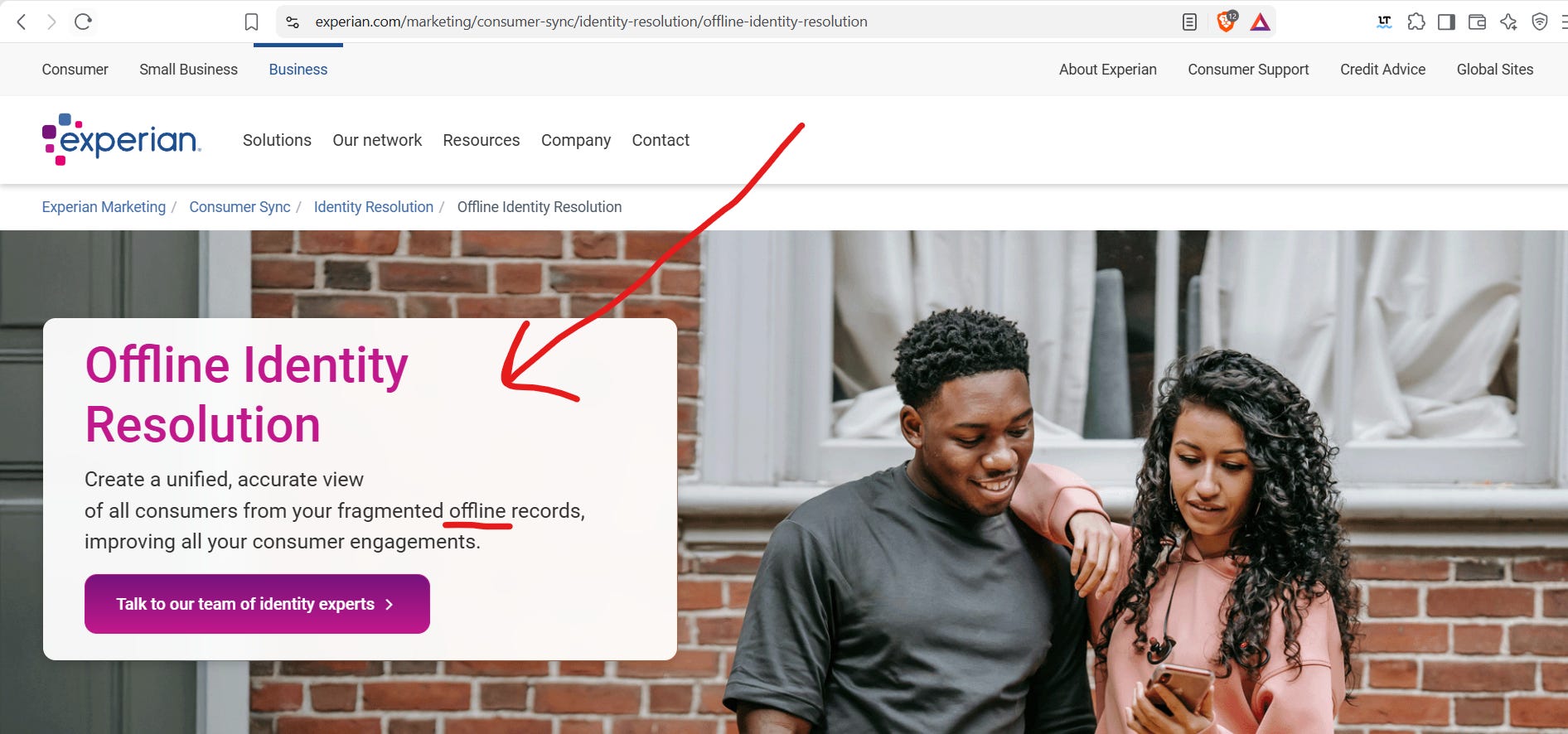
Considering that Experian is already a provider of “credit scores,” which take our payment history, amounts owed, length of credit history, new credit, and more and combine them into a score that determines if we can buy a house, car, and so on, you can see how we are only a flip of a switch away from a full-blown social credit system. Quite horrifying.
Speaking of offline data harvesting, there is another thing we must discuss…
AMAZON ECHO, GOOGLE HOME, AND SIMILAR DEVICES
Unless you have been living under a rock, by this point you are very familiar with Amazon Echo devices, which use AI assistant technology called Alexa (now Alexa+).
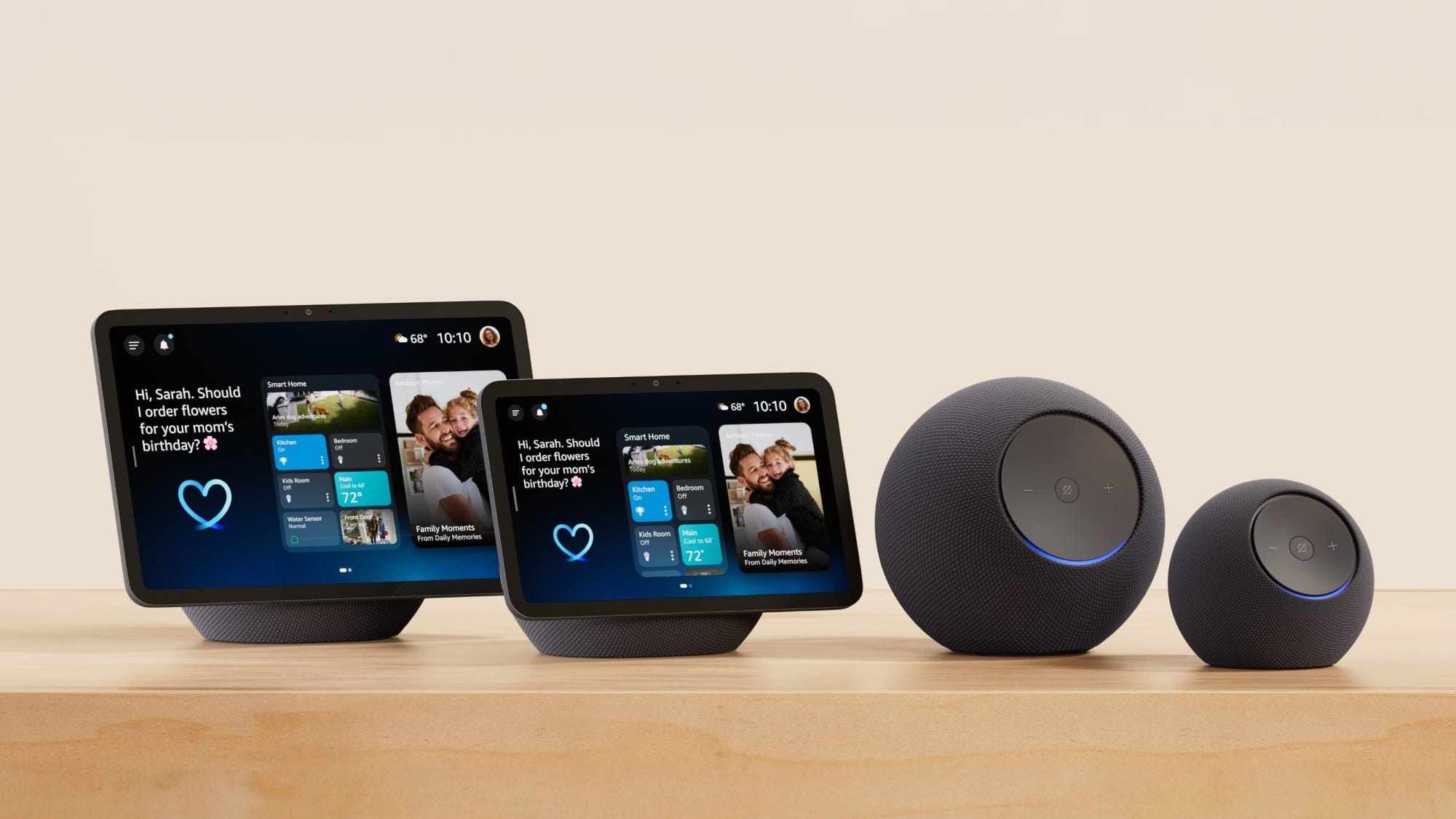
These devices allow you to say voice commands for actions, such as booking a flight or an Uber, reordering your favorite olive oil, even getting the score of last night’s ballgame. All of this is indeed convenient, but it comes at a high price surveillance-wise.
When Alexa responds to a request, Amazon receives the voice interaction and creates a transcript, but we didn’t really know the full extent of what was going on with that data until an Federal Trade Commission case back in 2023. If you read this case, you will see that the FTC discovered that Alexa AI technology was (and is) collecting “vast amounts of data about consumers ranging from their geolocation data via the company’s Alexa app to their voice recordings collected by Amazon’s Alexa voice assistant service.” And, we also learn that Amazon gave 30,000 employees access to Alexa users’ voice recordings—even though many, if not most, of those staffers had no business need for the files because those files are allegedly not a part of Amazon’s business.
However, if we rewind a few more years, we learn that these voice files really were a part of Amazon’s business.
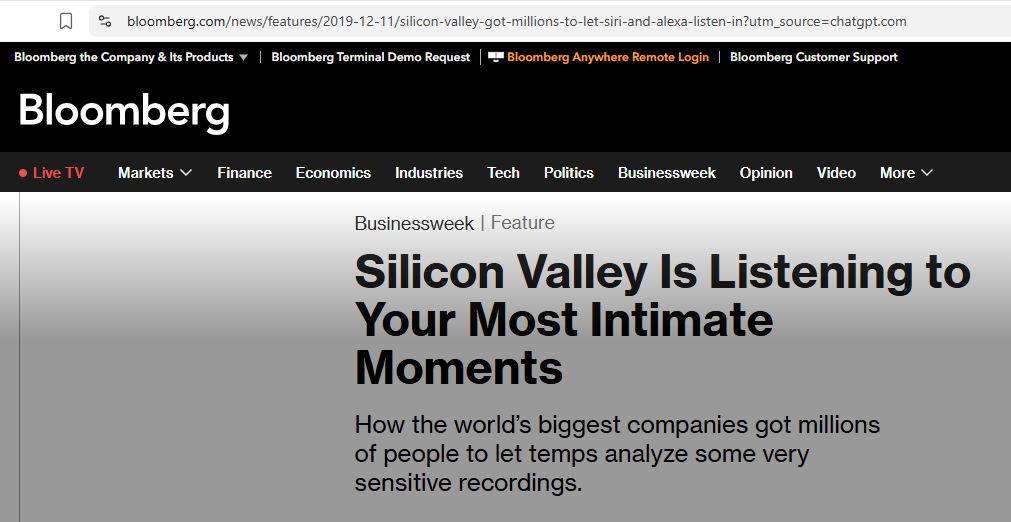
To quote from a Bloomberg article titled Silicon Valley is Listening to Your Most Intimate Moments, “Ruthy Hope Slatis couldn’t believe what she was hearing. She’d been hired by a temp agency outside Boston for a vague job: transcribing audio files for Amazon.com Inc. For $12 an hour, she and her fellow contractors, or “data associates,” listened to snippets of random conversations and jotted down every word on their laptops. Amazon would only say the work was critical to a top-secret speech-recognition product. The clips included recordings of intimate moments inside people’s homes…
The recordings she and her co-workers were listening to were often intense, awkward, or intensely awkward. Lonely sounding people confessing intimate secrets and fears: a boy expressing a desire to rape; men hitting on Alexa like a crude version of Joaquin Phoenix in Her. And as the transcription program grew along with Alexa’s popularity, so did the private information revealed in the recordings. Other contractors recall hearing kids share their home address and phone number, a man trying to order sex toys, a dinner party guest wondering aloud whether Amazon was snooping on them at that very instant. “There’s no frickin’ way they knew they were being listened to,” Slatis says. “These people didn’t agree to this.”
The whole issue has become so bad that there was a lawsuit filed in 2024 over Alexa illegally recording conversations without consent. The plaintiffs have pointed out that Amazon is collecting billions of conversations without the knowledge of the consumer. But let me tell you, this isn’t limited to Amazon products. Let me share with you the intel Bloomberg dug up on Apple:
“…At a GlobeTech office near an airport in Cork, Ireland, some say, they sat in silence at MacBooks wearing headphones, tasked with transcribing 1,300 clips a day, each of which could be a single sentence or an entire conversation… When a contractor clicked play on a voice recording, the computer filled a text box with the words it thought Siri “heard,” then prompted the worker to approve or correct the translation and move on. GlobeTech didn’t respond to requests for comment.
A program the workers used, called CrowdCollect, included buttons to skip recordings for a variety of reasons—accidental trigger, missing audio, wrong language—but contractors say there was no specific mechanism to report or delete offensive or inappropriate audio, such as drunk-sounding users slurring demands into the mics or people dictating sexts. Contractors who asked managers whether they could skip overly private clips were told no clips were too private. They were expected to transcribe anything that came in. Contractors often lasted only a couple of months, and training on privacy issues was minimal. One former contractor who had no qualms about the work says listening in on real-world users was “absolutely hilarious.”
Google and Facebook aren’t innocent either. Facebook has used human transcribers for its chat app Messenger—you know, the app you are supposed to believe is super duper safe.
And now that AI has officially rolled out, there is no need for human transcription because the software can do it all on its own. This brings us to the next question: being that all of these entities are desperate to obtain every trace of information about us…
HOW MUCH IS OUR DATA WORTH?
Researchers at Duke University investigated what data brokers would charge for data (“datasets”) about Americans. They found that one broker offered a dataset containing 435,780 individuals’ records for $0.06 per person. This means it would cost the company a little over $26,000 to purchase the whole load. Another broker quoted $275 per 1,000 people with a 5,000-record minimum. Pricing for mental health information varied: one data broker charged $275 for 5,000 Americans’ mental health records, while other firms work off a subscription model that rakes in $75,000 or $100,000 annually. And keep in mind, this is digital data that is not exclusive. The same dataset can be sold a dozen or more times in a single day. It could even be sold hundreds of times if needed.
NETWORK SHARING
Aside from selling data, data can be shared for free. And the kicker is that sites that say, “We don’t sell your data!” can say that with a straight face and then transfer the data out through an SDK to a company that does sell it. Again, this is all completely legal.
THE MOBILE HEALTH DATA HARVESTING INDUSTRY
Mobile health, known as “mHealth,” is a new industry that eliminates a trip to the doctor by allowing people to connect remotely. mHealth also refers to the use of mobile devices and technologies, such as smartphones, tablets, apps, and wearable devices, that are used to collect, monitor, or deliver health-related information and services. All of these mHealth entities offer apps, and, as one can assume, these apps collect highly sensitive data. What you may be surprised to learn is what is happening with that data after collection.
You see, most mHealth apps are not covered by the Health Insurance Portability and Accountability Act (HIPAA); therefore, they are not bound by the same laws. This means they are not legally obligated to keep their clients’ data confidential. This means all of these companies that are collecting customer data, whether that be through wearables, cell phone apps, websites, or social media platforms, can legally share, license, and sell users’ health data (in addition to other data) to third parties without users’ knowledge or consent, and data brokers love it.
To quote from an investigation by Duke University, “The 10 most engaged brokers advertised highly sensitive mental health data on Americans, including data on those with depression, attention disorder, insomnia, anxiety, ADHD, and bipolar disorder as well as data on ethnicity, age, gender, zip code, religion, children in the home, marital status, net worth, credit score, date of birth, and single parent status. Pricing for mental health information varied: one data broker charged $275 for five thousand aggregated counts of Americans’ mental health records, while other firms charged upwards of $75,000 to $100,000 a year for subscription/licensing access to data that included information on individuals’ mental health conditions.”
Check out this insane list showing what some of the collected information includes:
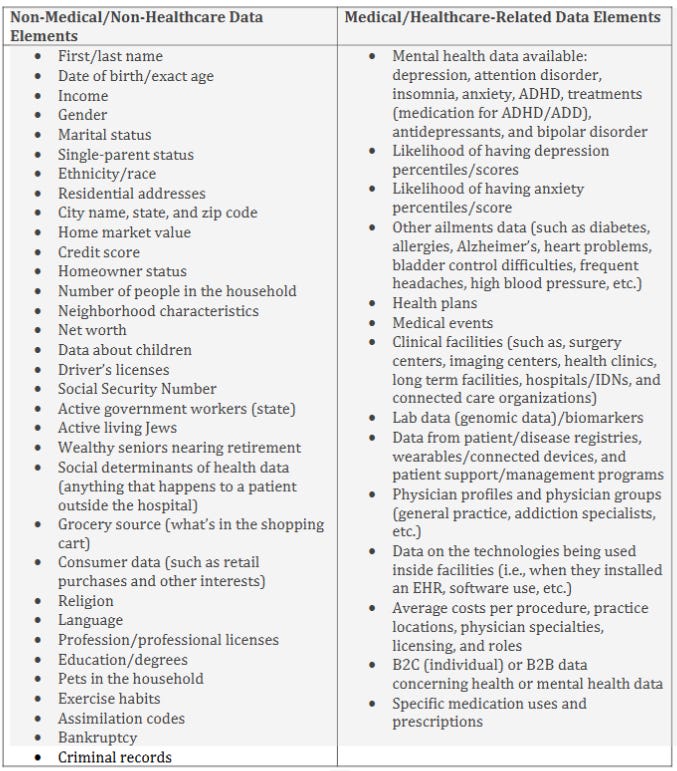
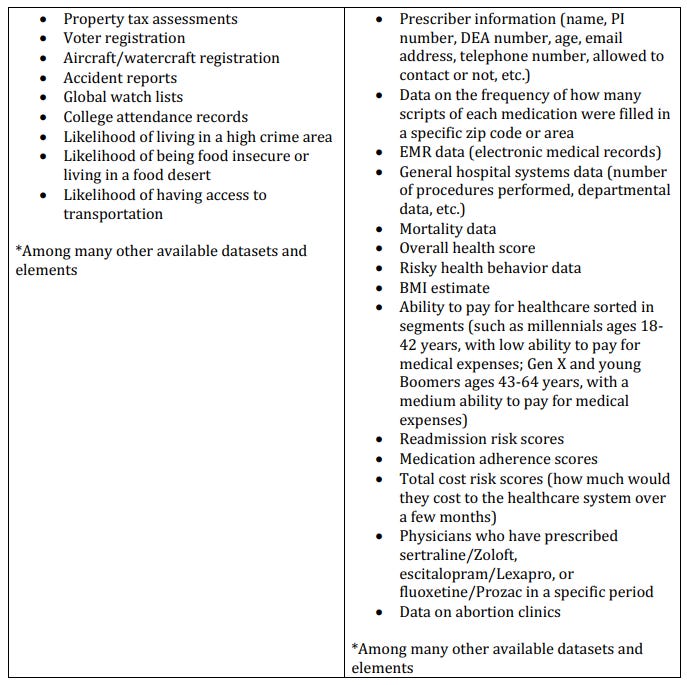
Now we must ask, “What exactly are these data buyers doing with this information?” Answer: In many cases, they are sending communications, such as letters that say things like:
“Dear [name], We are reaching out to you because someone at this residential address may have or has been formerly diagnosed with depression and/or anxiety. Please contact us if anyone in your household would be interested in being connected with community resources.”
Yes, these secretive data harvesting operations are the reason you keep receiving junk mail telling you the warranty on your car has expired or you need to contact the company ASAP about a problem with your loan, when in reality there are no problems with your loan. But it’s not just junk mail; it’s also emails, text messages (including political texts), and phone calls. If these businesses could send us smoke signals and carrier pigeons, they would. I should mention that many of these data brokers have partnerships with pharmaceutical companies or other entities, so the data brokers themselves are partners with Pfizer, Merck, Johnson & Johnson, and so on. This means a data broker can obtain your sister’s data from her loyalty club card for the local pharmacy. From this data, the broker discovers that she recently took your nephews to get a flu shot. Being that the kids got one shot, it is likely their mother can be sold another. The broker can solicit all of her information to the pharmaceutical company, and they can bombard her with fear propaganda until she returns to the pharmacy for more jabs.
WEAPONIZING HARVESTED DATA
But that’s not all. As Duke University pointed out, the collection of the data can be weaponized. Just how Flock cameras network with car insurance companies, these online data harvesters can do the same. As Duke said, “Health insurance providers—which already buy individuals’ race, education level, net worth, marital status, and other data without their knowledge or full consent to predict healthcare costs—could buy mental health data to discriminately charge individuals for care or discriminately target vulnerable populations with advertisements.” But it’s not just mental health. Equally, let’s say you throw your back out on the job and file for workers’ compensation. You have never complained about your back to your doctor, you have never had back surgery, and you have never filed for compensation before, but the insurance company, through data harvesting, discovers that you recently told someone on a dating app that you can’t meet up because your back is sore again. Now your compensation is denied on the grounds of your back being a pre-existing condition. This is just the tip of the iceberg.
Here is the point in this publication where I will begin tying all of it together; Flock, Leonardo, MAIDs, Facebook, every last bit of it…
NEXT READ: YOUR CREDIT CARD IS SPYING! WE ARE BEING TRACKED LIKE DEER
Thanks for reading this article! Believe it or not, writing free content actually isn’t free. If you want to support my work, buy me a coffee, make a Ko-fi donation, or shop my eBooks and download and preserve true history. Donations allow me to pay for websites and programs that allow me to write content that you haven’t seen elsewhere.
Also, I just marked down my first class ever, How to Research Chemicals and Read Manufacturers’ Safety Data Sheets. It is now only $25; no coupon code or subscription is required. Upon purchase, you will have access to all four weeks so you can take it at your own pace. Although it was my first class, it’s still good, and you will learn a lot. Armed with this knowledge, you will never have to rely on Google to tell you if a supplement or product is safe. Check out this awesome deal here.

Aside from that, if you want to further support my work, buy me a coffee, make a Ko-Fi donation, or shop my eBooks and download and preserve true history.
Oh! One more thing, Truth Be Told: The Mega Event is now available on a thumb drive!
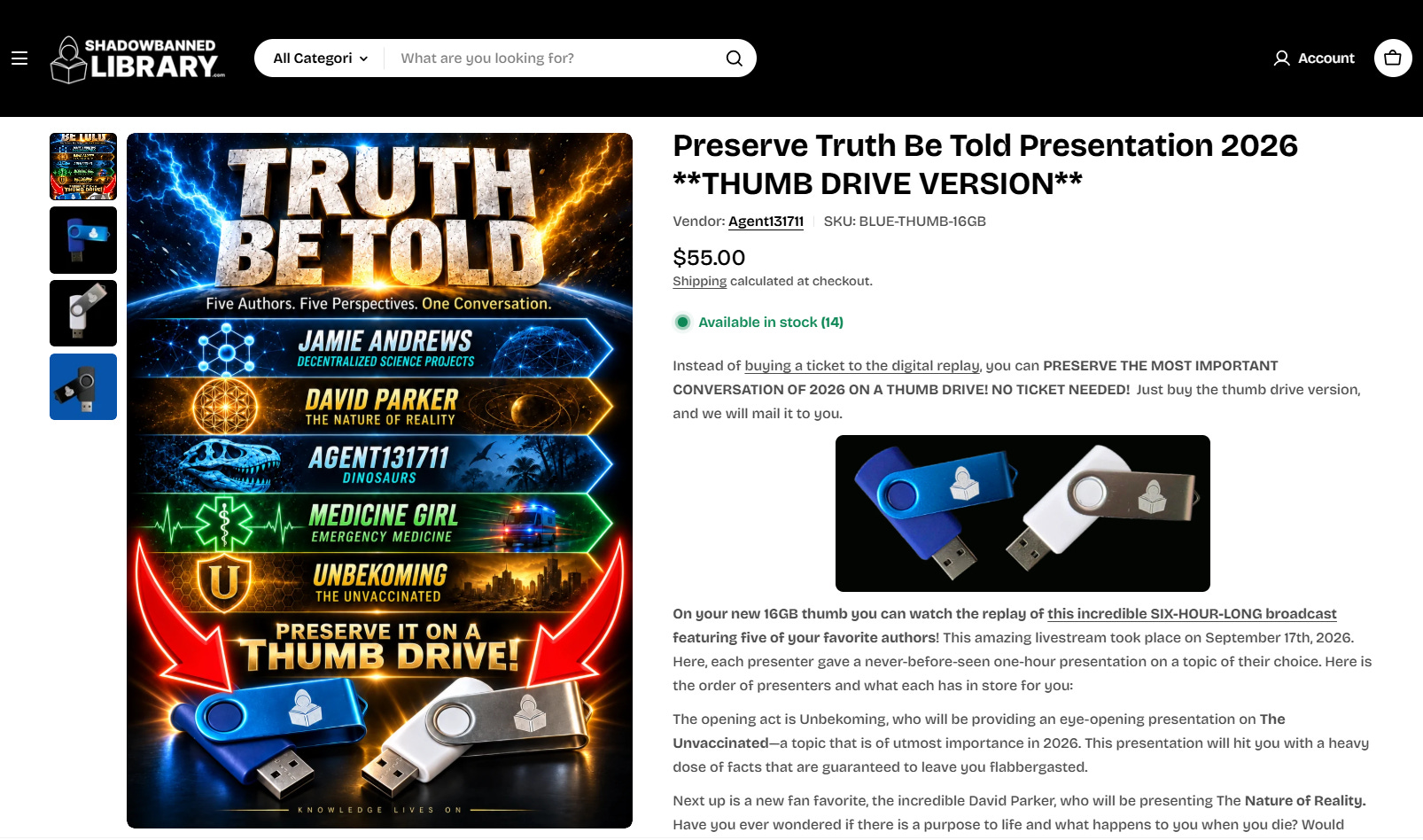
If you didn’t grab a ticket to the 7-hour-long livestream, you can pick up a thumb drive and see all five authors’ presentations. The event got outstanding reviews. Click here to order it on a thumb drive, and we will get it mailed out to you quickly. International shipping is now stupid expensive, so if you are outside of the United States, you are unfortunately better off grabbing a ticket to watch the livestream replay. Click here to watch the livestream or click here to order it on a thumb drive.
If you want to make sure you are updated when new articles, eBooks, events, and podcasts are released, be sure to sign up for WhatsApp notifications:
![Facebook: The Surveillance Machine You Voluntarily Installed [Flock Part 7 by Agent131711]](https://dropinblog.net/img/ois3ro1s/700/facebook)
![App-Based MASS SURVEILLANCE (and we thought Flock was bad…) [Flock Part 6]](https://dropinblog.net/img/86s55pex/700/app-based-mass-surviell)
![Who the F*ck is Leonardo? [Flock Part 4 by Agent131711]](https://dropinblog.net/img/8i0acekh/700/leonardo)
![Epstein, Ring Doorbells & Axon: Israel Controls America's National Security [Flock Part 3 by Agent131711]](https://dropinblog.net/img/afe1quuw/700/epstein-ring-axon)
![Flock: The Secret Warehouse & Front Companies [Part 2 by Agent131711]](https://dropinblog.net/img/8pbc3ou5/700/flock-2)
![HELP! I'm Being STALKED! [Flock Part 1 by Agent131711]](https://dropinblog.net/img/qgpivitn/700/flock-1)
![The Players in WWII: Once You See It, You Can Never Unsee It [Part 16 by Agent131711]](https://dropinblog.net/cdn-cgi/image/fit=scale-down,format=auto,width=700/34264201/files/featured/the-players-wwii.png)

![Skull and Bones Connection to the Nazis [WWII Part 15 by Agent131711]](https://dropinblog.net/img/yyz0iyjj/700/skull-and-bones-connection-to-the-nazis-hitler)
![Who ACTUALLY Funded the Nazis? [WWII Part 14 by Agent131711]](https://dropinblog.net/img/rml5s7ce/700/who-funded-the-nazis)

