
I started researching menopause not because I had problems, but because I didn’t. To be fair, I also knew I wouldn’t. When I was very young, around 7 or 8, I knew I would never look old. It wasn’t fear of wrinkles, so much as refusal to believe they are inevitable. I believed other people would age because they believed and accepted what they were told by others. I rarely did.
With menopause, we first need to challenge the dominant narrative. Are our expectations about menopause rooted in our innate biology, or are they created by culture and industry? Everywhere, indoctrinated women warn each other about symptoms as if they’re inevitable. They laugh about it together, which is the most dangerous part. Or they bond over it through manufactured friendships on television, watching their favorite movie stars laugh about shared symptoms. It’s the same playbook used by media outlets like People Magazine, selling you stories meant to make you identify with illness, just like your favorite celebrity British princess getting brave for her “cancer” diagnosis or figure on a silver screen melodramatically telling your about their “rare disease”.

I had to ask whether there is truly a hormonal imbalance or a story maintained by messaging and profit as by physiology. Put more simply, are people who buy into the narrative experiencing symptoms driven by suggestion and hypochondria, or is something actually happening? We still have people convinced they suffer from “long CONVID” or believe they lost taste and smell from a fictitious virus. So is there something that actually goes haywire in a woman when her monthly cycles end?
In this three-part series, I will use the words menopause and perimenopause as industry-created terms, not issues I consider valid or in anyway truthful but for sake of agreed upon terms and initial understanding. In Part Two, I will explain why women believe they are experiencing symptoms, what behaviors contribute to hormonal disruption, what hormone therapy actually does (transfers) to a woman’s body, and how to stop participating in narratives that shape beliefs about the demise of your health.
The Diagnosis
Perimenopause and menopause are not biological facts, they’re stories, shaped and amplified by medicine, media, and markets. Instead of a biological crisis, menopause is often framed as such by a culture and industry invested in women’s decline. My goal is to challenge how much we truly know, and to ask: Who benefits when menopause is cast as a chronic problem requiring lifelong treatment?
This isn’t about denying age related changes, instead it’s about rejecting information that profits from women’s brainwashing. When industries convince women that natural changes need lifelong treatment, we must ask whose interests are served. Diagnosis can be done over a computer, hormone injections are now available for purchase online and delivered monthly. Rather than just accepting trends, we should think critically. This project examines language, culture, fertility, food, and fear—always asking who benefits from convincing women their bodies will fail. I will go more in depth on the fictitious diagnostic criteria of treating hormones with hormones in article 2. But for now suffice it to say that taking a blood test to “see where your hormone levels are” is equivalent to taking a picture of a wave and telling you about the ocean. It is meaningless to the whole and ever changing.
Following the Money Clarifies the Story
Once I stopped focusing on symptoms and examined the business side, the financial picture stood out. Industry reports state that the global hormone replacement therapy (HRT) market was valued at approximately $23.58 billion in 2024 and is projected to reach $39.42 billion by 2033. This projection is based on a calculated compound annual growth rate of 5.8 percent. Such consistent growth reflects not only increased demand but also possible expansion in how menopausal symptoms are diagnosed and treated.
The U.S. accounts for roughly $9 billion—about 28 percent—of the roughly $32 billion market. This concentration highlights American prescribing practices and the normalization of the pharmaceutical industry. This doesn’t include a growing grey market of prescriptions from online pharmacies—another industry cash grab.
When one country drives so much of the global market, it’s not just about biology anymore. It’s about systems, incentives, and the cultural framing of this life stage. This growth arises from defining aging as needing ongoing treatment.
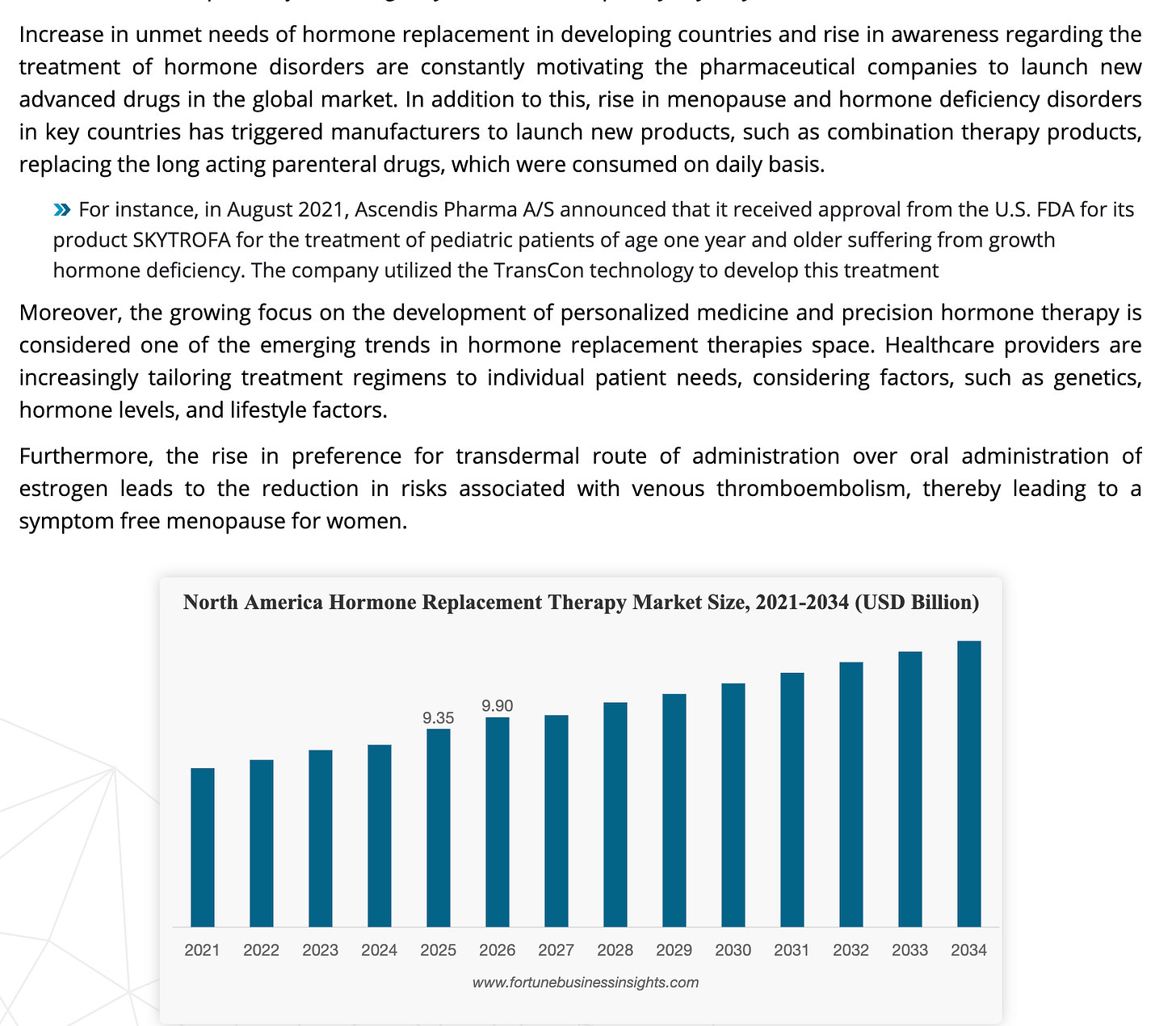
Menopause treatments drive this market, with estrogen and progesterone therapies making up over half the revenues. Pills are the most common due to their ease of distribution. North America leads sales after years of aggressive marketing. The Asia Pacific is the fastest-growing market as companies target new areas. India gets educational campaigns, and even “Menopause the Musical” spreads the message. I’ll discuss hormone therapy risks later.
When Menopause Entered the Record
Menopause did not begin as a diagnosis. It began as a rite of passage into a woman’s full power. Across ancient civilizations, women reached a season when monthly bleeding ceased, fertility ended, and another phase began. Early Greek medical texts note that menstruation stops between the ages of 40 and 50. Traditional Chinese medicine describes life unfolding in cycles, with later decades marking a shift in internal energy and responsibility. Ayurvedic writings speak of aging as a natural movement of qualities within the body, calling for adjustment and awareness rather than correction. In these systems, bleeding stopped, and life continued. The event was acknowledged as marking a milestone, not a breakdown.
Before concepts of imbalance or decline, this life season was integrated into existence. The body changed, as all bodies do, but meaning carried dignity. To grasp what followed, we must recognize this older pattern when menopause was a threshold, not a crisis.
What the Old Texts Actually Say
If menopause were inherently a biological negative, it would show up clearly in the earliest medical and philosophical records. It does not. What appears instead is something quieter and far more unsettling for modern narratives.
Ancient Greece
Hippocratic texts, dating to around the fifth century BCE, mention the cessation of menstruation as an expected event of aging. One commonly cited line, paraphrased across translations, states that menstruation ceases “around the age of forty to fifty.” There is no diagnostic category attached to this observation, no treatment plan follows it, and no list of symptoms is assigned.
Aristotle, in the History of Animals, notes that women cease menstruating later in life and continue living normally afterward. He treats it as a simple biological fact rather than a disorder. The absence of alarm is striking, especially given how often Greek physicians speculated wildly about women’s bodies. Even in a medical culture steeped in error and false premise, menopause did not register as a crisis. There were no reports of hot flashes, mood swings, weight gain, or excess facial hair. The change was not even registered as a cessation of fertility.
Traditional Chinese Medicine
In the Huangdi Neijing, often translated as The Yellow Emperor’s Inner Canon, written roughly between 300 BCE and 100 BCE, female aging is described in seven-year cycles. Around the seventh cycle, menstruation naturally ends.
One translated passage explains that at this stage, “the heavenly water dries up, the channels are no longer flowing, and the body enters a new phase.” Again, this is not presented as a problem. It is presented as completion.
In traditional Chinese philosophy, women past their reproductive years were often considered more divinely guided, stable, more authoritative, and less governed by cyclical forces. Their energy was understood to turn inward and upward, toward wisdom rather than fertility.
There is no record in these texts of treating this transition with herbs meant to restore bodily functions, relieve dryness or hot flashes, or treat deficits. And the Chinese treated every malady with some herbal concoction. That alone should raise more than a few eyebrows.
Ayurveda
Ayurvedic texts such as the Charaka Samhita and Sushruta Samhita describe aging as a gradual shift in bodily qualities. Menstruation ending is mentioned, but again, not isolated. It is grouped with other age-related changes that apply to all humans.
Later Ayurvedic writings link post-reproductive life to greater clarity and discernment, often in women who had completed childbearing. This phase was considered suitable for teaching and leadership. The wisdom and power of older women were respected, and their status was elevated within their communities.
Ayurveda does not recognize a specific menopausal disorder. No set of symptoms is expected, and intervention is not presumed necessary. Herbal remedies were widely used for other conditions, underscoring the significance of this omission in menopause.
This gap in modern and historical approaches prompts discomfort for current medical perspectives. Studies of cultures outside Western medical influence often document minimal menopause-related complaints, particularly for symptoms like hot flashes. In Indigenous, East Asian, and rural populations, menopause is typically described simply as the end of menstruation, without added interpretation.
In almost all cultures I looked at with written records, the end of menstruation meant only increased social authority and elevated status. Over and over the messaging was a women simply settled into her wholeness and experienced the fullness of her potential power.
The Blood That Turned Inward
In multiple ancient and traditional cosmologies, menstrual blood was not waste. It was power. It was a generative force. It was the visible evidence of creative capacity.
In certain Tantric and yogic interpretations within India, reproductive fluid was understood as a refined life substance. Energy that could create a child could also be transmuted into spiritual force. What once moved outward into physical creation could be redirected inward into heat, discipline, clarity. The elder woman was no longer dispersing that energy monthly. She was immersed in it and it grew more powerful with each retained monthly cycle.
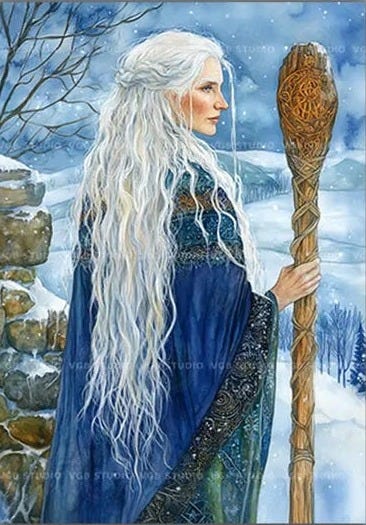
In some strands of Celtic folklore, older women were associated with the Cailleach, the veiled one, the winter crone who shaped mountains and controlled storms. Youth and fertility belonged to spring. Authority over land and season belonged to the elder. The shift from maiden to mother to crone was not degradation. It was a movement toward singular power. The crone was feared and respected because she was uncontained.
The Crown and the Current
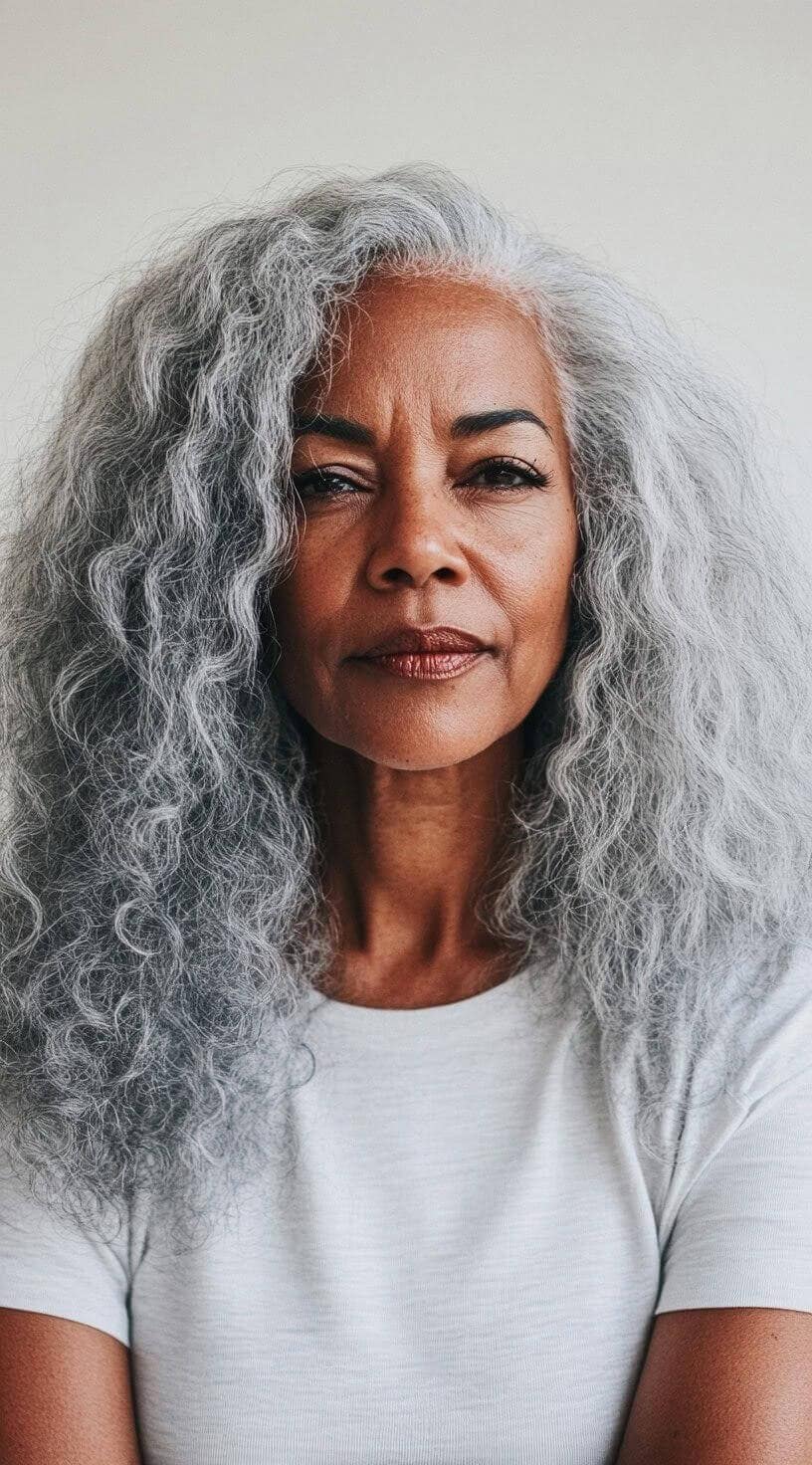
In many traditional societies, a woman who had stopped bleeding was not considered to be fading. She was finally coming into her own. And her mind, body, soul, and spirit reflected it.
Grey or white hair was not something to be hidden. It was read as evidence. Years carried in visible form. In Hebrew scripture, grey hair is described as a crown of splendor earned through a life lived in wisdom. In other cultures, the silvering of hair marked entry into elderhood, understood as an elevation of authority.
Long, uncut hair has been is seen across traditions as a sign of strength. Among Plains nations, hair is considered an extension of the self, a record of lived experience. In various spiritual systems, hair is associated with vitality, intuition, and spiritual sensitivity. When an elder woman allowed her hair to grow long and turn naturally silver, it was an act of alignment. Nothing synthetic or masked. The body speaks honestly about time. I did an entire series on the power of hair and keeping it long and coated with external myelination, also known as sebum. WAshing, cutting, coloring, burning, or using chemicals in anyway destroys the antenna and ability to connect with the divine wisdom and sensory perceptions most would call esp, magical or psychic. These are just the normal human perceptions, weeded out long ago to keep us from our full power.

The shift from dark to silver became symbolic in later esoteric traditions as well. In yogic systems, the crown of the head is associated with expanded perception and higher awareness. Silver hair gathering at the crown was read as a visible sign of inward refinement, as life had carved depth like the tree in fall, some argue, at its most beautiful and vibrant. The woman who had endured births, losses, seasons of labor, and survival did not react the way she once did. Her perception widened. She saw patterns. She felt consequences before they arrived. She had the perspective of the eagle flying above from a distance, able to see the whole picture.
Hands mattered too. In many cultures, elder women were midwives, herbalists, and caretakers of the sick. Their touch could heal a body. Nails unpolished without plastic blocking the energy moving through the fingertips. Healing was not mystical theatrics. It was accumulated knowledge applied calmly with inner knowing.
The archetype that later became known as the crone was not an insult. She was winter, not spring. Winter stores. Winter sharpens. Winter sees clearly because the leaves have fallen away, revealing what was once hidden. Everything is now seen. Industrial culture taught women to dye the crown, trim the length, soften the edges, and cut herself from her wisdom, potential and wholeness.
The Power of a New Season
Among certain Native North American oral traditions, women who no longer bled were sometimes described as being in a state of constant power. When a woman menstruated, that power cycled. When it stopped, it was said to remain with her. That made her presence potent in the ceremony. In some communities, elder women could handle sacred objects or participate in rites from which younger, cycling women were temporarily restricted. The shift did not diminish access. It expanded it.
In parts of West Africa, blood is intimately tied to lineage and ancestral continuity. When a woman’s reproductive years come to an end, her body is considered settled. Settled bodies are trusted bodies. In spiritual practice, steadiness matters. An elder woman could approach ancestral shrines as a vessel of accumulated life.
Across these frameworks, the common thread is startling once you see it. And the thread runs through every single tribal community from the farthest northern climates to the hottest African deserts, the theme, understanding, and record were identical.
The end of visible blood did not mean the end of power.
It meant the power was no longer leaving.
It was the most honored time in a woman’s life.
Haudenosaunee Confederacy (People of the Longhouse)
The Haudenosaunee, often called the Iroquois Confederacy, is one of the oldest participatory democracies in the world. Long before European constitutions were drafted, the Mohawk, Oneida, Onondaga, Cayuga, Seneca, and later the Tuscarora were united under what is known as the Great Law of Peace. Their society was organized through the longhouse, a structure that represented many families living together under one roof, and lineage moved through the mother.
Children belonged to their mother’s clan. Land use followed the maternal line. Identity came through women. Within this structure, Clan Mothers were political authorities. They selected the male chiefs who would sit in council after years of observation. He watched how a man handled responsibility, how he treated women, whether he could listen, and whether he could think beyond himself. Leadership was not self-declared; it was conferred by a woman who had already lived long enough to recognize character.
If a chief failed in his duty, if he acted without humility or strayed from the Law, the Clan Mother could remove him. This is the value of wisdom within the tribe.
These were women who had completed their childbearing years. They had space to think long-term. The Great Law of Peace required leaders to consider the welfare of the seventh generation. It was elderly women who were expected to hold that long memory. In our society and culture, we don’t even revere our 2nd generation. Or for that matter, our first.
In Haudenosaunee society, the closing of the reproductive chapter was not framed as a loss. It marked entry into a different form of responsibility, one rooted in discernment, steadiness, and the protection of collective balance.
There was no syndrome attached to this transition. No medical alarm. No cultural panic. There was only ancient wisdom passed down to the present, earning authority and respect.
Hopi
The Hopi are a matrilineal people. Clan identity follows the mother. Homes pass through the female line. A man moves into his wife’s household. The center of continuity is not abstract. It is the women.
In that structure, elder women do not fade into the background. They become the backbone of the clan household. They are the ones who remember who belongs to whom, which ceremonies align with which season, which marriages strengthened alliances, and which ones fractured them. They remember drought years. They remember relocation. They remember who held fast and who wavered.
Younger women are busy raising children, managing daily demands, and keeping life moving. The elder woman has already done that work. Her value shifts from physical labor to discernment. When conflict arises within a family, it is not the youngest voice that settles it. It is the one who has watched decades unfold.
In a culture where land, ceremony, and identity are inherited through the mother’s line, the senior woman holds quiet authority. She is not ornamental. She is continuity.
Her status is not accidental. It is earned through time, endurance, and memory. The tribe does not discard her when fertility ends. It leans on her.
Lakota and Plains Nations
Lakota teaching about women begins with Pte San Win, White Buffalo Calf Woman, the one who brought the sacred pipe and the law. Her story establishes how women are to be regarded. When she appeared to two young men during a time of starvation, one approached her with lust and control in his mind. He was reduced to bones. The other recognized her as wakan, sacred, and listened. Through him, she brought ceremony, instruction, and restoration to the people. The teaching is simple. Women are not objects. They are carriers of natural law.
A Lakota elder woman, writing about becoming an Unci, grandmother, explains that this story lays the foundation. Even in thought, women are to be treated with respect. That respect does not diminish with age. It deepens.
When a Lakota woman becomes an elder, she becomes a stabilizing force. Grandmothers hold ceremony knowledge, guide younger generations, and remind the community of its original instructions. Their authority is rooted in lived experience and spiritual continuity. The wise woman remembers what breaks a person apart and what keeps them whole.
Tshivenḓa and Southern Africa
In Tshivenḓa communities of Southern Africa, a woman does not quietly fade when her monthly shedding ends. She crosses into a different standing.
She becomes vhakegulu, which means elder in the full sense of the term. It carries authority, moral weight, and proximity to the ancestors.
In Venda cosmology, menstruation is tied to cycles of fertility and physical creation. When that cycle closes, a woman is no longer seen as bound to reproductive labor. Her body is considered settled. Because she is no longer bleeding, she is regarded as ritually clean and spiritually stable. That stability matters in a culture where communication with ancestors is a practice.
Vhakegulu are called upon during family disputes. They preside over rites of passage. They guide marriage negotiations. They interpret ancestral expectations when illness or misfortune strikes. Younger women go to them for instruction. Men listen when they speak. Childbearing completes one responsibility. Elderhood begins another, that of earned value and reverence in the tribal order.
West and Southern Africa
In Yoruba society, as well as in Zulu and Xhosa communities, families are organized into lineage compounds that span generations. Children grow up surrounded by grandparents, aunts, uncles, cousins, and the quiet authority of elders who have already weathered decades of births, deaths, droughts, and disputes. A woman who has raised her children and kept her household intact does not disappear into the background. She becomes one of the women others come to when something serious is at stake.
In matters tied to Ifá and Òrìṣà practice, senior women serve as priestesses, diviners, and caretakers of shrines. Ritual knowledge is not downloaded in youth. It is entrusted after years of discipline and observation. Younger women watch how she handles conflict, speaks in council, and carries herself during a ceremony. er steadiness becomes the model.
When a marriage negotiation falters, or an inheritance creates tension, it is often the senior woman who reminds the family of precedent. She remembers who promised what. She remembers how a similar conflict was resolved thirty years ago. That memory gives her leverage. Her age is not tolerated. It is relied upon.
Among the Akan of Ghana, this authority is formalized. The queen mother sits within the chieftaincy system itself. She participates in selecting the chief from the royal lineage and can influence his removal if he fails the people. She advises on succession and holds the genealogical knowledge that determines legitimacy. The political structure assumes that an older woman’s judgment is necessary to balance power.
In these societies, a woman’s standing rises as her reproductive years draw to a close. Her value shifts from physical creation to guardianship of memory, spiritual responsibility, and political discernment. It is a stage families look toward, not one they dread. Or make musicals about stray hairs.
Asia
In traditional rural Japan, a woman’s standing inside the household did not remain static across her life. A young bride entered under the authority of her husband’s family. She worked. She observed. She learned the rhythms of the house and the unspoken rules that governed it. But when her monthly cycles ended, her position shifted in a way that everyone understood without needing to name it.
The senior woman of the household held the practical center of power. She controlled food stores, oversaw seasonal preparation, managed marriage negotiations, and carried the memory of family agreements stretching back decades. Her sons might speak in public, but inside the home, her judgment carried decisive weight. Years of navigating childbirth, scarcity, and family conflict were seen as tempering a woman into steadiness. With the cycles behind her, she was regarded as less entangled in emotion and more anchored in perspective. That steadiness translated into authority.
In rural China, especially within extended courtyard families, a similar progression unfolded. A young woman married into a hierarchy where she began at the bottom. Over time, and especially once her childbearing years closed, she rose. The grandmother presided over ancestral rites at the family altar, directed household labor, and influenced how resources were distributed among sons and grandchildren. Her knowledge of lineage and obligation positioned her as the family’s living archive. She was no longer defined by fertility. She was defined by continuity.
In both settings, the end of bleeding marked a movement upward in status. It was understood as a crossing into seniority, and seniority carried power.
Conclusion: Before It Was a Condition
Across continents and centuries, the end of monthly shedding marked a transition, not a malfunction. In tribal societies, agrarian cultures, and ancient civilizations, this phase was folded into the architecture of life. A woman completed one biological responsibility and stepped into another. Authority often increased. Responsibility shifted. Her value did not collapse with fertility. It consolidated with experience.
There was no universal panic script attached to this transition. There was no cross-cultural checklist of decline and blood to give to “see what your hormones are doing”. There was no automatic assumption that a woman had entered a biochemical emergency. What existed instead was integration into elderhood, stewardship, and continuity. It is also very clear that the elder women was the backbone of each tribe and culture. The modern world has lost this, we throw way our elders and treat them as slightly annoying barnacles we have to pay someone to take care of or handle the burden ourselves.
In the next article, we will trace when and how this natural life stage was reclassified as a problem to be solved. We will look at the historical moment when naming led to categorizing, when categorizing led to diagnosing, and when diagnosing led to prescribing. We will examine how hormone isolation through lab values, pharmaceutical development, and cultural messaging transformed a sacred transition into a marketable deficiency. The long-term physiological consequences of synthetic and compounded hormone use deserve careful scrutiny, and the data surrounding cardiovascular risk, cancer associations, clotting disorders, bone density manipulation, and neuroendocrine feedback disruption will be laid out clearly.
The third article will move beyond critique. It will explore how women can navigate this season without defaulting to lifelong drug management. We will look at environmental exposures, metabolic stability, circadian rhythm, mineral balance, nervous system regulation, and ancestral lifestyle patterns that support strength during this phase. We will examine how to cultivate authority, clarity, and resilience without outsourcing power to a prescription.
This series is not about restoring and healing, but about truth and our innate right to live healthy, happy lives without being tricked by profiteering poison centers. When truth is restored, fear loses its leverage.



Disclaimer
The information shared here reflects my personal research, study, and lived experience. Sources include historical archives, scientific literature, and public records wherever possible. It is intended for education and discussion, not as medical or legal advice.
I am a Registered Nurse, no longer practicing, and am not acting as a healthcare professional while writing for Substack. Every reader should use their own discernment and consult qualified professionals for personal decisions. My goal is to help people think critically, question openly, and restore their relationship with truth and nature.
References
Aristotle. (1910). History of animals (D. W. Thompson, Trans.). Oxford University Press. (Original work published ca. 350 BCE)
Buckley, T., & Gottlieb, A. (Eds.). (1988). Blood magic: The anthropology of menstruation. University of California Press.
Charaka. (1994). The Charaka Samhita (P. V. Sharma, Trans.). Chaukhambha Orientalia. (Original work published ca. 1st century CE)
Chrisler, J. C., & Caplan, P. J. (2002). The strange case of Dr. Jekyll and Ms. Hyde: How PMS became a cultural phenomenon and a psychiatric disorder. Annual Review of Sex Research, 13, 274–306.
Daly, M. (1973). Beyond God the Father: Toward a philosophy of women’s liberation. Beacon Press.
Davis, E. L. (1983). The first sex. Putnam.
Ehrenreich, B., & English, D. (1973). Witches, midwives, and nurses: A history of women healers. Feminist Press.
Eliade, M. (1958). Rites and symbols of initiation. Harper & Row.
Hippocrates. (1959). The genuine works of Hippocrates (F. Adams, Trans.). Dover Publications. (Original work published ca. 400 BCE)
Huangdi Neijing. (1995). The Yellow Emperor’s classic of internal medicine (I. Veith, Trans.). University of California Press. (Original work published ca. 300–100 BCE)
Lock, M. (1993). Encounters with aging: Mythologies of menopause in Japan and North America. University of California Press.
Martin, E. (1987). The woman in the body: A cultural analysis of reproduction. Beacon Press.
Ortner, S. B. (1974). Is female to male as nature is to culture? In M. Z. Rosaldo & L. Lamphere (Eds.), Woman, culture, and society (pp. 67–87). Stanford University Press.
Rosaldo, M. Z., & Lamphere, L. (Eds.). (1974). Woman, culture, and society. Stanford University Press.
Sahlins, M. (1972). Stone age economics. Aldine.
Sushruta. (1999). The Sushruta Samhita (K. R. Srikantha Murthy, Trans.). Chaukhambha Orientalia. (Original work published ca. 600 BCE)
Weatherford, J. (1988). Indian givers: How the Indians of the Americas transformed the world. Crown.
Wilson, A. C. (1998). Grandmothers of the light: A medicine woman’s sourcebook. Bear & Company.

![The Great Magnesium Poisoning [Part 1]](https://dropinblog.net/img/xptysacc/700/mg-mg-2)