

![The Great Magnesium Poisoning [Part 1]](https://dropinblog.net/cdn-cgi/image/fit=scale-down,format=auto,width=700/34264201/files/featured/mg-mg-2.png)

I used to take magnesium every night. It became part of my routine without ever questioning it. I took it because influencers like Eric Berg and Lee Merritt repeated the same script in their calm, authoritative tones. Use it to prevent leg cramps, they said. Use it to keep your body from falling apart. I listened. Most people did.
It made me feel drowsy enough to fall asleep, or at least I told myself it did. I still woke up at 3 a.m. I still couldn’t get back to sleep. But I kept taking it anyway. I even gave it to my son because it promised to soften the ligament contractures in his legs from toe walking. Maybe it helped for a few hours. Maybe it didn’t. I can’t say with certainty because we never had a control. What I do know is this: skipping days never made things worse, and the only thing that reliably eased his tightness was massage — not magnesium.
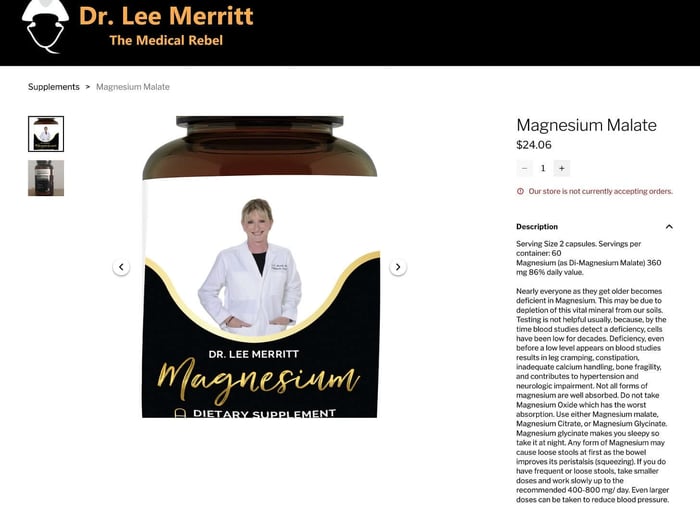
What I could never understand was why we needed it every single day. I believed the soil depletion story. I believed modern life had stripped minerals out of our food. I believed supplementation was necessary to replace what the earth could no longer provide. Epsom salts held a place of nostalgia for me. They felt old-fashioned and reliable, the kind of remedy my grandmother would trust for aches and pains. It felt safe because it felt familiar.
But something was not adding up. I never actually researched what magnesium is. I assumed since it was on the Periodic Table it was a natural occurring mineral that was essential to our health. Everyone I knew was taking magnesium in one form or another. Everyone needed it daily. Everyone had rebound symptoms when they stopped. The pattern looked less like nourishment and more like dependence. At some point it stopped behaving like a remedy and started behaving like a (p) harmaceutical.
The shill Berg is at it again, he will do ANYTHING for money. He clearly know less about the topic than a 3rd grader but has no problem with the fear based narratives lying to your face to sell his poison (https://www.tiktok.com/@drbergofficial/video/7443829326711196959

That was the moment the pattern matched the (p) harmaceutical model. A substance that provides temporary relief without correcting the cause. A cycle where symptoms return the moment the dose wears off. A progression where short-term relief eventually gives way to long-term consequences. The playbook remains the same. Keep people using a substance that never resolves the underlying problem. Keep the cycle going until the body begins to show secondary effects that can be labeled as new conditions. The profit margins and lies run deep on this one.
When I realized magnesium was not solving anything but simply masking symptoms, the entire story of deficiency and supplementation began to collapse. This exposed a different question. If magnesium is not fixing the problem, then what is the problem? And how did a reactive metal from the periodic table become a daily essential for nearly everyone?
That is where this investigation begins.
The Periodic Table and the Reality of Magnesium
The periodic table is the place to start because it strips away every wellness claim and every deficiency story. It shows magnesium for what it is before anyone polishes it up, spins a new narrative, packages it, promotes it, or sells it. If you missed my three-part series on the fallacy of the periodic table, I recommend starting there for more context.
Magnesium is listed as an element. Elements are described as base substances that cannot be broken down any further. You know, the building blocks of life. They need this narrative to make the Big Bang theory work, the Carbon Dating haox a framework and of course the absolutely asinine fairy tale of buying carbon credits to offset our carbon footprint. WTF????? And I have crowds on here who attack me for pointing out the facts. I’m not basing my research on corporate tied peer reviewed articles as you can see where that will get me. Just like Lee shilling 10,000iu of Vitamin D3 on her website. By the way keep the emails coming for the class action lawsuit we are building.
Alkaline Earth Metals
Magnesium sits in the group known as alkaline earth metals. These metals react quickly, corrode, burn intensely, and never exist in nature as free, loose elements. They bond instantly to whatever surrounds them. That alone tells you everything: magnesium is never found lying in soil, never found as a piece you can pick up, and never found in any form the supplement industry implies.
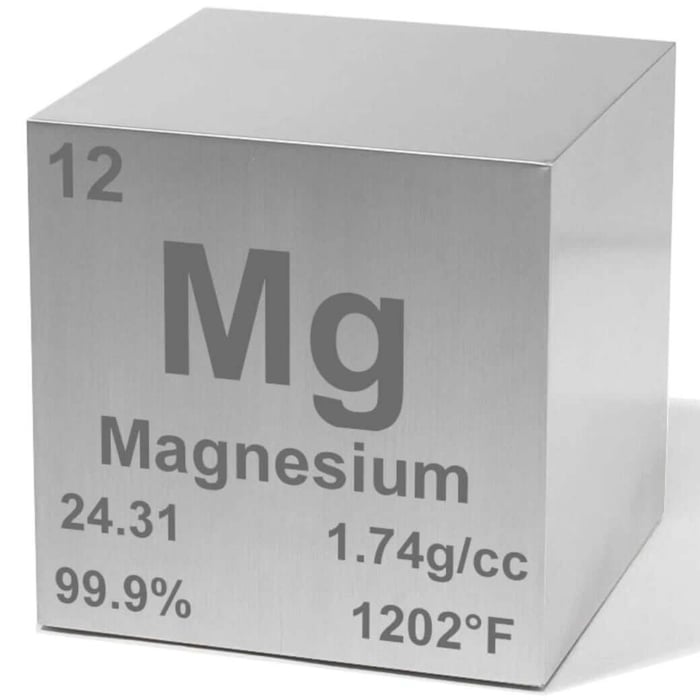
You cannot walk outside, find magnesium metal, scrape it loose, and bring it home. It would react before you could store it. Pure magnesium cannot sit on a shelf, cannot survive exposure to moisture or air, and cannot be consumed. Nature does not present magnesium as a safe, available material. It is always locked inside geological structures.
The best known are magnesite and dolomite—ordinary-looking rocks where magnesium is trapped in a rigid matrix. Extracting it requires extreme heat or chemical force. That means one simple thing: the “magnesium” used in supplements is not discovered in nature, it is manufactured. Companies alchemize rock to create something that does not exist in a free, consumable form.
Before magnesium could be swallowed, it had to be broken out of stone, separated, dissolved, heated, and transformed into brand-new compounds. This is where people get confused. They still think they’re talking about a mineral from soil. They’re not. They’re talking about a reactive metal that only becomes a “nutrient” after industrial processing.
A Reactive Metal Inside Stone
Elemental magnesium exists only in labs or factories. It is never found in food and never found in nature as a loose metal. What companies call magnesium is not something the human body ever encountered historically.
To produce supplement forms, manufacturers begin with metallic magnesium or magnesium-bearing rock and force it through reactions with acids or industrial chemicals. The result becomes magnesium oxide, citrate, glycinate, gluconate, malate, chloride—none of which exist naturally. Every one of these forms is a created compound.
This is nothing like the magnesium that has passed through a plant. When a plant absorbs magnesium, microbes and enzymes restructure it into living compounds such as chlorophyll. At that point it is no longer a metal, no longer reactive, and nothing like the powder people swallow.
Sharing a chemical symbol does not make two substances identical. Plant-transformed magnesium and industrial magnesium compounds simply share a name. Their realities are different.
Magnesium and Water: The Reaction That Changes Everything
Before going any further, there is one property of magnesium that changes the entire conversation.
When metallic magnesium meets water, it reacts instantly. It breaks apart, forms magnesium hydroxide, releases hydrogen gas, and gives off heat — sometimes a surprising amount. It destroys itself on contact.
This reaction is not subtle. It is the reason pure magnesium metal does not exist in nature. It cannot survive in moisture. It cannot sit in soil. It cannot sit in the air. It cannot sit inside the human body.
This is why you cannot ingest elemental magnesium. It will not stay in its original form. The moment it touches moisture or stomach acid, it converts into byproducts that were never part of the human diet.
This is also why all magnesium supplements must be manufactured. Companies have to force the metal into a different form — oxide, citrate, glycinate, malate — because the metal itself is too reactive to use directly.
Supplements are the opposite. They begin as a reactive metal that must be tamed through processing. The body cannot treat that the same way it treats magnesium that has moved through a living system. You have a problem drinking from an aluminum can but not guzzling your nightly magnesium metal?
Plants Are Not Converting Metallic Magnesium
Plants are not converting metallic magnesium. Metallic magnesium never reaches them. It cannot survive in soil long enough to interact with a root. The moment exposed magnesium meets moisture or oxygen, it destroys itself. Soil contains both. So the metal never exists there.
What plants actually encounter are geological minerals like dolomite and magnesite — solid rock structures. Roots are not dissolving metal. They etch the surface of rock slowly with weak organic acids, and most of the work is done by microbes and fungi breaking material down over time. By the time a plant absorbs anything, it is no longer a metal. It is a biological compound connected to the food matrix, created through life, not chemistry.
This is the part the supplement industry avoids. If plants cannot access metallic magnesium because it does not exist in soil, then humans cannot be deficient in a form of magnesium nature never provided because the soils cannot be depleted in something that never existed in the first place and a called necessary nutrient. What people swallow today has no biological precedent. It is not replacing anything the body was designed to need.
Alchemy and the Culture of Inversion
The first people who tried to break magnesium out of rock were alchemists. They heated stones, dissolved them in acids, burned them, crushed them, and forced reactions to see what appeared. Their work was based on the idea that raw materials must be transformed.
The alchemical worldview rests on one principle: the original form is not the final form. Matter must be altered. Substances must be broken apart. Natural states are the starting point. Everything must be pushed into a different version if forced through the right steps.
That worldview shows up anywhere the natural body or natural identity is treated as incomplete. If the original state is declared flawed, whoever claims the power to correct it becomes the authority. Just like that trans agenda.
Some belief systems adopt this position directly. They present the natural human state as insufficient and emphasize transformation through ritual, symbolism, or ideological restructuring. Inversion becomes the method. Up becomes down. Inner becomes outer. Original nature is wrong. Altered becomes right.
The inversion framework replaces an intact natural order with the idea that nature is defective until processed, corrected, or alchemized. The body becomes a project. Identity becomes material to reshape. Nature becomes something that needs intervention before it can be trusted.
This exposé is about what can be observed. Water is water. Air is air. Life exists without being built in a lab. The body cannot be replicated into true form. These belong to a category that cannot be engineered or manufactured. Their origins do not need explanation to be real. That unbroken category is what I call God — a word pointing toward the reality that some things exist beyond human creation.
When something cannot be created or destroyed, it does not need improvement. It does not need inversion. It does not need alchemy. It exists as it is. Anything that requires modification to be “corrected” replaces nature with interference.
The conflict is clear. One worldview recognizes what exists on its own. The other insists on changing it. Alchemy sits on one side. The living body on the other. If I take my arm off, burn it into ashes, add different acids and chemicals what does that tell you about the human body besides nothing? It tells you about ashes and chemical soup.
How Magnesium Forms Are Manufactured
Once magnesium was broken out of rock, the next problem appeared immediately. It could not be consumed in its elemental state. It was too reactive and too unstable. It had to be controlled. Every form of magnesium sold today exists because of that problem. None of them exist in nature.
The starting materials are magnesium oxide and magnesium carbonate. These powders are byproducts of extraction. They are industrial materials, not nutrients. Companies take these powders and bind them to acids. That binding step produces compounds that will not burn, corrode, or react as aggressively. Each acid creates a different version of magnesium. Each version becomes a product.
Gluconate is created by reacting magnesium with gluconic acid. Gluconic acid is produced by fermenting glucose with microbes. The cheap to make mixture is combined, heated, filtered, and dried. The result is magnesium gluconate.
Citrate is created by reacting magnesium with citric acid. Industrial citric acid is produced by growing black mold in vats. When bound to magnesium oxide, it forms magnesium citrate. Yummy.
Glycinate is made by binding magnesium to glycine, a synthetic amino acid made in factories. The effect people describe as calming comes from the glycine itself.
Malate is created by binding magnesium to malic acid. Malic acid is manufactured for food additives. It does not exist in nature attached to magnesium.
Chloride is created by reacting magnesium with hydrochloric acid or by processing brine. The liquid version is sold as magnesium oil. It is not oil. It is a chemical salt solution.
Oxide, the base form, is created by heating magnesium carbonate or hydroxide until it breaks down. It is the cheapest to make and the least biologically active, but it often becomes the base for the other forms.
Every form follows the same pattern. A reactive metal from stone is reduced to powder. It is combined with industrial acids. It is heated, dissolved, filtered, crystallized, or dried. The final compound is packaged and presented as a nutrient.
The more forms created, the more products sold. One metal becomes an entire category. Gluconate for sensitivity. Glycinate for calm. Citrate for digestion. Malate for energy. Chloride for the skin. Oxide for everything else. None of this variety comes from nature. It comes from manufacturing. Oh the tangled web they weave when they practice to deceive.
This is the turning point where chemistry became a market. The next part is how that market was expanded into a health narrative. The shift from industrial chemistry to wellness culture is what created the modern magnesium boom.
Industries grow when people are trained to match their symptoms to a product. Magnesium followed the same pattern as any pharmaceutical marketing. First identify the most common discomforts. Then attach them to a single explanation. Then present the product as the solution. Muscle tension. Cramps. Stress. Poor sleep. They are universal. That is the strategy. A market with no limits.

If you appreciate Medicine Girl's research, please consider hooking her up with a coffee or making a Ko-Fi donation.



Disclaimer
The information shared here reflects my personal research, study, and lived experience. Sources include historical archives, scientific literature, and public records wherever possible. It is intended for education and discussion, not as medical or legal advice.
I am a Registered Nurse, no longer practicing, and am not acting as a healthcare professional while writing for Substack. Every reader should use their own discernment and consult qualified professionals for personal decisions. My goal is to help people think critically, question openly, and restore their relationship with truth and nature.




![Magnesium Vs. Zinc The Battle Royale That Ends the Debate [By Medicine Girl]](https://dropinblog.net/cdn-cgi/image/fit=scale-down,format=auto,width=700/34264201/files/featured/94577ece-6b84-4d7c-b622-6e764231d715.png)

![Mag-Naus-Eum: The Metal You’ve Been Drinking [Part 2]](https://dropinblog.net/cdn-cgi/image/fit=scale-down,format=auto,width=700/34264201/files/featured/mg-mg-part-2.jpg)

![BLOOD PRESSURED TO DEATH: How to DESTROY Your Kidneys in 5 Easy Steps [Part 1 of 3]](https://dropinblog.net/cdn-cgi/image/fit=scale-down,format=auto,width=700/34264201/files/featured/bce83ada-f4c0-4cdb-a4e7-bf4eab08bb07-1280x720.webp)

![Bringing Up The Underworld: Vivisection and Organ Donation [Cannibals Part 4]](https://dropinblog.net/cdn-cgi/image/fit=scale-down,format=auto,width=700/34264201/files/featured/4aad8890-f8f1-4198-910c-e85a0171247c-1280x720.webp)