
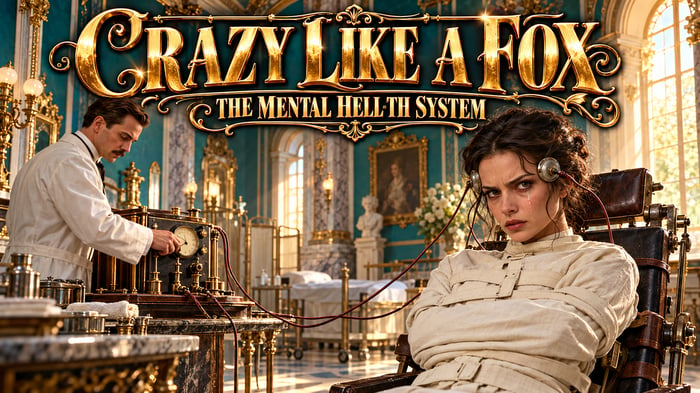

WE ARE NOT CRAZY THEY ARE (PART 5)
We’ve come too far to pretend the textbook version of history was ever real. Columbus was not a hero. He was a portly, alcoholic, murderous mercenary who did not discover anything. The idea that peaceful Native Americans lived in untouched wilderness with no evidence of past civilizations is just as false. The recent past, shaped by the Rockefellers, Carnegies, and others like them, was built on open-air slave markets and the trafficking of children, adults, and sex at an industrial scale.
Look at the facts. Small towns with populations of three thousand had post offices built for empires. Even more disturbing were the asylums, built larger than entire towns, looming at the outskirts. These buildings and the machinery behind them are missing from the official record.
Now it’s time to stare straight down the barrel of the shotgun, no matter how incongruent it is. Nothing, repeat, nothing about our past is in the history books. Sorry, history majors, but your degree is about as productive as E-Wrong Musk’s rocket ship on a one-way mission to the Bermuda Triangle. If we do not understand what was built and who profited, we are allowing our children to be trapped in the same mind cage we were taught to build for ourselves. If you want freedom, you have to be willing to see the entire system for what it is.
My journey into the mental health system began with a bird's-eye view of the in-your-face dismantling of the human psyche and warehousing adults like commodities, boxes of cereal and rice. Early on, I began to notice hauntingly similar eerie patterns across cases, especially among young, highly successful men. And by across cases, I mean I worked in Missouri, Washington, Nevada, and California. These were not the stereotypical poor, drug addicted, or chronically ill. They were men in their late twenties to early thirties. Engineers, big-tech workers, finance professionals, Boeing, MIlitary, CEOs, you name it, brought in after sudden, spectacular breaks from reality. Again and again, I heard the same story: “The CIA implanted a microchip in my brain.” Not the FBI, not aliens, not some vague, shadowy force. Always the CIA; always the same narrative, delivered with absolute conviction. They said it in the same identical way.
How could they all be saying the same thing? They didn’t know each other. They lived states away, with different cultures, different tap water, different parents, and different schools. They hadn’t watched a TV special or read the same book. These were not pop culture delusions. This is a script running underneath our society, one that no one would ever believe, and that’s precisely the point. When delusion is engineered, it must be implausible enough to ensure the victim’s isolation. Not to mention, they have openly tested how to do this, such as with Project Naomi.
We now know that mental illness is not “bad luck” or “bad genes.” The history of madness, human and animal, shows that the mind breaks in predictable, programmatically engineered ways. Put any sentient being in a 4 walled cage, deprive it of freedom, bombard it with fear and uncertainty, and it will fracture. We’ve seen it in hospital wards and laboratories: chimps and monkeys rocking obsessively in their pens, elephants swaying back and forth in chains (I witnessed this firsthand volunteering with elephants in India), dogs in puppy mills chasing their tail or biting themselves until raw an. The infamous “learned helplessness” experiments of the mid-20th century proved you could break even the most resilient animal with enough confusion and pain.
Those who sought to control entire populations used this as a tactic of war. Under Hitler, WWII German doctors and psychologists ran torture experiments to attempt to map the human mind. They used starvation, isolation, sleep deprivation, and chemical poisons to induce psychosis and compliance, to learn how to break and reprogram the psyche. Every military operation does this; organized school does this; medical school curriculum does this. These lessons led directly into Allied intelligence work after the war, forming the backbone of mind control programs like MK Ultra.
What I saw in the locked mental treatment centers, young men suddenly “insane,” hearing voices and insisting on government surveillance, was not random. It was the inevitable result of a system that has strategically used every learned lesson from animal captivity, Nazi experimentation, and Cold War psychological warfare. The mind is not a fortress; it is a living organism, and under enough pressure, it will break in ways as scientific as they are brutal. And keep in mind, you can measure the mind outside of the body, which is where the operations start their work.
To understand the actual roots of mental illness, we have to first look at the powers that be engineering and then hiding behind it, how trauma, captivity, chemicals, and engineered belief are the tools used to continue the game. This is about a broken system by design, perfected by those who profit from our demise.
2. The Roots of Madness in Nature
If you want proof that “madness” isn’t some ancestral curse or genetic misfire, look at the infamous Rat Park experiments. In the 1970s, researchers took groups of rats and set up two different worlds. The first was the classic nightmare: rats jammed together in cramped, ugly cages, nothing to do, nowhere to hide, no beauty or comfort, just endless monotony and stress. In these conditions, when offered a choice between plain water and water laced with cocaine or morphine, the rats did what any sane creature would do in a living hell: they drank themselves into oblivion, overdosing until they died a confused, drug-induced death.

Then came Rat Park, a rodent utopia. Spacious enclosures, toys, tunnels, food, mates, sunlight, and a little rat community. Same setup: two bottles, one with drugs, one with plain water. Here’s the evidence that shows you they know exactly what they are doing to us: the rats in paradise ignored the drugs. They barely touched the cocaine water. Given freedom, connection, and stimulation, addiction would all but disappear.

What does this have to do with human madness? Everything. When you pack any animal, rat, monkey, elephant, or human, into a cage, cut it off from beauty, purpose, and real connection, the mind will break; it just depends on the severity of the manifestation. It will reach for oblivion, aggression, or whatever escape is available. Think of pretty much everything inside the DSMIV, PTSD, Anxiety disorder, ADHD, Depression, bipolar disorder, all trace directly to the intentional mass-scale mind-breaking. When we restore agency, community, and meaning, the urge for self-destruction evaporates.
 Just a brief look at modern cities: overcrowded apartments, concrete deserts, 24/7 surveillance, the endless grind. Our own self-built “rat cages.” Anxiety, addiction, and psychosis are epidemic. The system is designed to produce exactly this result, and then blame it on your brain chemistry and faulty junk DNA.
Remember the infamous couple who sued an adoption agency after their adopted child developed schizophrenia, seemingly “out of nowhere.” The lawsuit argued that the agency failed to disclose the child’s “bad genetics,” as if madness simply appears out of nowhere, coded into mythical DNA (which is actually long enough to stretch from the Sun to Pluto and back roughly 17 times, about 74 trillion meters in total) like a curse. This story became a media spectacle, reinforcing the idea that mental illness is all about heredity and has nothing to do with what a child experiences, breathes, or attempts to survive.
Lessons from Animal Captivity
If you have had the misfortune to walk into any working government-sanctioned ranch, rodeo, zoo, laboratory, or roadside circus, you will see what happens when you strip an animal of everything natural. The desperate eyes of a chimpanzee locked in a wire cage tell you more about the origins of madness than any delusional for-profit psychiatric textbook. You will see the same behaviors: endless rocking, hair pulled out in clumps, senseless fights, flesh bitten and torn, moving in repetitive useless ways. These are the habits of the psychotically broken, the mind’s attempt to endure the unendurable.
Then the darkest, most deviant of behaviors: in the most deprived environments, mothers, stripped of space, stimulation, and purpose, will kill or abandon their own babies. Primates in sterile labs, cows in factory farms, even captive rodents, have been documented turning on their offspring in acts of confusion and desperation. This is what happens to a mind shattered by captivity, grief, and the total collapse of innate intelligence and the strongest of bonds. Humans are born into this and scream for the right to kill their own children.

I saw this firsthand in India: a young elephant, chained by her handlers, rocking back and forth for hours, her spirit slowly breaking as she realized there was no way out. The same pattern shows up in captive dolphins and orcas, left to float listlessly or slam themselves against tank walls, their instincts and intelligence wasted. In labs, rats kept in barren cages chew their own limbs or turn on each other when they have nothing but concrete and wire for company.
Madness is manufactured by an environment that destroys the essence and unknowable, along with everything we need to survive, much less thrive. Take away freedom, sever bonds of family and village, replace Nature, the sunlight and earth with sterile monotony, add the unpredictability of punishment, starvation and deprivation, and you will see the mind unravel. This is simply the logical, devastating result of captivity and trauma.
The parallels with human suffering are unavoidable. Orphanages, locked psychiatric wards, windowless apartments, and overcrowded cities, endless work schedules, connectionless friendships, living behind a facade, keeping up with the Joneses, the rat race, a life without purpose or meaning, all run on the same recipe: isolation, deprivation, endless tracking surveillance, and fear. When the mind breaks under these conditions, it is the inevitable outcome of a system designed to crush the spirit and erase even the idea of freedom.
The First Spark of Madness
Long before the psychotic white coats, manufactured diagnostic-delusion manuals, or even petroleum poison pills, ancient societies understood that illness, mind or body, did not come out of the aethers. It had a cause, a disruption in the natural order of things, like a physical or spiritual wound, a trauma to the soul or the tribe. In the oldest texts and recorded traditions, madness resulted from profound loss, violence, or disconnection.
The earliest records of insanity I could find: in Mesopotamia, clay tablets described “ghost sickness,” a state of madness brought on by unresolved grief, banishment, or the wrath of disturbed ancestors. The Greeks spoke of “melancholia” or “mania,” conditions that followed war, famine, or catastrophic change, not mysterious flaws your grandmother passed on. Hippocrates wrote that mental disturbances flowed from an imbalance of humors, an archaic way of simply describing imbalance and a break in nature's harmony.
Ancient texts and oral histories describe people wandering the streets in rags, muttering to themselves, tearing at their hair, or collapsing in public fits of weeping. In Babylonian tablets, the “possessed” were said to hear ghostly voices, sometimes shrieking back in terror or pleading with shadows no one else could see. Greek tragedies told of women struck by mania who would run wild through the hills, howling at the moon or falling to the ground in convulsions. In ancient China, families described loved ones who stopped speaking, sat catatonic for days, or raved through the night, keeping entire villages awake with their screams. Long before anyone invented the language of “mental illness,” the suffering was visceral, public, and raw—a living testament to the mind’s ability to break when the world around it collapses.
Across cultures, madness would surface after violent disruption: forced relocation, land destruction, or the breaking of familial bonds. In Algonquian traditions, “windigo psychosis” was linked to starvation, isolation, and the spiritual devastation wrought by the ongoing slave trade. (Don’t think you are exempt from what you have heard the slave trade is, by the way; if you are paying for your existence, you are a slave). In our recent “Native American” accounts, “ghost sickness” struck after epidemics wiped out villages, invaders massacred families, or ecosystems and land were bulldozed for slave farms, proof that mental illness follows destruction of the animals' natural environment. You can not stay sane if you live inside 4 walls, scroll on screens, watch the world through a windshield, and sit behind partitions.
Chinese medicine recognized mental disturbance as a spirit thrown out of balance, a person ripped from the pulse of family and land. Healing was about restoring connection and meaning. It’s so obvious I want to slap my forehead. But for people trapped in today’s mental prison, common sense has to be repeated until it eventually sinks in.
Even in the harshest times, communities sent shamans, healers, and family to guide the lost soul back, recognizing that madness was a message, not a life sentence to be drugged and chemically imprisoned. Yet, it wasn’t until they changed the system and convinced people to work for a piece of paper that the psychosis could be set in motion as an industry.
Mental instability exploded only when societies traded nature for monetary value, hierarchy, and control. As the powerful learned to manipulate minds for personal gain, they stopped trying to heal and started pathologizing, exiling, or locking up anyone who didn’t fit.
The Asylum Era
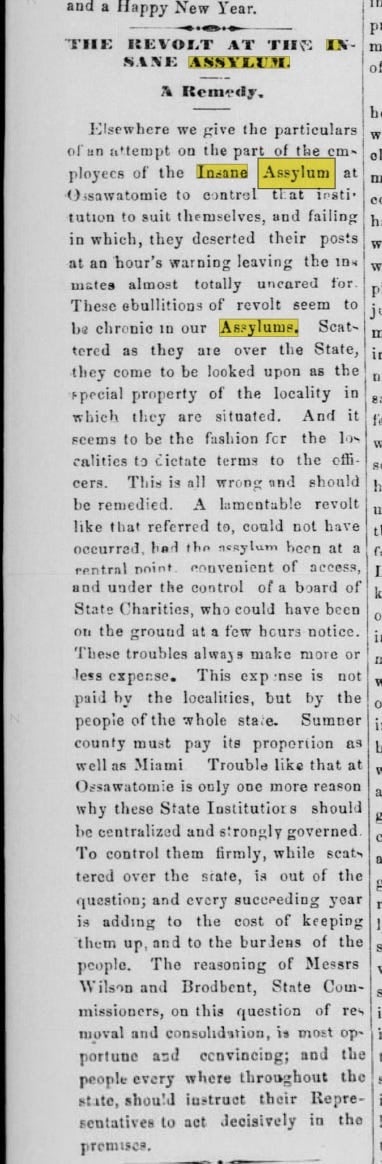
Before the cult of science gods started selling the myth of brain “chemical imbalances,” they needed somewhere to stash the inconvenient, the traumatized, and anyone who threatened the new world order after their costly great reset. Enter the massive asylums: huge, self-contained fortresses built on the outskirts of towns, larger than the cities themselves. These monstrous institutions didn’t just appear for show. They were designed to disappear tens of thousands of people, often the poor, the rebellious, the grieving, the unwanted, and those who simply didn’t fit the mold. They could not only take their wealth, homes, land, savings, and family heirlooms but erase any trace those families ever existed.
Who were these “patients”? Step back into the records, and you’ll find the truth: women committed for “hysteria” by refusing to give up family land, men locked away for unemployment or drunkenness, orphans labeled “incorrigible,” immigrants and minorities swept up for being in the wrong place. Sometimes, entire families were institutionalized for nothing more than poverty or a potential inheritance.
Getting someone declared legally insane was disturbingly easy, especially if they owned something worth taking. All it took was a jealous relative, a greedy neighbor, or an ambitious bureaucrat to claim you were “acting strangely.” A court-appointed psychiatrist, often with ties to the asylum, would rubber-stamp your commitment after a brief, one-sided hearing. No real defense or impartial review. In some states, one doctor’s signature was enough to erase your freedom and your fortune. Again, we see this today.
Committing both parents was the ultimate reset. The state quietly seized their assets or funneled them to connected insiders. The children, stripped of their names and history, became government property, trafficked through a conveyor belt of orphanages and “placement” programs. Mom and pop vanished into the asylum’s torture chambers, condemned to a fate worse than death.
This was population control and asset liquidation, no question about it. The “mental illness” industry became the perfect tool for siphoning off generational wealth, resetting families back to zero, and feeding new bodies into the machinery of experimentation, commodity, and self-sustaining industry.
We Have You on Record
And this isn’t conspiracy; it’s right there in the public record. Newspapers from the late 1800s and early 1900s are littered with stories of families broken by commitment proceedings, with county officials auctioning off their homes and possessions. Headlines like “County to Sell Estate of Insane Man” and “Children Made Wards of State After Parents Judge Insane” ran regularly in papers like the New York Times, Chicago Tribune, and countless small-town dailies.
In 1907, the Chicago Tribune reported on the Cook County Infirmary’s practice of seizing committed patients' property, then auctioning it to fund the institution’s operating budget (“Insane Patient’s Home Sold by County,” Chicago Tribune, February 13, 1907). Throughout the 1920s and 1930s, papers across the country documented “lunacy commissions” and probate courts transferring land, farms, and personal effects from the “insane” to state control or local elites.
You’ll find notices like “Estate of Mrs. Clara B. Smith, adjudged insane, to be sold at public auction…” in rural weeklies, and legal ads for “orphans’ court” hearings where children were made state wards and sent to overcrowded orphanages. For a chilling glimpse, search headlines from 1880–1940 with terms like “insane asylum,” “estate auction,” “lunacy hearing,” or “children wards of state.”
One especially telling example: The St. Louis Post-Dispatch, March 2, 1911, ran an article titled “Home of Insane Woman Sold; Children Sent to Orphanage,” describing how a mother’s commitment meant the county seized her house, while her children, labeled “destitute”, were shipped off to a state institution. The children would be trafficked, psyche’s fractured and lives destroyed.
In some notorious cases, the corruption ran even deeper. One asylum psychiatrist was exposed for running a brothel out of the institution itself, trafficking patients whose legal status made them perfect prey. This was standard practice, not the exception.
Inside the Asylums
Once inside, the real horror began. These were human warehouses, laboratories for social control. Patients were dosed with early barbiturates, chloral hydrate, bromides, and later on, a parade of “antipsychotics” and tranquilizers designed to sedate and erase. Experimentation was the norm: insulin shock therapy, ice baths, and the infamous lobotomy.
The movies got some of it right. One Flew Over the Cuckoo’s Nest wasn’t a parody; it was a documentary that revealed their methods and warned future dissidents. Electroshock, forced chemical restraints they call medication, perpetual sedation, and the ever-present threat of brain surgery kept the inmates docile, defenseless, and defeated, and mostly forgotten. The lucky ones were released as hollowed-out shells; the unlucky ones never left, buried under a number in some anonymous cemetery. And today, not much has changed. They still perform ECT, still use massive doses of chemical restraints, and surgical decimation.
What are Chemical Restraints?
The Pharmacy of Control
- Chloral hydrate (since the 1870s)—left patients groggy, disoriented, unable to resist.
- Bromides—prescribed by the bucketful, causing slurred speech, memory loss, and a zombie-like gait known as “bromism.”
- Barbiturates (like phenobarbital)—induced sleep or simply kept patients quiet. Overdose and addiction were routine.
- Paraldehyde—foul in taste and smell, but used extensively for sedation, often forced on patients.
- By the 1950s, the first antipsychotics like Thorazine ushered in the era of the “chemical straitjacket”—patients drooled, shuffled, and stared blankly, their personalities erased. still used today.
Newspapers like the New York Times and Chicago Tribune published stories and letters describing patients “motionless, their faces slack, eyes empty,” and families seeing loved ones “sedated to the point of catatonia.” I can attest to that working in the system in the late 90s and on.
Shock and Awe: Electroconvulsive Therapy and Beyond
 Electroconvulsive therapy (ECT), or “electroshock,” became standard in American asylums by the late 1930s. Touted as a miracle cure, it was really a tool for compliance and erasure.
Patients were strapped to gurneys, electrodes on temples, massive jolts of electricity convulsing their bodies, sometimes breaking bones or shattering teeth. Early ECT was performed without anesthesia or muscle relaxants. Nurses described “screams and thrashing” in the wards, and repeated shocks for anyone who resisted staff authority. Yet another reason to dislike and mistrust the entire profession of Nazi-style nurses.
Lobotomy: The “Miracle” Cure That Destroyed Lives
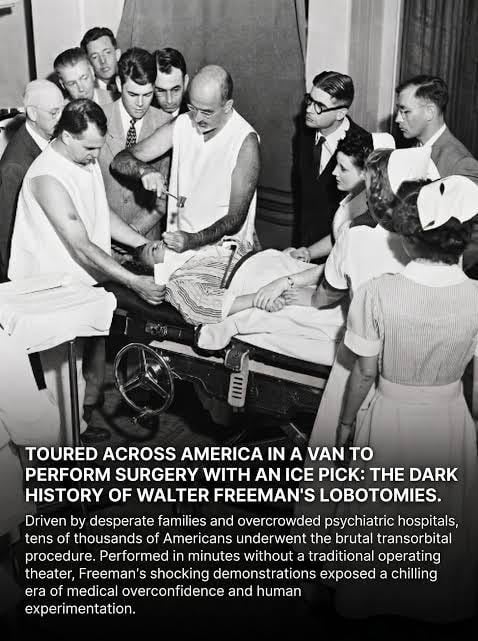
The lobotomy craze of the 1940s and 50s, led by Dr. Walter Freeman, was not just a medical fad—it was a mass silencing. Freeman toured the country in his “lobotomobile,” hammering ice picks through eye sockets before students and the press. Some patients died during surgery. Many were left incontinent, docile, or permanently vacant. The media called it a “success.” Pulitzer Prize-winning journalist William Allen White wrote, “We have made our madmen into ghosts, but they still walk among us.”
Other Experiments and “Treatments”
- Insulin shock therapy: Insulin shock therapy injected patients with large doses of insulin to induce repeated hypoglycemic comas, often causing seizures, brain damage, memory loss, and sometimes death. It was abandoned in the 1950s.
- Hydrotherapy: Ice baths, like insulin shock therapy, were a staple of asylum “treatment”. Patients were forcibly immersed and strapped into tubs of freezing water for hours at a time to calm agitation or subdue violent behavior, leaving people shivering, panicked, and sometimes in shock. It often caused trauma and long-term harm to the nervous system. Despite its brutal history, the image of the ice bath has been revived and rebranded in today’s wellness culture, with little acknowledgment of its roots in psychiatric torture. Those doing ice baths do not look like the picture of health.
- Sterilization and experimentation: forced sterilizations on thousands deemed “unfit,” lists published in newspapers.
- Straightjackets, seclusion rooms, beatings: daily routine. Physical punishment, sleep deprivation, forced feeding, and sexual abuse.
The Paper Trail of Horror
A quick search of period newspapers yields hundreds of articles, lawsuits, and government reports:
- New York Tribune, November 25, 1871:
“Scenes of Horror at the Bloomingdale Asylum—Patient Starved and Chained” - The Boston Globe, March 22, 1895:
“Insane Woman Dies in Straps: Shocking Brutality at Danvers State Hospital Exposed” - The San Francisco Call, February 6, 1904:
“State Asylum Attendant Arrested for Beating Patient to Death” - St. Paul Daily Globe, July 5, 1888:
“Tortured in the Madhouse: Testimony of Former Inmates Reveals Atrocities” - The Sun (New York), June 16, 1892:
“Chained to the Wall: Aged Man Found Naked and Starving in County Asylum” - Washington Times, October 13, 1902:
“Outrages in the Asylum—Nurses Admit to Drowning and Beating Patients” - Chicago Inter Ocean, March 6, 1908:
“Asylum Horrors Laid Bare: Women Drugged, Children Locked in Cages” - Boston Herald, February 14, 1915:
“Naked and Freezing: Patients Left to Die in Cold Baths at State Hospital” - Cleveland Plain Dealer, August 23, 1911:
“Forced Feeding Kills Girl: Asylum Nurse and Doctor Held in Death Inquiry” - New York Times, May 17, 1907:
“Insane Man’s Estate Stolen—County Officials Accused of Plundering Property” - New York Evening World, October 28, 1909:
“Children Sold from Asylums—State Investigation Reveals Orphan Trafficking” - St. Louis Post-Dispatch, January 13, 1913:
“Mental Patients Used for Medical Experiments: Doctors Defend Torture as ‘Progress’” - The Boston Daily Globe, July 19, 1922: “Beatings and Starvation at State Hospital.”
- Life Magazine, May 6, 1946: “Bedlam 1946”—photo essay of neglect and brutality.
- Chicago Tribune, October 23, 1933: “Mother’s Death Blamed on Insulin Shock.”
- New York Times, December 12, 1953: “State Probes Lobotomy Complications.
Why Was This Done? The Real Purpose
This wasn’t just cruelty or medical ignorance. The system of torture and experimentation in asylums served several cold, calculated purposes:
- Profit and Industry: Asylums were goldmines for pharmaceutical companies and device makers, who used the captive population to test new drugs and contraptions. “Successful” products—often nothing more than sedatives or restraints—were patented and pushed into hospitals, schools, and prisons across the country.
- Social Engineering and Population Control: The Tavistock Institute and its American allies treated asylums as real-world laboratories, perfecting trauma-based mind control and behavioral conditioning. Their findings were exported into propaganda, advertising, education, military training—and most insidiously, the entertainment industry.
- Hollywood and Music Industry Programming: Techniques pioneered behind asylum walls, from trauma-based mind control to dissociation and suggestibility, were adopted by Hollywood studios and the music industry. Scripts, symbols, and psychological triggers learned from institutional “treatment” found their way into films, TV, pop music, and celebrity programming. The same principles that broke patients’ minds were used to shape public opinion, manufacture stars, and keep the masses distracted and docile, always targeting promising young talents for direct manipulation and exploitation. Look at their before-and-after images.
- Blueprints for Mass Mind Control: Methods refined in asylums fed directly into CIA black projects like MK Ultra, where the goal was to erase memory, shatter identity, and manufacture docile, programmable populations.
- Political and Economic Cleansing: Asylums provided the perfect cover for erasing “undesirables,” seizing property, and wiping inconvenient families from the record. All of it justified under the noble-sounding banner of “mental health.”
And what did all this suffering teach the psychiatric establishment? Nothing about healing. Instead, it gave them the perfect cover story: madness was a “disease,” and the brain was a machine to be fixed, rewired, or shut off. With every failed cure and every broken patient, the myth of brain anatomy as destiny grew stronger, setting the stage for the next chapter of control.
If we remove the propaganda, the cult scientism, the programming, and examine what we have left: ancient ruins littered with forgotten lives, psych wards packed with the split and broken, animals driven mad in cages, and families ripped apart by force. We can see a thread of reality and truth. Insanity is a mind scar left by a physical or mental injury, event, mental cages of mind captivity, and psyche-splitting loss.
And if you think you’ve seen the worst of the deception, think again. The biggest lie is hiding in plain sight, buried in those anatomy diagrams you were forced to memorize in school. The real machinery of control is far more twisted than you’ve been led to believe.
References:
- Braslow, J. T. (1997). Mental Ills and Bodily Cures: Psychiatric Treatment in the First Half of the Twentieth Century. University of California Press.
- El-Hai, J. (2005). The Lobotomist: A Maverick Medical Genius and His Tragic Quest to Rid the World of Mental Illness. Wiley.
- Gollaher, D. L. (1995). Voice for the Mad: The Life of Dorothea Dix. The Free Press.
- Healy, D. (2002). The Creation of Psychopharmacology. Harvard University Press.
- Pressman, J. D. (1998). Last Resort: Psychosurgery and the Limits of Medicine. Cambridge University Press.
- Shorter, E. (1997). A History of Psychiatry: From the Era of the Asylum to the Age of Prozac. John Wiley & Sons.
- Szasz, T. S. (1970). The Manufacture of Madness: A Comparative Study of the Inquisition and the Mental Health Movement. Harper & Row.
- Valenstein, E. S. (1986). Great and Desperate Cures: The Rise and Decline of Psychosurgery and Other Radical Treatments for Mental Illness. Basic Books.
DISCLAIMER
The information presented in this article is provided for educational and informational purposes only, and is not intended as medical advice, diagnosis, or treatment. Although I am a former Registered Nurse and remain licensed in the field, I am not writing in the capacity of a healthcare provider. The content reflects my personal research, experience, and opinions. Nurses are not experts in healthcare; they simply follow MDs’ orders and do what they are told, and should never be relied on for health advice.
Readers should not interpret any statements in this article as a substitute for professional medical care or individualized healthcare advice. Do not disregard, delay, or avoid seeking medical advice from a qualified healthcare provider because of any information contained herein. Medical decisions should always be made in consultation with a licensed physician or appropriate healthcare professional familiar with your individual circumstances.
The author expressly disclaims any and all responsibility for any liability, loss, or risk incurred as a direct or indirect consequence of the use and application of any of the contents of this article. Reliance on any information provided in this article is solely at your own risk.
If you have, or suspect you have, a medical condition, please contact your qualified healthcare provider promptly. If you can find one. Good luck and Godspeed.