



To Dream the Impossible Dream
This is a new series on the mysteries of sleep. I started writing a simple article on Melatonin and thought a few paragraphs on sleep would suffice. What I have uncovered will shock even the most seasoned of conspiracy theorists. Before we get into the nitty-gritty, we need to understand what sleep is, what dreaming is, and how very little we know about either.
Leaving My Body
I’ve always had flying dreams.
Throughout my life, there have been moments when I feel myself falling backward in my bed. A heavy weight settles over my face, ears, and the back of my head, pulling me down. At the same time, there’s a sound, very loud and unmistakable, almost metallic, like the rising roar of an airplane engine.
It’s intense. I welcome the feeling, though, because I recognize what it means: something is about to happen.
When the sound begins, there’s also a kind of subdued elation. I’ve learned that if I get too excited, the transition stops. It requires control—holding awareness steady without interfering with it.
When I fall fully out of my body, I can fly. The experience is direct and controlled, not distant or imagined. My awareness is as clear as it is now while I’m writing this.
Because these moments come without warning and can’t be forced, I feel a flash of anxiety and gratitude each time—they’re rare, precious, and I’m always careful to savor them.
Amid these experiences, I realized there are rules that shape what can happen.
I always sleep with a window open because I can only leave through an open window or door. I don’t know how I learned this. I just know.
Most of the time, I move across landscapes—mountains, valleys, coastlines with the ocean stretching out below. Everything is dark. I haven’t gone outside my timezone, which raises its own questions, but that’s something for another time.
One experience changed how I understood the scale of this. That night, I began to go upward instead of across. At first, it felt the same, but as I continued rising, the sense of distance shifted. I accelerated toward the moon, getting close enough to begin making out the topography of its surface. Then something happened that I can’t fully explain. I felt the cold, not as touch, but as something like the sound of coldness. The way you can tell a propeller plane sounds different in freezing air than it does on a warm day.
I passed the moon and kept accelerating, moving into an endless stretch of empty space.
What was beyond that distance felt overwhelming. I stopped. At that moment, curiosity faded; instead, I realized I didn’t understand how far I could go, or whether I could return. The speed was beyond my control, and suddenly, the possibility of losing any connection to where I started became urgent. I might not be able to find my way back at all, ever.
That very moment opened a door to understanding just how wondrous and awe-inspiring it is to be human, to slow down and experience things moment to moment. Being attached to a body started to feel powerful in a way I hadn’t considered before.
Here, we can slow down and observe life at a pace we can count.z We can speak to each other. We can watch people change and age over time. We can take part in something that unfolds gradually. We can compare perspectives, question what we’re seeing, and try to understand where we are, why we are here, and what our true purpose is.
We can also step away from the constant need for more, from the constant drive to keep reaching for the next level, ever evolving into something “better” and instead fully immerse ourselves in what’s in front of us.
The Mystery of Sleep — What We Know, and What We Don’t
One of the clearest ways to understand the importance of a biological process is to observe what happens when it is suppressed.
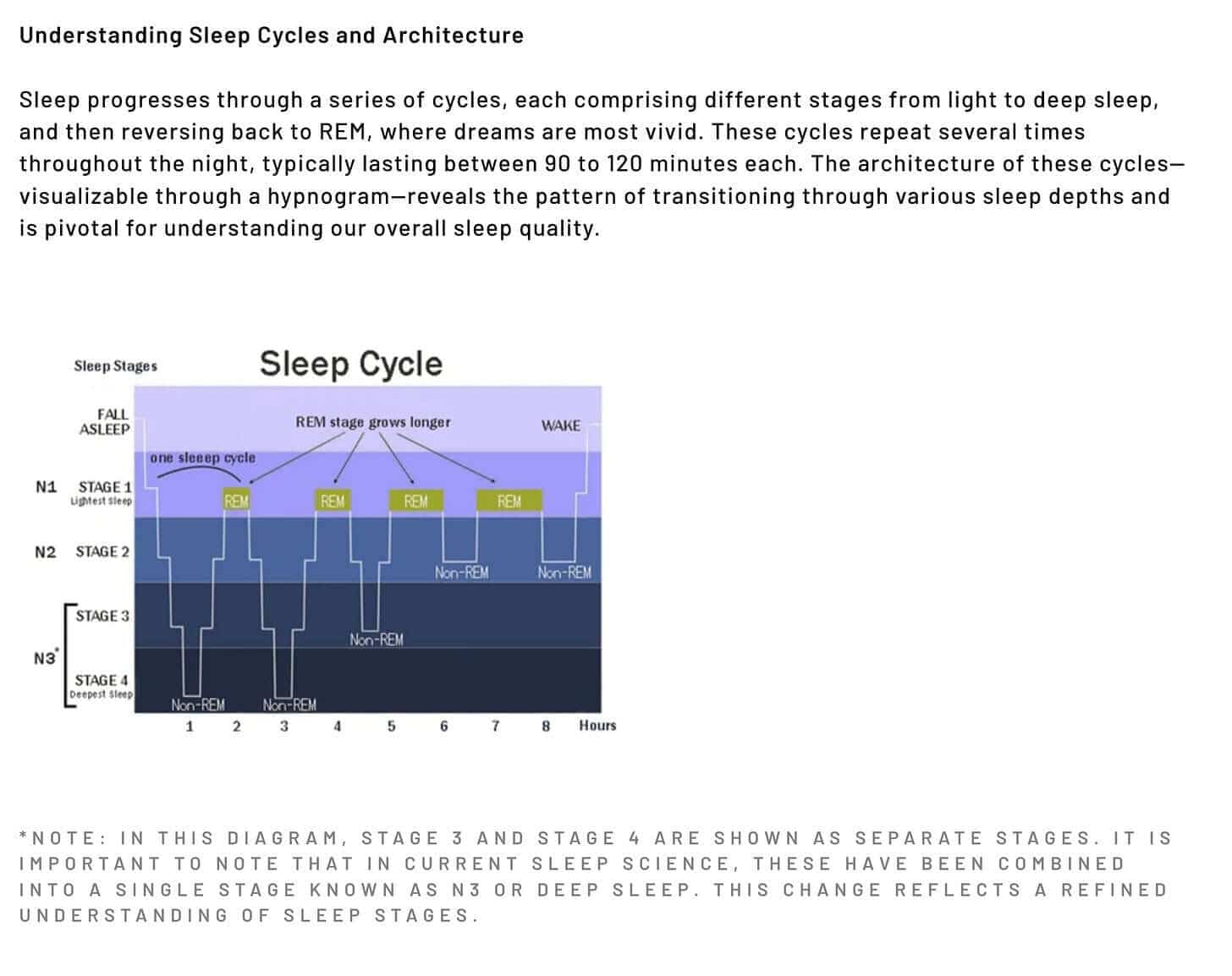
Sleep cycles provide a useful example of this. Over the course of a night, the brain moves through repeating stages, shifting between slower, deeper states and periods of heightened internal activity. Sleep is not a single state. It is a structured cycle the brain moves through repeatedly across the night.
Each cycle lasts roughly 90 minutes, and most people pass through four to six of them before waking. But these cycles are not uniform. They shift in composition as the night progresses. Sleep begins in non-REM stages.
The first stage 1 is brief. It is the transition out of waking, where awareness fades but has not fully disengaged. Sensory input is still partially processed, and it is easy to wake.
The second stage follows. This is where sleep stabilizes. Brain activity slows in a patterned way, marked by sleep spindles and K-complexes. External awareness drops further, and the body begins to settle into a more consistent state of rest. This stage makes up the largest proportion of total sleep.
Then the brain moves into deep sleep, often referred to as stage three. Activity shifts into slow-wave patterns. This is the most physically restorative phase. Arousal threshold is high, and waking from this stage produces disorientation. Growth hormone release, immune activity, and cellular repair are all associated with this period.
After this, the cycle reverses direction.
The brain transitions out of deep sleep and into REM. During REM sleep, the body is actively paralyzed, not just relaxed. This is controlled by the brainstem, particularly the pons, which suppresses motor signals before they reach the muscles. Inhibitory neurotransmitters like glycine and GABA are released into the spinal cord, effectively blocking movement. The brain remains highly active, but the body cannot respond. This prevents people from physically acting out their dreams, while allowing the internal experience to continue uninterrupted.
During REM, neural activity rises sharply. The cortex becomes highly active, particularly in regions involved in vision, emotion, and internal simulation. At the same time, the body enters a state of muscle atonia—movement is actively inhibited.
This is where vivid dreaming most commonly occurs. Then the cycle ends and begins again. But the proportions change. Early in the night, deep sleep dominates. REM periods are short, sometimes only a few minutes. As the night progresses, deep sleep decreases and REM expands. By the final cycles, REM can last 30 to 60 minutes at a time.
REM sleep is not a passive state. Brain activity rises to levels approaching those seen during waking, while the body remains largely still. It is a phase that appears to be organized, repeatable, tightly regulated, and necessary.
For those who consume alcohol, even one drink over several days to weeks, REM sleep is consistently reduced. The person may still sleep, but the internal structure of that sleep is significantly altered. When alcohol is removed, the brain responds in a predictable way.
It compensates until it regains all of its missing cycles.
This process is known as REM rebound.
After periods of REM suppression end, the brain increases the frequency and intensity of REM sleep. The time required to enter it shortens, and a greater proportion of the night is spent in that phase. Under normal conditions, REM accounts for roughly 20 to 25 percent of total sleep. During rebound, that proportion can increase significantly, sometimes more than doubling.
The experience changes with it. Dreams become more vivid, more persistent, and more difficult to ignore. In some cases, they become disorienting. Sleep itself can feel less stable, even as the brain spends more time in this state.
What matters is not the discomfort, but the pattern.
The mind tracks the loss of REM sleep and responds by prioritizing its recovery, sometimes over multiple nights, until its internal balance is restored.
Entering REM sleep is not a trivial metabolic process. It involves coordinated changes in neural activity, shifts in neurotransmitter balance, and a level of organization that is a cost to the body, yet is so important that as soon as the drugs are removed, the REM rebound begins. The body is working furiously to make up for lost time. Why?
We can describe what happens during REM. We can measure it, map its timing, and observe which regions of the brain are active. During this phase, areas associated with memory, perception, and emotion become engaged, and the brain generates internally coherent experiences that, while they are occurring, often feel indistinguishable from waking reality. Again, why?
There is also evidence that the brain learns during sleep. In controlled experiments, animals trained to navigate a maze produced specific neural firing patterns as they moved through it. During sleep, those same patterns reappeared in compressed form as the brain replayed the experience at an accelerated rate.
The brain appears to review experience while the body is inactive. Why does this occur during sleep, and why is it tied so closely to dreaming?
Sleep is not just about resting the body. It is structured, active, and regulated with a level of precision that suggests it is fundamental to brain function. The consequences of disrupting it make that clear. Sleep deprivation produces cognitive instability, impaired judgment, emotional dysregulation, and, in extended cases, psychosis and hallucinations. The brain begins to lose coherence.
Which returns us to the central problem.
We know sleep is necessary. We know it follows a structured pattern-we are tired and need to rest, but so does the brain. How it rests and restores is the crux of this sseries. We know the brain remains active throughout it, and that certain phases, particularly REM, are preserved with unusual priority. But these are just the mechanics.
What we do not fully understand is why the brain requires this specific state to perform functions it cannot perform while awake, or why those functions are tied to experiences that, in the moment, feel indistinguishable from reality.
At a minimum, sleep represents a shift in how the brain operates.
At maximum, it may represent a shift in what the brain is doing and, more importantly, why.
And if REM sleep is essential, and dreaming is its most visible feature, then the question is no longer just what sleep does.
The question becomes what dreaming is, and whether it is as contained within the brain or even the mind as we have been led to believe. As we learn about sleep and dreaming, keep in the back of your head that our entire society is built around suppressing sleep and the dream state, which I will go into in Part 2.
This can’t be explained.
If dreaming were entirely contained within the brain, as we fully understood, then explaining it would be straightforward. We would be able to map the systems involved, describe their function, and connect that activity directly to the experience itself.
But we can’t. Not even close.
We can measure when dreaming occurs and identify which regions of the brain become active during it. During REM sleep, activity increases in areas associated with vision, spatial awareness, and emotion, while regions involved in executive control and critical evaluation are reduced. The body is largely immobilized, yet the system remains active and organized internally.
That gives us a structural description of the state.
What it does not provide is an explanation of why we have the experience.
What comes next is even harder to compartmentalize and understand.
One night a few years ago, I was having a nightmare. It was intense and disturbing, but I wasn’t aware that it was a dream. There was no distance from it, no lucidity, no sense that I could wake myself up. I was fully inside it. Trapped in the moment that you don’t realize how awful it is until you are away from it.
At some point, something really strange happened.
I began to wake up, but not abruptly. I noticed a sensation first, a light scratching along my ribcage. It was familiar. It was something I used to do as a child, a kind of self-soothing habit. The movement was controlled and deliberate, not enough to startle me, just enough to pull me out of the state gradually.
This is mental gymnastics if you can see all of the players in the game and everything that’s entailed to bring this moment about.
First, there was the part of me that was inside the dream, fully immersed and unaware. There was whatever process was generating the dream environment. And then there was something else—separate enough to recognize that what was happening was distressing, to identify it as something that needed to stop, and to initiate a physical response to wake the body. Who was watching this, aware and responsive to what was happening in the dream state, and making decisions on how to remedy it?
That response required movement, even though the body was in a state of inhibition. I became aware of the sensation as it was happening. The movement came first, then the awareness of it, and only after that did the dream begin to dissolve. Another part of me woke up a different part of me.
It wasn’t abrupt. It was controlled.
I’ve gone back to that moment a number of times, as it suggests that the state is not as unified. There appear to be layers operating simultaneously, with varying levels of awareness and control. Meaning, the part of me having the nightmare. What part of the brain was creating the nightmare that another part OPPOSED and changed the course. The unconscious gave rise to the conscious while being unconscious.
What We Can Observe
The brain is generating an environment that includes space, movement, sound, and a consistent point of view. For the duration of that state, the experience is not perceived as internal. It is simply what is happening.
The distinction between waking and dreaming, from that perspective, is not based on whether the experience feels real, but on what constrains it. In waking life, perception is tied to external input. In dreaming, that constraint is removed, but the process of constructing experience appears to remain the same.
Across cultures, this question has been approached in a way that is hard to ignore.
Some Aboriginal Australian traditions don’t treat dreaming as something that happens inside the mind during sleep. What is often translated as the “Dreaming” is described more as a continuous layer of reality, something that exists whether you are awake or not. It’s not a memory of the past or a symbolic state but an ongoing dialogue with all that is.
In that framework, the dream is not a private experience. It’s not something you make, but more than it is something you enter. The distinction between waking and dreaming isn’t sharp because both are understood as coming from the same underlying structure. We are creating our reality as we engage with it, as much as our dream state is creating our conjured reality. Yet, when we look more closely at both, we are creating each perspective of our observable reality.
That idea shows up elsewhere in different forms. In certain Tibetan practices, the goal is to remain aware inside the dream and eventually across all states, including deep sleep. Not to control it, but to recognize that the difference between waking and dreaming is not as solid as it appears.
Taken at face value, both of these perspectives make a similar move. They don’t treat the dream as secondary or less real. They treat it as continuous with reality, just less constrained. This will become more important in the next articles as we examine more closely the nature of our reality and why someone’s control of it matters.
The assumption that dreaming is something separate, contained, and internally generated is not nearly as stable as it seems.
There are also points where the transition between these states is not clean. Under certain conditions, the body begins to enter sleep while awareness remains. Sensation changes before perception fully disconnects. Reports of pressure, vibration, sound, and movement without physical motion are common in this window.
These experiences are consistent across individuals, even when interpretations differ, and they occur in a narrow overlap in which systems that are usually separated begin to operate simultaneously. And what makes them any less real than what we are observing in our waking states?
The body enters a more inhibited state as the brain begins to generate internal experience. Awareness does not fully disengage. That combination produces a state that does not fit entirely into either waking or dreaming.
Experiences like the one I described earlier follow this pattern. At the same time, there is evidence that the brain uses this period for specific functions. Patterns of neural activity associated with waking experience reappear during sleep, often in compressed form, suggesting that information is being reorganized rather than simply stored. Emotional systems also remain active, indicating that the process involves both adjustment and retention. What then distinguishes that reality from this one as each is real in the moment you experience them. Which brings us back to the original conundrum. Why is it vitally important to go into each and every natural REM cycle?
Taken together, these points to a system that is structured, repeatable, and essential to the whole.
When We Lose Our Dreams
The clearest indication of that comes from what happens when it is disrupted.
When REM sleep is suppressed, whether through alcohol, medication, or other factors, the brain does not simply continue without it. It compensates. Once the suppression is removed, REM returns more quickly, lasts longer, and becomes more intense. The content of dreams becomes more vivid and more persistent during this period. The brain makes up for every lost REM cycle.
This response is consistent and measurable. The brain tracks the loss and adjusts its behavior until that loss is recovered for as long as it is able. This would be like when you wake up from a coma, the body would force you to go through every missed muscle movement, while remaining motionless. But it doesn’t mean it doesn’t matter. But REM does. And more than we realize.
That suggests that dreaming is not incidental to sleep but rather part of a process the brain maintains with the highest priority.
We can observe that dreaming is associated with memory consolidation and emotional processing, and that those functions are impaired when sleep is disrupted. What is less clear is why those processes are tied to a state that involves immersive, internally generated experience, rather than occurring in a more direct or abstract form.
The experience itself is stable and reproducible across individuals. The explanation for why it takes this specific form is still incomplete. Which brings the focus back to the original question.
If dreaming is structured, necessary, and actively restored when disrupted, then it is worth considering what happens when that process is repeatedly disrupted.
Finally
At some point, this stops being theoretical. Because the brain does not treat dreaming as optional. It tracks it, restores it, and returns to it with precision when it’s lost. That alone tells you this is not background activity. It’s part of how the system maintains itself. But the form it takes is still unresolved. It builds full environments, complete with perspective, movement, sound, emotion, experiences that, while they are happening, are indistinguishable from another reality.
Because if the brain depends on a state we don’t fully understand, and that state can be altered consistently without being noticed, then the effect is not limited to sleep. It changes the conditions under which experience is organized. Not all at once. Gradually. Until whatever has shifted no longer feels like a shift at all.
It just feels normal. And look around you. Does this seem like it should feel normal?
The idea that whoever controls the media controls the people. But information comes after the mind has already processed what it’s seeing. If you can alter the state in which that processing happens, you don’t need to control what people think. You shape how thinking forms. The manipulated ideas are come from within and are accepted as self.
Part 2 is not about theory.
It’s about what is actually suppressing sleep, how widespread it is, and what happens when that altered state becomes the baseline most people live in.
He who controls the nations dream state controls the very nature of reality itself.
References
Carskadon, M. A., & Dement, W. C. (2011). Normal human sleep: An overview. In M. H. Kryger, T. Roth, & W. C. Dement (Eds.), Principles and practice of sleep medicine (5th ed., pp. 16–26). Elsevier Saunders.
Diekelmann, S., & Born, J. (2010). The memory function of sleep. Nature Reviews Neuroscience, 11(2), 114–126.
Hobson, J. A., Pace-Schott, E. F., & Stickgold, R. (2000). Dreaming and the brain: Toward a cognitive neuroscience of conscious states. Behavioral and Brain Sciences, 23(6), 793–842.
Maquet, P. (2001). The role of sleep in learning and memory. Science, 294(5544), 1048–1052.
Nir, Y., & Tononi, G. (2010). Dreaming and the brain: From phenomenology to neurophysiology. Trends in Cognitive Sciences, 14(2), 88–100.
Rasch, B., & Born, J. (2013). About sleep’s role in memory. Physiological Reviews, 93(2), 681–766.
Revonsuo, A. (2000). The reinterpretation of dreams: An evolutionary hypothesis of the function of dreaming. Behavioral and Brain Sciences, 23(6), 877–901.
Stickgold, R. (2005). Sleep-dependent memory consolidation. Nature, 437(7063), 1272–1278.
Walker, M. P. (2017). Why we sleep: Unlocking the power of sleep and dreams. Scribner.
Walker, M. P., & van der Helm, E. (2009). Overnight therapy? The role of sleep in emotional brain processing. Psychological Bulletin, 135(5), 731–748