



The Sleep of the Damned (Part 2)

You lie awake at night, ruminating on what you need to do the next day, what you said yesterday that was cringey, and how your coworker could be so arrogant and dismissive. Then your mind jumps, what is your daughter going to do after high school? She can’t even decide what to wear in the morning. And you really need to start exercising regularly, even your extra large fat pants are screaming at the seams.
You stare at the clock: 2:30 a.m. Your heart is racing from the two beers before dinner, and now you can’t sleep. The alcohol has cycled through your liver again, glucose floods your system, and you’re as awake as you would be at noon. You can’t shut your brain off until the glucose clears, around 4:00 a.m.—just in time to finally fall into a deep sleep before being jarred awake by your alarm.
At this point, there’s no option; you need coffee to compensate for the disrupted sleep. You slam your first cup from the pod machine and head out the door. Traffic is brutal, and by the time you drag yourself in and slump at your desk, you need another coffee run that the administrative assistant is offering. You get a grande macchiato with an extra shot.
The sugar and caffeine hit your nervous system like the perfect answer to your toxic lifestyle loop. You feel great until about 2:00 p.m., when you crash again. A Diet Coke from the vending machine and a pack of trail mix get you back on track until you leave at 6:00 p.m. and hit traffic again. No time for the gym, so a couple of beers before dinner substitutes for actual relaxation and recovery. You’ll get healthy tomorrow. —The Tale, as told, simultaneously, by 80% of Americans.
And people wonder why ONE-THIRD (WTH?) of Americans over 85 have significant dementia and Alzheimer’s. A fate worse than death. Just like 1/3 of children now have autism—or sorry, the new word, neurodivergent. My son’s stepmom calls it his superpower. She says that all the way from her condo in Canada, fortunately for her. But it is not just the vaccines that are destroying almost half of our country’s fellow humans. And no Shannon, it is not a superpower. Brain damage is almost always permanent. I haven’t seen many recover from either. It can improve slightly, but parents of healthy kids don’t have to wonder what will happen to their child if they are not alive to take care of EVERYTHING. It weighs heavy on the soul.
Which is why we need to break the loop from these corporate psychopaths and stop blaming one another. We need to look at the root cause, where my research shows up. I am not owned, sponsored, or affiliate-linked to anyone or anything. Never will be.
When you look at the source, my research simply identifies the root causes, without having to examine the corporate-funded research studies that bamboozle people like Amanda Vollmer or Lee Merritt into thinking pharmaceutically produced, lab-made cholecalciferol, also known as rat poison, is beneficial because the paper said so. In this article, we are going to examine the root causes of a significant number of cognitive disorders—focusing on what actually drives cognitive decline, not the corporate-funded papers that send people on a wild goose chase for a magic elixir. And when I speak of cognitive decline, I am speaking of memory loss and confusion. When a person loses their memory, they have suffered a fate worse than death.
What is worse than being dead?
Yes, there is a fate worse than death. Living the rest of your life without your memory. There’s not much difference between that and being one of the living dead. If you’ve had a loved one with dementia, then you know exactly what I mean. They’re still alive—eating, sleeping—but the spirit is gone, the light is out. Sometimes they even turn combative or violent, like salt in an already open wound. They don’t remember their life, don’t know how old they are, and don’t know who you are. Walking into a memory care ward feels like stepping into some Alice in Wonderland, twisted daycare for old people, people sitting there blank, confused, waiting to eat, waiting for their diaper to be changed, with no idea who they used to be. When family shows up, if they do, it’s often a disaster. They don’t recognize their own spouse, don’t care if you stay or leave, and don’t even know what they’ve lost. The wisdom passed on through the generations is completely and utterly lost.
And the worst part? This can go on for a decade or more. If families can’t handle it, and most can’t, they end up in a facility that can cost $5,000, $6,000, or even $10,000 a month once you add in the basics. Do that math over ten years, and you’re staring down nearly a million dollars. Almost nobody has that sitting around. So your choices are brutal: stick them in some underfunded place where three TVs are blaring in one room, and you’re lucky if they get changed that day, or keep them at home and let it slowly destroy your life. We’re told we’re supposed to take care of our elders, but nobody tells you they’ll be up all night, wandering out the door, screaming obscenities at you, hitting you, scratching you, needing 24/7 care like a newborn that never grows up. No human can keep up with that forever. It wrecks marriages, drains families, and leaves you stuck in a place where you feel guilty either way, guilty for putting them in a home, and guilty for what it costs you to keep them out. That’s one small piece of one of the greatest tragedies of this life.
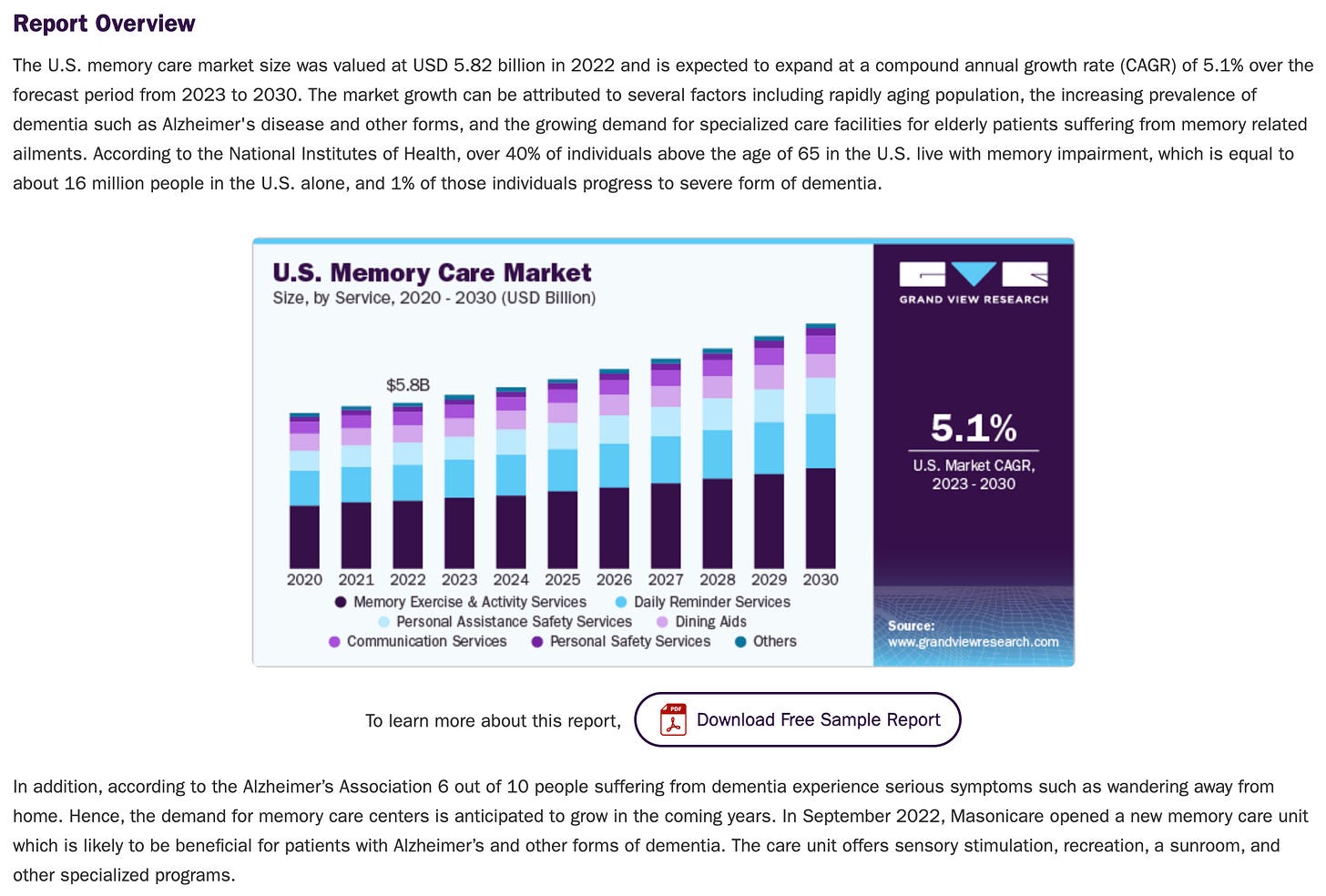
As we know, once an industry exists, it never goes away. It only gets bigger, and its appetite becomes more and more voracious. The hungry ghost of corporations. When I worked as an RN, I regularly visited these facilities. They are corporate-run, and they run exactly how you’d expect a corporation to run, with minimal effort for maximal profit. And your grandma suffers from the setup. Look at the expected trillion-dollar memory care market. If you’re heavily invested and need to keep that projected revenue climbing, you need one thing: more customers. If granddad is going to live to 101, healthy as a horse, walking three miles a day, and living his best life, the industry gets nothing.
So you need a setup for memory care issues. Again, statistically, one-third of the population globally over the age of 85 has Alzheimer’s or dementia; for this purpose, the same difference. But how do you get a planet filled with dementia-riddled seniors? That’s where sleeping and dreaming come in, or more to the point, the lack of it.
Sleep Disturbance Diseases
What actually counts as a disruption in sleep isn’t complicated, and you don’t need a lab or a wearable (ironically, sleep-disrupting) to tell you. If you’re falling asleep during the day, while sitting, in meetings, in a car (not even driving, just sitting), that is not “normal fatigue,” that is sleep deprivation. Nodding off during meetings or video meetings, struggling to keep your eyes open in the middle of the day, or feeling too drowsy to drive safely are all hard red flags. These are not subtle signals; they are your brain hitting its limit. Add in poor concentration, irritability, memory lapses, and repeated mistakes, and you’re no longer dealing with inconvenience—you’re dealing with functional impairment that shows up in your job, your decisions, and your relationships.
You can quantify it simply: if your daytime alertness is compromised, your sleep is insufficient or disrupted. Period. This is observable and repeatable—you can see it in yourself and everyone around you. When the brain starts forcing shutdowns during the day, it’s because it didn’t get what it needed at night. That’s when accidents go up, reaction time slows, and judgment drops. Being sleep-deprived has been shown to impair performance to a level comparable to alcohol intoxication; people just don’t treat it with the same seriousness.
And the more extreme the deprivation, the more obvious the breakdown becomes. In controlled settings, people kept awake for extended periods, or after several days, reaction time becomes erratic, attention collapses, and people start making irrational decisions. In the well-known case of the wake-a-thon, awake for 11 days, the 17-year-old developed paranoia, hallucinations, and severe cognitive dysfunction, because the brain cannot sustain wakefulness indefinitely without dire consequences.
What people brush off as “just being tired” is the early stage of the same breakdown that appears in controlled sleep-deprivation experiments. In the 1959 case of radio DJ Peter Tripp, who stayed awake for over 200 hours, the effects were immediate and severe. He lost the ability to perform simple math, couldn’t recite the alphabet, and eventually developed paranoia and hallucinations, believing his shoes were filled with spiders and that someone was coming for him. Although he later slept and appeared to recover, some reports suggest his personality changed permanently. That kind of breakdown doesn’t come out of nowhere. It starts with the same attention loss, irritability, and poor judgment that people brush off every day.
Similarly, in Michel Siffre’s isolation experiments, removing normal sleep cues caused his internal clock to drift dramatically. His perception of time broke down so badly that he believed weeks had passed when months actually had. In later studies, his sleep cycles became completely disorganized, with “days” ranging from 18 to over 50 hours. This is the same system that, on a smaller scale, shows up as daytime drowsiness, missed focus, and emotional instability. Both of these experiments show that when the brain is prevented from entering normal sleep stages, it doesn’t just get tired; it loses structure, stability, and the ability to regulate itself, which is exactly where the progression toward long-term permanent cognitive decline, along with the billion-dollar industry, begins.
Taking a closer look at what minor sleep disturbances can cause, we need to understand that what the medical industrial complex tells us about the root causes of diseases is usually anything but. What gets labeled as separate conditions, anxiety, depression, metabolic dysfunction, and cognitive decline, often share a common starting point that gets ignored because it’s too simple and too widespread to monetize. Sleep disruption doesn’t stay contained. It spreads through every system, quietly at first, showing up as small lapses people dismiss, until those same patterns stack into something that suddenly gets a diagnosis. If you actually follow the progression instead of the labels, the connection becomes obvious.
Concentration, Performance, and Daily Function
Sleep deprivation first shows up in areas where people can’t hide it, such as focus, performance, and basic decision-making. Concentration drops, reaction time slows, and mistakes start stacking up. At work, that turns into missed details, poor judgment, and preventable errors. On the road, it means delayed reactions and increased accidents. At home, it bleeds into relationships—short tempers, poor communication, and conflict over things that normally wouldn’t matter. Chronic sleeplessness doesn’t just make you tired—it makes you unreliable, and over time, that instability starts to affect every area of life.
Anxiety and Depression
As sleep disruption continues, the emotional toll becomes harder to ignore. The brain loses its ability to regulate stress, and baseline anxiety rises. Small problems feel bigger, and resilience drops. Over time, this can progress into persistent anxiety and depression, driven by dysregulated neurotransmitters and chronic stress signaling. Sleep is when emotional processing and reset are supposed to occur—without it, the system stays in a heightened, reactive state. People don’t just feel tired—they feel overwhelmed, irritable, and mentally stuck.
Metabolic Disorders
Sleep loss also drives measurable physiological dysfunction, particularly in metabolic regulation. Insulin sensitivity decreases, glucose control worsens, and appetite hormones become dysregulated. This leads to increased cravings, weight gain, and a higher risk of developing conditions like type 2 diabetes. Cortisol remains elevated, pushing the body into a chronic stress state that further disrupts metabolism. Over time, poor sleep becomes a direct contributor to systemic metabolic disease—not just a side effect.
Cognitive Decline and Long-Term Damage (Dementia)
When sleep disruption becomes chronic, the damage becomes less subtle. This is not just fatigue or a few bad days. This is degeneration. The brain loses its ability to maintain itself. Memory formation breaks down, recall becomes unreliable, and decision-making degrades in ways people don’t recognize until it’s already advanced. This is the point at which you cross from functioning to decline. Without deep sleep, the brain no longer clears waste, repairs, or stabilizes the systems that keep cognition intact. The damage doesn’t just accumulate. It becomes structural.
Dementia doesn’t come out of nowhere. It builds under the surface for years, long before anyone puts a label on it. Chronic sleep disruption accelerates that process. Toxic proteins accumulate, connectivity in regions responsible for memory and reasoning weakens, and control over thought and behavior begins to erode. What people casually call “aging” is often this exact process playing out in slow motion.
The Nun Study makes one thing clear. Damage alone doesn’t always dictate symptoms. Autopsies showed that some nuns had brains full of Alzheimer’s plaques and tangles and never showed signs of dementia, while others declined. The difference was resilience. Cognitive reserve, lifelong mental engagement, and stronger baseline function delayed the onset of damage.
But delay is not protection. The brain can compensate for a time, but it cannot outrun sustained damage forever. When that reserve runs out, the symptoms appear. So you’re left with a simple reality. The damage can build silently for years, and lifestyle factors can delay its expression, but if the underlying drivers, including chronic sleep disruption, are not corrected, the outcome remains the same. It just shows up later.
It’s Not Too Late
At some point, this stops being something you can ignore or rationalize away. This is not about comfort, convenience, or even just feeling better tomorrow. This is about whether you keep your mind intact or slowly lose it piece by piece. Nobody plans to end up in a memory care ward. Nobody thinks they’ll be the one who forgets their own family, their own life. But that’s exactly how this plays out, quietly, predictably, and completely avoidable until it’s not. The system doesn’t fail all at once. It degrades, adapts, compensates, and then collapses. And when it collapses, it can be past the point of no return. And I don’t wish that fate on anyone.
And the reality is, most of what is driving this isn’t random or inevitable. It’s built into the environment people live in every day. The habits, the exposures, the “normal” routines that people defend are the same ones breaking the very system that keeps their brains functional. You don’t lose your cognition overnight. You trade it away slowly, one disrupted night at a time, one more glass of wine, one double-tall latte, until there’s nothing left to negotiate with.
In the next article, we’re going to expose the sleep interrupters driving this entire cycle, the ones people use every single day without a second thought. Not fringe. Not rare. Normal. Some are hiding in plain sight. Some are sold to you as “solutions.” And some are so disruptive that once you understand what they’re actually doing to your brain, you won’t be able to ignore them anymore.
We’re also going to get into melatonin. Not the version you’ve been sold, but what it actually does inside the body, how it’s being pushed, and why the story most people believe doesn’t hold up. Because when you think you’re fixing your sleep, you are actually doing the exact opposite.
Disclaimer
The views expressed in this article are the author’s opinions, based on clinical experience, historical sources, public records, and secondary reporting. Where applicable, references to peer-reviewed and archival material are provided to support discussion of physiology and public health policy.
The author is a licensed Registered Nurse (RN) no longer working in the field. This article reflects professional observation and analysis, but it is not intended as individualized medical advice, diagnosis, or treatment. Readers should consult their own licensed healthcare professionals for personal medical decisions.
This piece is written for informational and educational purposes only. It does not allege proven legal wrongdoing by any named company or individual.
If you believe this article contains a factual error, or if you represent an entity mentioned and wish to provide source documentation or request a correction, please contact robin@purifywithin.com. Corrections will be made promptly where warranted.
Nothing in this article should be construed as medical or legal advice. For legal guidance regarding publishing, liability, or defamation, consult a qualified attorney.
References
Belenky, G., Wesensten, N. J., Thorne, D. R., Thomas, M. L., Sing, H. C., Redmond, D. P., Russo, M. B., & Balkin, T. J. (2003). Patterns of performance degradation and restoration during sleep restriction and subsequent recovery: A sleep dose-response study. Journal of Sleep Research, 12(1), 1–12.
Cappuccio, F. P., D’Elia, L., Strazzullo, P., & Miller, M. A. (2010). Sleep duration and all-cause mortality: A systematic review and meta-analysis of prospective studies. Sleep, 33(5), 585–592.
Killgore, W. D. S. (2010). Effects of sleep deprivation on cognition. Progress in Brain Research, 185, 105–129.
Lim, A. S. P., Kowgier, M., Yu, L., Buchman, A. S., & Bennett, D. A. (2013). Sleep fragmentation and the risk of incident Alzheimer’s disease and cognitive decline in older persons. Sleep, 36(7), 1027–1032.
Lo, J. C., Groeger, J. A., Cheng, G. H. L., Dijk, D. J., & Chee, M. W. L. (2016). Self-reported sleep duration and cognitive performance in older adults: A systematic review and meta-analysis. Sleep Medicine, 17, 87–98.
Mander, B. A., Winer, J. R., & Walker, M. P. (2017). Sleep and human aging. Neuron, 94(1), 19–36.
Mander, B. A., Marks, S. M., Vogel, J. W., Rao, V., Lu, B., Saletin, J. M., Ancoli-Israel, S., Jagust, W. J., & Walker, M. P. (2015). β-amyloid disrupts human NREM slow waves and related hippocampus-dependent memory consolidation. Nature Neuroscience, 18(7), 1051–1057.
Rechtschaffen, A., & Bergmann, B. M. (2002). Sleep deprivation in the rat: An update of the 1989 paper. Sleep, 25(1), 18–24.
Spira, A. P., Gamaldo, A. A., An, Y., Wu, M. N., Simonsick, E. M., Bilgel, M., Zhou, Y., Wong, D. F., Ferrucci, L., & Resnick, S. M. (2013). Self-reported sleep and β-amyloid deposition in community-dwelling older adults. JAMA Neurology, 70(12), 1537–1543.
Van Dongen, H. P. A., Maislin, G., Mullington, J. M., & Dinges, D. F. (2003). The cumulative cost of additional wakefulness: Dose-response effects on neurobehavioral functions and sleep physiology. Sleep, 26(2), 117–126.
Williamson, A. M., & Feyer, A. M. (2000). Moderate sleep deprivation produces impairments in cognitive and motor performance equivalent to legally prescribed levels of alcohol intoxication. Occupational and Environmental Medicine, 57(10), 649–655.
Snowdon, D. A. (2001). Aging with grace: What the Nun Study teaches us about leading longer, healthier, and more meaningful lives. Bantam Books.
Snowdon, D. A., Kemper, S. J., Mortimer, J. A., Greiner, L. H., Wekstein, D. R., & Markesbery, W. R. (1996). Linguistic ability in early life and cognitive function and Alzheimer’s disease in late life: Findings from the Nun Study. JAMA, 275(7), 528–532.
Bennett, D. A., Schneider, J. A., Arvanitakis, Z., Kelly, J. F., Aggarwal, N. T., Shah, R. C., & Wilson, R. S. (2006). Neuropathology of older persons without cognitive impairment from two community-based studies. Neurology, 66(12), 1837–1844.
Xie, L., Kang, H., Xu, Q., Chen, M. J., Liao, Y., Thiyagarajan, M., O’Donnell, J., Christensen, D. J., Nicholson, C., Iliff, J. J., Takano, T., & Nedergaard, M. (2013). Sleep drives metabolite clearance from the adult brain. Science, 342(6156), 373–377.
Taheri, S., Lin, L., Austin, D., Young, T., & Mignot, E. (2004). Short sleep duration is associated with reduced leptin, elevated ghrelin, and increased body mass index. PLoS Medicine, 1(3), e62.







![Magnesium Vs. Zinc The Battle Royale That Ends the Debate [By Medicine Girl]](https://dropinblog.net/img/h6yzo8eq/700/94577ece-6b84-4d7c-b622-6e764231d715)