


 Introduction
I wrote Part One of my Vitamin A series with the assumption that there might be at least one “vitamin” that doesn’t attract large groups of cult followers rallying around an all-knowing leader spewing his brand of vitamin rhetoric. That assumption didn’t hold. If you missed my first article, it is a good idea to start there. I lay the groundwork for my biggest checkmate ever.
The comments section quickly shifted toward repeated references to Dr. Garrett Smith and his position that certain foods themselves are responsible for disease, rather than the underlying issue of toxicity. His framework centers on the idea that vitamin A accumulates in the body over time and that reducing intake, particularly from foods, can resolve a wide range of chronic symptoms. I can’t let this go by without saying something that may seem trivial.
I am not going to teach a class on how to have a healthy relationship or tips and tricks to stay happily married. Why? Because I don’t know what I am talking about. I don’t have a healthy relationship, and I am divorced. I have a lot of work to do in this department, and I fully acknowledge it. I have a friend who declared bankruptcy 3 times and lost his home to poor financial choices. He is not the one to follow for building wealth and estate planning. One look at this Garrett Smith character, and he is not the one to follow for any kind of health advice. This is not a healthy individual. This should be your first clue. And to be fair, this is not about attractiveness. I think he is a very attractive man, especially a few years ago, but something is happening to his health. If the theories were accurate, we should see him maintaining health and vitality. This is a man with health concerns, including hair loss, dark circles under his eyes, lymphatic puffiness, and dull, sallow skin. As an RN with 3 decades of experience in industrial healthcare and of observing people for a living, I notice things. What he is promoting is not working for him. He is going after the wrong enemy. It is never about something nature created; it is only and always about the synthetic poisons.
What he is promoting is not working for him. He is going after the wrong enemy. It is never about something nature created; it is only and always about the synthetic poisons. When we target plants, fruits, and vegetables, our overall health suffers. Yes, we can eat only meat or only fruit, or these fad diets like Keto, Carnivore, Paleo, Pescatarian, whatever they repackage are the last fads that didn’t work. Remember Atkins, The Rotation Diet, Fat Free Fads? They die because they don’t work, so you can’t recycle them without a fresh new name and “science”. The problem is simple. You are telling your body’s infinite wisdom to shut the hell up, you are reading a book that tells you what to eat, and the divine connection to your nutritional needs is severed. You trust the for-profit translator that literally has NO CLUE what you should be eating and drinking. How do I know?
Because they are not inside your body. Your body tells you what your perfectly tailored nutritional and hydration needs are through taste, smell, thirst, and satiety. Like a wild animal. Sever the connection to an influencer or guru, and you will be lost, and your health will start to fail. Eat only whole foods found in nature without any chemical processing whatsoever, and watch your health improve 100-fold. There is no secret diet, no secret formula, and someone touting an MD after their name will discover. They want you to follow them as a translator, nothing more, nothing less. Then, you will be lost, forever following the next shiny new object that crosses your path.
This is fine if that floats your boat, but the problem is what happens when your kidneys give out because of the bad advice 15 years later, or your pancreas can’t take it anymore and gives up, riddled with toxins, they diagnose it as the Big C, and your hopes of living a long, healthy life are dashed. This is why I write what I write and call out those promoting dangerous ideas that perpetuate pharmaceutical myths that ultimately harm.

People love to proselytize his ideas. One woman stopped eating liver, and her hair miraculously grew back. Thanks, Dr. G! Another said all his chronic health issues vanished overnight when he followed his Vitamin A guru’s commands religiously. This reads like a page from the classic snake-oil salesman’s how-to-sell-a-con book. Get the testimonials, because you can make them up, people can’t resist them, and they allow you to sell whatever you want. First, you can get testimonials because the part of the population that is easily swayed by your ideas will experience the classic placebo/nocebo effect and write about it with such vigor and praise that you no longer have to fuel the machine.
Thanks for reading Medicine Girl’s Substack! This post is public, so feel free to share it.
Before getting into the details of that argument, it is important to step back and examine the concept foundation as we did in article 1.
The modern idea of “Vitamin A”, commonly defined as a group of fat-soluble retinoids including retinol, retinal, and retinyl esters, is not simply a neutral discovery of nature. It was isolated, defined, and commercialized in a way that enabled inexpensive, toxic chemical compounds to be labeled, standardized, and sold as essential nutrients. This pattern is not unique. It has repeated itself across the entire supplement industry, where substances that would otherwise be considered industrial or pharmaceutical products are repurposed and marketed as beneficial.
In many cases, compounds that would require disposal or remediation are instead reintroduced into the system under the authority of scientific labeling and professional endorsement. Examples of this pattern exist across multiple substances, each following the same trajectory of rebranding and promotion. DMSO, methylene blue, chlorine dioxide, turpentine, etc.
Fat-Soluble Compounds and What Happens When You Ingest Them
Before getting into what “vitamin A” does, it is important to understand what it means for a substance to be fat-soluble. And why it is so dangerous.
Fat-soluble compounds do not behave like water-soluble ones. They are not rapidly cleared from the body through urine and do not pose the threat of overdose or accumulated toxicity as much as fat-soluble compounds. Instead, they are absorbed alongside dietary fats, transported through the lymphatic system, and stored in tissues, primarily in the liver and adipose (fat) tissue.
This means two things: they persist, and they accumulate.
Once inside the body, these compounds are not simply used and eliminated. They are stored, redistributed, and re-released over time depending on metabolic demand and physiological state. The body must actively regulate them, as excess cannot be easily excreted.
Fat is not limited to what is visible externally. It exists throughout the body, including within and around vital organs. When a compound is fat-soluble, it has the potential to distribute anywhere fat is present, not just in subcutaneous stores but throughout the entire system. Anyone who has prepared heart, kidney, or liver for eating knows just how much fat these organs contain. It is a lot, and it is not visible, so it is entrenched throughout the organ. Along with the fat-soluble drug, you were convinced to take.
Because of this, once these compounds enter the body, there is no simple way to track where they go, how much is stored in each location, or how long they remain before being mobilized again. Their movement depends on metabolic state, hormonal signals, and the condition of the tissues storing them. Meaning, it could just as easily be stored in your love handles as your heart, and eventually, both, depending on how much you consume.
The compounds grouped under “vitamin A” include retinol, retinal, and retinoic acid, along with carotenoid precursors. These are different forms the body can store or convert. When these compounds (which, for argument’s sake, we will assume can be individually broken down and isolated by the body) are consumed through whole foods, they arrive as part of a larger WHOLE structure and are handled gradually, as our bodies were designed to. The body can regulate how much is absorbed, how much is converted, and how much is stored or excreted.
In synthetic supplement form, this changes; these compounds are delivered as concentrated, isolated inputs. This means they are absorbed directly and in a fixed amount. Once absorbed, they are sent to the liver, which is the main organ responsible for storing and managing them. Once they are in, it is difficult to get them out. Hence, the toxicity I will explain later and in greater detail.
When intake is repeated and consistent, especially in concentrated form, the situation changes. The body is no longer responding to a variable input. It is receiving the same compound, in the same form, on a regular basis.
Over time, this increases the amount stored and alters how these compounds move through the body. The liver continues to manage what it can, but the overall system has to adjust and prepare for steady rather than fluctuating input.
The Food Matrix
When these same compounds occur in food, they never appear as isolated inputs. They exist within the food matrix. Horrible name, but very important concept to understand, and once you do, you will never believe the isolation myth again.
The food matrix is the complete structure of a food as it exists in nature. It includes hundreds of thousands of compounds, such as fats, proteins, enzymes, and minerals, as well as countless interacting components that influence how the body processes that food. Variables such as the content of the stomach acids, fat content, and the level of toxins already stored in the fat, you get the idea, too many to list. The number of variables occurring simultaneously when you eat an apple dipped in almond butter is into the trillions. We cannot map this, let alone comprehend what is happening at any level, let alone a few. Taking something out of the synergy is destroying the whole, and it annihilates any understanding of the observation. This is the nail in the coffin against the idea of a pharmaceutical-created vitamin. This structure is not random. It reflects the biology of the organism it came from and the environment in which it developed.
When the body consumes a whole food, it does not identify and extract a single compound and discard the rest. It is responding to the entire structure as a unified input. Absorption, conversion, and utilization are influenced by the relationships among all components. Something too large and variable to study in any meaningful way.
In foods such as eggs or liver, fat-soluble compounds are embedded within this structure. Their absorption is moderated by surrounding fats, which vary daily within individuals and are highly variable across individuals. Their activity is influenced by the overall condition of the food, including how the animal was raised or how the plant was grown.
When You Remove the Whole
When a compound is allegedly replicated from this matrix and delivered on its own, everything changes. First, we need to blow up that assumption that we can ALLEGEDLY make ONE chemical copy of the hundreds of thousands of chemical compounds that make up something found in nature and say we have the magic isolated ingredient your body was after in the food and give it to you in a conveniently sized tablet or pill. A supplement does not carry the structure of a food. It delivers a single synthetic chemical at a fixed dose, often repeated day after day. The surrounding factors that normally influence absorption, conversion, and regulation are gone.
This is where the entire model starts to break down. When outcomes are attributed to a single labeled compound, it is assumed that the compound acts independently of everything else. It assumes that one variable explains the response. But once you understand the food matrix, that assumption no longer holds true; it lies.
So when someone removes a food and sees a change in symptoms, that does not prove that a single nutrient inside that food was the cause. It only proves that removing the entire TOXIC food input changed the system.
What Vitamin A Toxicity Looks Like
First, we need to understand what vitamin A toxicity is and why it occurs. The second shot in a series of smoking guns against vitamin A.
The compounds grouped under “vitamin A” are not passive nutrients floating around harmlessly in the body. Retinoids, especially retinoic acid, are considered biologically active signaling compounds. They allegedly help tell cells what to do, how to grow, how to mature, and how to behave. I doubt it, but this is what the medical industrial complex, paid for by industry research, tells us, so take it with a grain of salt.
Vitamin A chemical derivatives influence fat deposits, energy metabolism, and tissue regulation. The same literature also admits that there is no clearly established human dose for safely using manufactured vitamin A to manipulate metabolism, because most of the evidence comes from animal studies, petri-dish studies, and controlled experiments using isolated compounds.
That matters because vitamin A toxicity is not just about “taking too much” one time. It is about what happens when a fat-soluble signaling compound builds up faster than the body can regulate it.
Vitamin A is stored mainly in the fat within the liver and other adipose tissue, as excess is not simply flushed out in the urine. As I said, this can remain in the body, move between tissues, and be released again later. This is why toxicity can look different from person to person and why symptoms may appear slowly over time.
Clinically, vitamin A toxicity is usually described in three forms: acute, chronic, and teratogenic.
Acute toxicity happens when a very large amount is taken over a short period of time. This can cause nausea, vomiting, dizziness, blurred vision, drowsiness, irritability, and headache within hours. In more serious cases, pressure inside the skull can increase, especially in children, which can lead to vomiting, severe headache, and neurological symptoms. In extreme cases, coma and death have been reported if the exposure continues.
Chronic toxicity is the slower form, and it becomes more relevant when people discuss long-term exposure. Over time, excess vitamin A can affect the skin, hair, liver, bones, brain, and metabolism. The skin often shows early signs because retinoids directly affect epithelial tissues. This can look like dry, rough skin; itching; peeling; cracked lips; and dryness of the eyes, mouth, and nose. Hair can become coarse or thin, and in some cases, people may lose hair, including the eyebrows. Again, not from food sources, but from the chemicals called vitamin A added to the food.
As the burden increases, symptoms can move deeper. People may develop fatigue, weakness, poor appetite, bone pain, joint pain, and headaches. Children may stop eating well, fail to grow normally, or have developmental problems. Older people may become more vulnerable to fractures because chronic excess vitamin A can interfere with bone remodeling and reduce bone strength. Oh, just like Vitamin D2 and D3. I mean, why have anyone over 60 walking around with their own joints when you can sell them yours?
The liver is especially important because it is the main storage site. With chronic toxicity, the liver can enlarge, liver enzymes can rise, and long-term injury can progress toward fibrosis, cirrhosis, or portal hypertension in severe cases. Imagine then eating the liver of a steer that was given large doses of Vitamin A. The spleen may also enlarge. This is not just a skin issue or a headache issue; it can become a full-body storage and regulation problem.
The most important warning sign, in my opinion, is pregnancy and infancy.
Retinoids influence development, and that is exactly what makes them dangerous during early development. A developing fetus is not just growing larger; it is receiving signals that tell tissues where to go, what to become, and how organs should form. If retinoid signaling is pushed too high during that window, the consequences can be permanent.
I hope this keeps you awake at night as it does me. High vitamin A exposure and retinoid medications during pregnancy have been linked to birth defects involving the brain, skull, face, heart, limbs, and urinary tract. The first trimester is the most sensitive period because that is when major organs are forming. This is why retinoid drugs like isotretinoin are treated so seriously in women who can become pregnant. There is no casual “wellness” framing here. These compounds are powerful enough to disrupt fetal development. Something needs to be done to stop these barbaric lunatics from prescribing vitamins and supplements to pregnant women. And those prescribing Vitamins like A and D to pregnant women belong in jail, knowing what they know and still doing it anyway.
This same concern matters in infancy because infants are still developing rapidly. Their organs, brains, bones, and signaling systems are not finished. When isolated fat-soluble compounds are added to formulas, fortified foods, drops, or other products, the assumption is that the label guarantees benefit. But biology is more complicated than that. A developing body is not simply “using” a vitamin. It responds to a multifaceted, synergistic signal.
This is the point that needs to stay front and center: vitamin A toxicity is not mysterious because its symptoms are well known. It is mysterious because the same compound can affect so many systems at once. Skin, liver, brain, bones, reproduction, pregnancy, infancy, metabolism, and development are all tied to the same core issue: signaling molecules need to be controlled. You won’t know which gun fired which bullet, so you can stop the assault.
Blowing Up the Premise
A common argument used to support the idea of “vitamin A toxicity from food” is the consumption of liver, eggs, dairy, fish, and certain plant foods that are labeled as “high vitamin A.” These foods are placed into the same category as if they all deliver the same isolated compound in the same way, with the same biological effect, under the same conditions. Let’s use a tiny bit of logic here. Does it make sense to you that a cantaloupe, a fruit grown from the ground, has the same isolated compound your body is after as a fish swimming in the deep ocean, or a leafy green, or an animal’s liver???? I know you have been brainwashed under a vitamin lie paradigm sold by the pHARMaceutical industry, but just looking at the list below should raise a few eyebrows. Is an animal’s filter organ the same as a leafy green or a sweet potato’s?
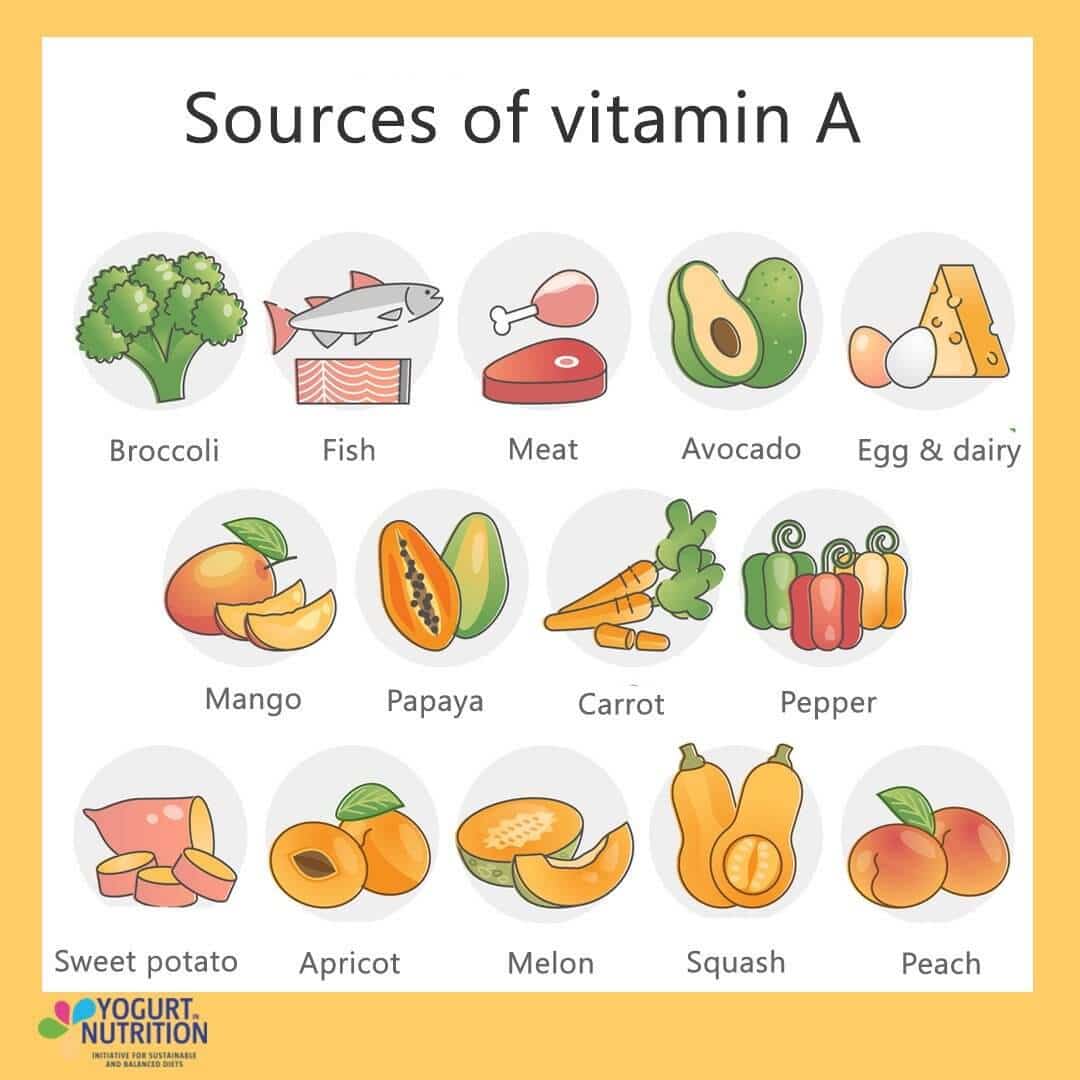
That is the first major problem. And quite ridiculous, if you really think about it.
A cantaloupe is not liver. An egg yolk is not broccoli. A carrot is not milk. These are completely different and produced under different conditions, processed through different systems, and handled by the body in dramatically different ways. Yet the vitamin A toxicity model collapses them into a single label and treats that label as the cause. That is a category error on a grand scale. This next part will completely blow out of the water the entire premise that vitamins are real and somehow exist separately inside our food. To see this more clearly and why food is not the problem, we need only to glance at the forced food fortification market.
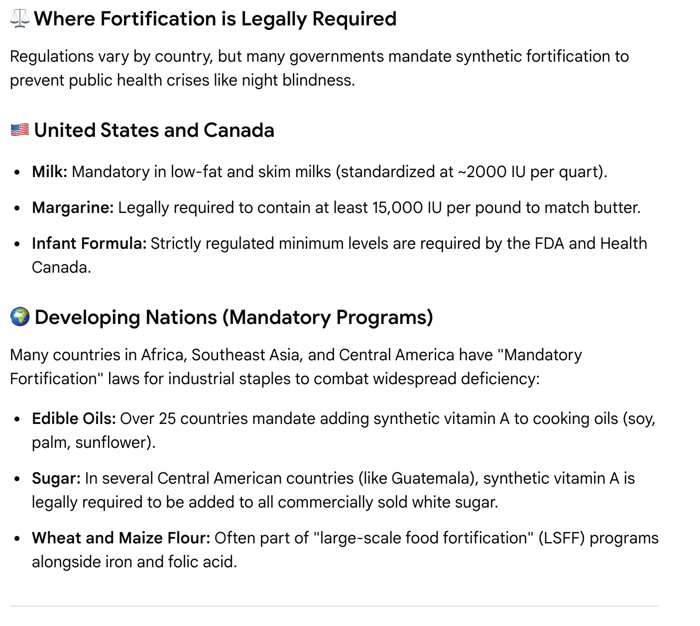
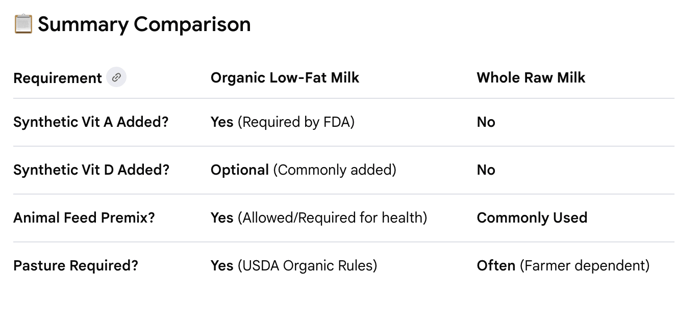
The second problem is even bigger: modern “vitamin A exposure” is not limited to food. It is layered into the food system through mandatory fortification, supplementation, processing, and animal feed, as shown in the chart above.
Synthetic vitamin A is required by the FDA to be added to low-fat and skim milk, infant formula, meal replacements, breakfast cereals, plant milks, margarine, spreads, edible oils, and other fortified products. It commonly appears as retinyl palmitate, retinyl acetate, or stabilized dry vitamin A forms designed to survive processing and shelf storage. These are not natural, variable, food-matrix exposures. These are standardized industrial inputs added in controlled amounts, often repeatedly across multiple foods eaten on the same day.
And oh, what a payday. This is why Merck Pharmaceuticals first won the corporate lottery by being the first to invent the idea of vitamins, through vitamin B1 (aka thiamine), and to force it into the food fortification market. Can you imagine the profit margin of having a pile of cheap chemicals you can buy by the ton, REQUIRED by a nation’s laws to be put into commonly eaten food sources? And REQUIRED to give to your farm animals if you are going to be selling the milk, eggs, or meat? You have been handed the golden rake to capture all of the dirty money coming in, and the industry as a whole caught on, and the race for the next chemical soup was on. All it takes is some dirty doctors and scientists, and you struck chemical gold through modern-day alchemy.


This alone changes the entire conversation.
If someone is eating fortified cereal with fortified milk, drinking a fortified meal replacement, taking a multivitamin, consuming fortified infant formula, using fortified plant milk, and then also eating animal foods from animals fed fortified premixes, the exposure pattern is no longer the ridiculous idea that “vitamin A in food.” It is a stacked, repeated, manufactured exposure coming from multiple directions.
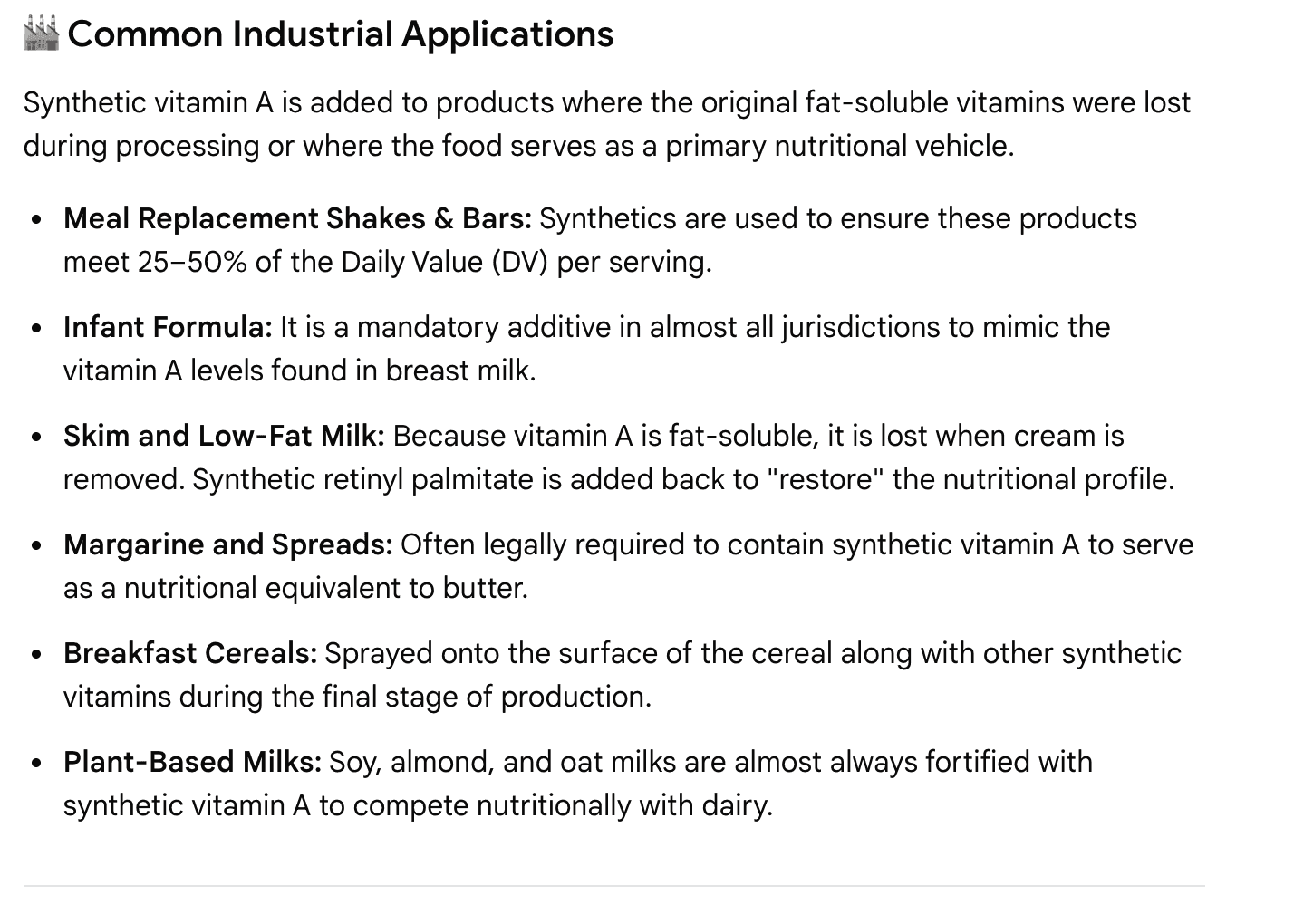
And that is before we even get to the animal.
In modern agriculture, animals are not simply neutral biological sources. They are managed through feed systems. Their rations are designed, adjusted, fortified, and standardized by the industry itself. Vitamin and mineral premixes are commonly used to mislead consumers into believing they are intended to maintain growth, reproduction, milk production, and basic animal health. Even organic systems are not automatically free of this. Organic rules still require producers to buy to meet the animal’s nutritional needs, and synthetic vitamins and minerals are required under specific livestock rules when needed. They are required to get tested by the industry that profits from their results. So, again, imagine if you hold the standardized rules for what a deficiency is, you make up the test and have total control over it (just like they made and utilized the PCR test for HIV and Convid 19), and you have total control over what correction looks like. A Ponzi scheme to end all Ponzi schemes.
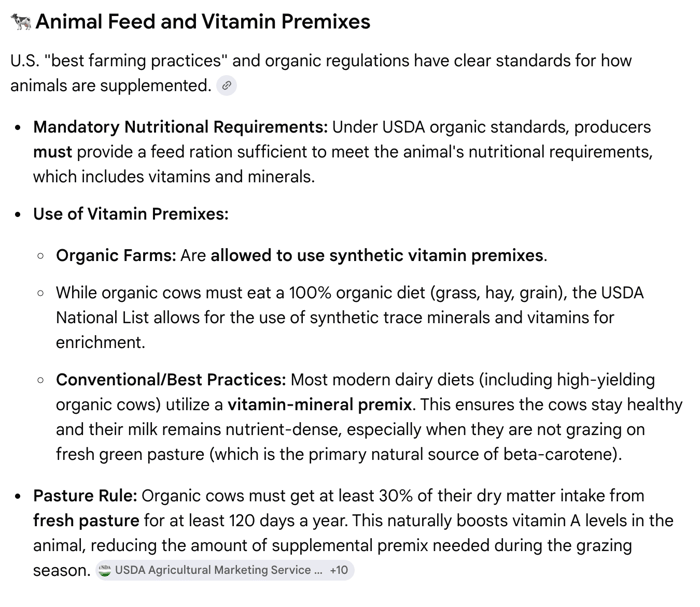
That means the animal’s tissues reflect the system in which it lived.
The liver contains the toxins that the animal was fed and processed.
The fat holds the synthetic chemicals that the animal stored.
The milk is marinated with what the animal was factory-fed and how it was managed.
The egg is infused with the hen’s factory feed diet, environment, and metabolic state.
So when liver and spinach are blamed as a “high vitamin A food,” the question does not appear on the food label, because it is not a food label. It is broccoli, it is a cantaloupe, it is a liver, not a collection of chemical compounds. Obviously. The real question is: what kind of animal produced that liver, what was it fed, what was added to that feed, what did the liver store, and what else came along for the ride?
This is where the argument turns.

Dr. Garrett Smith’s framework treats these foods as if vitamin A is naturally lurking inside them as a clean, isolated toxin. But in the real world, there is no isolated “vitamin A” floating alone inside an egg yolk, a slice of cantaloupe, a chunk of liver, or a glass of milk. There is a food matrix, an agricultural history, a feed history, a processing history, and often a fortification history.
Once that is admitted, the conclusion can only change. Sorry, Garrett, you lost this one by a landslide.
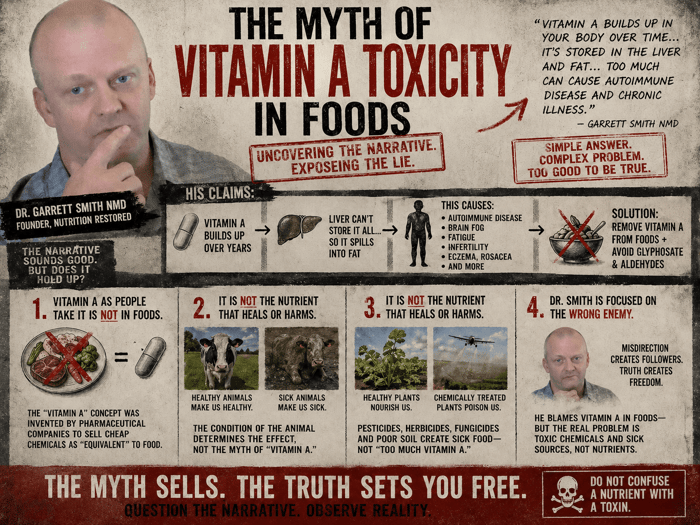
When someone removes liver, eggs, dairy, or other “high vitamin A” foods and feels better, that does not prove that vitamin A in those foods was the cause. It only proves that removing that entire food input changed the body’s response. That input included synthetic premixes, fortified feed, pesticides, contaminants, processing residues, oxidized fats, and/or the biological burden of a best-farming-practices sick animal being raised in a sick system.
You cannot remove the whole system and pretend you isolated one nutrient. Ever. But that is the entire system thrown on its head. The periodic table becomes the periodic fable and sales of elements and their properties. Nutrient deficiencies are the classic smoke-and-mirrors to get you to take synthetic chemicals.
This is the atomic bomb of all checkmates.
If the variable was never isolated, the conclusion was never proven. And you can’t isolate compounds out of food and still call it food. Obviously.
The improvement may be real. The symptoms may be real. The toxicity may be real. But the attribution is the problem. Blaming nature for not existing, and isolating “vitamin A in foods” ignores the much larger and more obvious reality: the modern food supply has been artificially saturated with synthetic vitamin A at multiple levels. That is the irony. Smith is after natural Vitamin A because it’s lacking in foods, and he’s dead wrong about the conclusion, but he completely misses the fact that the foods he tells people to avoid are infused with synthetic vitamin A.
It is added to processed foods.
It is added to infant formulas.
It is added to meal replacements.
It is added to low-fat dairy.
It is added to animal feed.
It is stored in animal tissues, especially the liver and fat.
Then the food itself gets blamed.
The final nail in the coffin is this: the toxicity literature itself shows that retinoids are powerful signaling compounds, especially during pregnancy and infancy. These are not harmless little “nutrients” when isolated and dosed incorrectly. They influence development, tissue formation, bone regulation, liver function, and neurological pressure. Excess exposure during pregnancy is serious enough that retinoid drugs are heavily controlled because of the risk of birth defects. But infused in prenatal vitamins and infant formula. This makes me sick to my stomach.
So we have a system that tells women, infants, children, patients, and the elderly that they need fortified products to prevent deficiency, while the same class of compounds is known to require careful regulation because they cause developmental harm.
The issue is not that nature accidentally hid a pharmaceutical-grade toxin inside food. The issue is that the industry isolated, standardized, fortified, supplemented, and redistributed synthetic vitamin A throughout the food supply, then turned around and allowed the food itself to take the blame.
That is how the myth survives: by people like Dr. Smith, who unwittingly (or knowingly) perpetuate a narrative and believe the illusion he has been given by a system that profits from his ignorance. This is why we need to be very cautious about anyone who is proud to put an MD after their name, or a fake one like Amandha Vollmer did. They are indoctrinated into a system that trains them to read and interpret data the way the industry wants.
Once you separate whole food from fortified input, animal biology from feed premix, and food matrix from isolated compound, the smoke clears, and the mirrors break. You see reality as it is. You cannot blame the delusion that vitamin A is in foods until you account for the only form that exists, the synthetic vitamin A added to the system before the food ever reaches the plate.
This is where the argument collapses.
Finally
When the full system is examined, from fat-soluble storage, biological signaling, food matrix complexity, industrial fortification, and agricultural feed practices, the claim that “vitamin A in whole foods” is the primary driver of toxicity does not hold as a complete explanation. The evidence shows that retinoids are powerful compounds requiring tight regulation, but it also shows that modern exposure is layered, repeated, and often introduced through synthetic fortification and controlled inputs long before food reaches the plate. Without isolating these variables, attributing toxicity to whole foods alone is not a demonstrated conclusion, but a misattribution. The more accurate question is not whether vitamin A can cause harm, but how form, dose, and cumulative exposure across the modern food system interact to produce the observed effects.
Disclaimer
The views expressed in this article are the author’s opinions, based on clinical experience, historical sources, public records, and secondary reporting. Where applicable, references to peer-reviewed and archival material are provided to support discussion of physiology and public health policy.
The author is a licensed Registered Nurse (RN) no longer working in the field. This article reflects professional observation and analysis, but it is not intended as individualized medical advice, diagnosis, or treatment. Readers should consult their own licensed healthcare professionals for personal medical decisions.
This piece is written for informational and educational purposes only. It does not allege proven legal wrongdoing by any named company or individual.
If you believe this article contains a factual error, or if you represent an entity mentioned and wish to provide source documentation or request a correction, please contact robin@purifywithin.com. Corrections will be made promptly where warranted.
Nothing in this article should be construed as medical or legal advice. For legal guidance regarding publishing, liability, or defamation, consult a qualified attorney.
References
Institute of Medicine. (2001). Dietary reference intakes for vitamin A, vitamin K, arsenic, boron, chromium, copper, iodine, iron, manganese, molybdenum, nickel, silicon, vanadium, and zinc. National Academies Press.
National Institutes of Health. (2025). Vitamin A and carotenoids: Fact sheet for health professionals. U.S. Department of Health and Human Services.
World Health Organization. (2023). Vitamin A fortification of staple foods. WHO Press.
U.S. Department of Agriculture. (2024). National Organic Program regulations (7 CFR Part 205). USDA Agricultural Marketing Service.
U.S. Food and Drug Administration. (2023). Infant formula requirements and nutrient specifications. FDA.
Penniston, K. L., & Tanumihardjo, S. A. (2006). The acute and chronic toxic effects of vitamin A. The American Journal of Clinical Nutrition, 83(2), 191–201.
Ross, A. C. (2012). Vitamin A and retinoic acid in T cell–related immunity. The American Journal of Clinical Nutrition, 96(5), 1166S–1172S.

![The Great Vitamin Liars Vitamins [Part 1 By Medicine Girl]](https://dropinblog.net/cdn-cgi/image/fit=scale-down,format=auto,width=700/34264201/files/featured/0c2c0703-aac4-4a09-8bbb-aa55f98bf33e.png)
![Magnesium Vs. Zinc The Battle Royale That Ends the Debate [By Medicine Girl]](https://dropinblog.net/img/h6yzo8eq/700/94577ece-6b84-4d7c-b622-6e764231d715)