


The Final Pillar
By the time we reach Vitamin B12, the entire vitamin story starts looking like a classic snake oil swindle and less like a group of well intentioned scientists trying to find ways to keep people healthy.
Over the course of the B series, we followed the history of the B vitamins from their earliest “discoveries” through industrial synthesis, pharmaceutical expansion, food fortification, and billion-dollar supplement markets. What the public never hears is how weak observational studies were quietly transformed into institutional certainty, and how isolated chemicals replaced broader nutritional discussions while industries built permanent markets around managing symptoms of toxicity and faulty deficiency labels. Few realize how expertly the lines between research and profit were never drawn.
The deeper I went into the research, I saw how nutritional science and industry attempt to adapt human biology to modern, industrial environments.
The folic acid story alone should have forced far more scrutiny than it ever received. Synthetic B9 was forced into the American food supply through mandatory fortification policies built on surprisingly fragile foundations, some of which industry insiders likely assumed would never be subject to serious re-examination. Observational work involving just 22 extremely malnourished pregnant women in colonial India, who temporarily improved after receiving nutritional extracts, formed the foundation for one of the largest forced nutritional interventions in modern history. Entire populations now consume synthetic folic acid daily through fortified foods, all while controversy and regulatory silence persist around neural tube defect causation, masking of B12 deficiency, unmetabolized folic acid, and long-term neurological implications. Once a pile of chemicals becomes profitable they go straight to the regulatory boards and make their poisons policy. Big Pharma’s dream come true.
Vitamin B12 pulls back the curtain on a disturbing reality: all of deficiency medicine rests on shaky observational studies, massively fraudulent flawed diagnostics, repeated citation errors, and commercial industries that expanded long before the science itself was ever plausible.
The public is taught that B12 deficiency is one of the most clear-cut concepts in modern nutrition. If your are a vegan yo will have B12 deficiency. But once the original literature, historical experiments, diagnostic standards, psychiatric controversies, industrial manufacturing methods, and absorption theories are examined closely, the certainty begins to fracture surprisingly fast.
This is the vitamin tied to paralysis, psychosis, dementia, fatigue, methylation, injections, energy drinks, livestock supplementation, fortified foods, anti-aging clinics, prenatal vitamins, and neurological collapse. It is also one of the most commercially valuable vitamins on Earth.
Underneath the entire story sits a deeply uncomfortable truth: we humans are not “deficient” in synthetic laboratory compounds that never existed in nature in the forms being sold, injected, fortified, stabilized, isolated, and patented. No ancestral human was drinking neon pink cyanocobalamin shots, swallowing petroleum-derived folic acid, or eating chemically fortified cereal dusted with industrial vitamin premixes.
A scientist can NOT separate a molecule from the whole without losing the original. I can not cut my finger off, burn it, add acids and chemicals and reactions, come up with a pile of goo, and then tell you what my finger is made of or anything meaningful about it after it has been removed from the whole system. I can’t take out my blood, burn it, isolate pieces of it in a lab, and then claim to understand me as a person. You have to talk to me, listen to me, observe me, and understand me as a whole living system to extract any real meaningful data.
That is the deeper problem sitting underneath modern deficiency medicine. The moment life is broken apart, chemically stripped down, “isolated”, heated, “stabilized”, “extracted”, synthesized, and reconstructed inside laboratory systems, the original living intelligence is completely gone. What remains may still produce reactions, measurements, colors, and chemical signatures, but that does not mean it represents the original living system it came from. Nutritional science reads less like the study of life and more like an occult ritual attempting to study what happens AFTER life has already been chemically destroyed and dissolved into fragments.
That is the real sleight of hand behind the deficiency narrative. The public is taught that isolating a compound from nature somehow proves humans require the synthetic laboratory version forever after. But isolation is not nutrition, the body cannot process anything altered or created in a lab. A leaf is not pharmaceutical folic acid. A living food is not a chemically stabilized synthetic injection. Much of modern deficiency medicine increasingly looks like an industrial patchwork system built to keep poisoned populations functional just long enough to continue consuming, working, medicating, and cycling through endless interventions while the underlying damage remains untouched. The public is never told that the system is structured to manage dysfunction, not eliminate its cause.
The Discovery of B12 and the Birth of the Deficiency Narrative
Before we get too far into the article, I highly recommend reading the Anthea V. Hayes book on Vitamin B12. The book is an excellent, well-documented history of the satanic roots of Vitamin B12 and much more pertinent information than I have room for here. She covers the truth about deficiency lies and skathing debate from angry vegans calling her every name in the book for simply pointing out the uncomfortable truth. Vegans are not deficient in B12; they are toxic and poisoned, and like taking a shopping cart full of toxic vitamins and poor food choices. They feel a boost in energy from the sugar, the release of adrenaline from taking a poison, but no, they are not deficient in a bright red made in a lab, a 500-million-dollar industry product. Obviously.

Before Vitamin B12 became an energy shot, a wellness injection, a fortified cereal additive, or a methylation buzzword, it was tied to one of the most terrifying diseases in medicine: pernicious anemia.
In the late 1800s and early 1900s, pernicious anemia was considered a death sentence. Patients developed profound weakness, numbness, burning feet, confusion, hallucinations, memory loss, paralysis, and sometimes severe psychiatric symptoms—what older medical literature called “megaloblastic madness” or “pernicious madness.” These psychiatric symptoms often led to institutionalization, long before doctors understood the biological causes.
At the time, nobody knew what caused the disease. There were theories involving infections, toxins, degeneration, insanity, heredity, and even moral weakness.
The first major breakthrough came not from isolating a vitamin, but from feeding patients massive amounts of raw liver. In the 1920s, physicians George Minot and William Murphy reported that critically ill pernicious anemia patients dramatically improved after consuming liver every day. The results appeared miraculous. Patients who had been dying regained strength, color, appetite, and blood production. The medical establishment celebrated the discovery, and in 1934 the Nobel Prize was awarded to George Whipple, George Minot, and William Murphy for the work.
But even this famous discovery was tangled in controversy from the beginning—a fact medical textbooks rarely disclose.
George Whipple’s original experiments were not conducted on human patients with pernicious anemia. He pulled a Fauci and created anemia in dogs by repeatedly bleeding them and then testing different foods to see which restored blood production fastest. Liver worked extremely well, but primarily because it was rich in preserved blood. The problem is that iron-deficiency anemia caused by blood loss is not the same disease as pernicious anemia in humans. Pernicious anemia is now understood as a complex absorption disorder involving intrinsic factor and cobalamin metabolism. In other words, one of the most celebrated Nobel Prize discoveries in nutritional medicine began with a biological mismatch that many historians later acknowledged was deeply flawed.
Even more controversial, many researchers argued that William Castle’s later work on the intrinsic factor was actually the key discovery explaining why liver therapy worked, yet Castle himself was excluded from the Nobel Prize. The history of B12 is filled with these kinds of scientific shortcuts, oversimplifications, and retrospective corrections that quietly disappear from modern educational summaries.
What also gets lost in the public retelling is what patients were actually consuming. These were not purified pharmaceutical compounds. Patients were receiving massive biological mixtures containing whole raw liver and organ extracts. Many patients were also recovering under medical supervision with rest, improved nutrition, hydration, and removal from severe illness states. Yet over time, this enormously complex therapeutic environment was reduced into a single conclusion:
There must be one “missing factor.”
That reductionist leap changed nutritional medicine permanently. By the late 1940s, pharmaceutical companies and researchers raced to isolate and synthesize the mysterious anti-pernicious-anemia factor. In 1948, Vitamin B12 was finally created "isolated” independently by teams associated with Merck and British researchers using massive quantities of liver extracts. The discovery immediately transformed B12 from a food-based therapy into a commercial pharmaceutical product. And of course the financial incentives exploded almost overnight.
Injectable B12 products flooded the market. Clinics marketed B12 as an energy booster, an anti-fatigue cure, a nerve tonic, and a vitality enhancer. Pharmaceutical companies aggressively expanded production while researchers rushed to define deficiency syndromes broad enough to justify widespread testing and supplementation. The public was gradually taught that fatigue, numbness, poor memory, weakness, depression, aging, neuropathy, and countless vague symptoms might all trace back to a hidden B12 deficiency. This is the identical tactic the ignorant influencers are told is a magnesium deficiency.
This is the identical tactic pushed by self-proclaimed health influencers who blame every muscle cramp on a so-called magnesium deficiency. Let me be clear for those selling magnesium supplements and misleading the public with smoke-and-mirrors science: when you experience leg cramps, it’s almost always because you overused the muscle (the classic weekend warrior scenario) or because your body is reacting to a toxin or poison.
Reaching for a blood pressure drug like magnesium, just to mask the symptoms, is as misguided as believing that synthetic chemicals made in a lab will erase your neurological symptoms. True healing doesn’t come from adding more pills—it comes from subtraction. Remove the toxins and poisons, and the body will only fall to homeostasis and health. That is the only state the body knows. But that approach doesn’t profit the low-level grifters who prey on public ignorance and confusion. Their business model depends on keeping you hooked on the next magic supplement, not on helping you actually heal. I can mask your symptoms with herbs, drugs or vitamins. You still have the same problem, you just made it worse with the added interference.
Remove the poisons, remove the stressors, remove the irritation, remove the offending mechanisms and causative burden, and the body naturally moves back toward homeostasis. But that approach is terrible for business and why some grifters are spending their days writing entire articles about me. There is far more money in convincing people their body is permanently deficient, weak and dependent on powders, pills, injections, and endless supplementation protocols than teaching them how to stop poisoning themselves in the first place.
But underneath the growing ad campaign swindle surrounding B12, the actual science remained surprisingly unstable, a reality the supplement and pharmaceutical industries have every reason not to advertise. One of the most disgusting examples involves the famous educational narrative claiming humans cannot absorb the B12 produced by bacteria in their own colon. For decades, textbooks and nutritional authorities repeated a story involving human stool extracts and B12-deficient patients as proof of this absorption theory. The problem is that when researchers later examined the historical record closely, the evidence became extraordinarily shaky.
The famous experiment was not a large controlled clinical trial. It largely stemmed from anecdotal observations involving ONE PERSON. There were NO control groups. The patients were severely ill. Researchers were conducting horrific interventions with crude biological extracts while observing blood responses in real time. Later, one of the most influential hematologists in the field confidently cited a British paper as definitive proof of the absorption theory, except researchers eventually discovered the cited paper did not actually contain the experiment being referenced at all.
The story had effectively become a scientific ghost citation, repeated across generations of educational material without anyone verifying the original source. Just like the entire field of psychology, built on literal smoke and mirrors. It’s a classic case of narrative laundering: a shaky anecdote, repeated often enough, becomes untouchable dogma in the hands of the establishment. Just ask Adolf Hitler’s ad campaign team how effective this strategy is.
The Diagnostic Chaos Behind B12 Deficiency
The public is often taught that B12 deficiency is simple: run a blood test, identify a low value, supplement the missing “vitamin”, and the problem is solved. In reality, they find a vague symptom everyone has like say muscle cramps or numbness and tingling in the feet, call it a deficiency, and treat it with a pharmaceutical with a vitamin or supplement label that suppresses the symptoms and eureka! You have a gold mine. The real crux of the industry however is in the testing. If you hate the PCR test but believe in deficiency tests, have I got some evidence for you.

shady salesman finding chemicals he can turn into gold and put on a vitamin label
B12 testing has always been controversial, with ongoing disputes about what qualifies as a “normal” level, which biomarkers actually matter, and whether blood measurements reflect true tissue status. The most common laboratory marker is serum B12, but serum levels always fail to match clinical reality. Patients with “normal” blood levels can still develop neurological symptoms, while others with low levels may show few symptoms. The smoking gun. Stop trusting the testing. It is a lie to sell you a drug. Even the official laboratory cutoffs vary dramatically between countries, some American labs use 200 pg/mL, while Japanese and European standards are closer to 500 pg/mL. Additional markers like methylmalonic acid and homocysteine are indirect and affected by other factors. As a result, B12 diagnosis relies on a shifting mix of tests, subjective symptom interpretation, and international disagreement.
Research has repeatedly shown that patients develop severe neurological symptoms long before classic anemia appears. MEaning they don’t have B12 deficiency, they are being slow drip poisoned. Some patients experience white matter changes in the brain, nerve degeneration, cognitive slowing, psychiatric disturbances, or spinal cord damage despite laboratory results falling within “normal” reference ranges.
The testing itself becomes even more complicated once additional markers are introduced.
Doctors may order methylmalonic acid (MMA), homocysteine, holo-transcobalamin, intrinsic factor antibodies, parietal cell antibodies, or polyethylene glycol (PEG) precipitation testing to clarify metabolic status. But these tests are indirect, inconsistently interpreted, and influenced by kidney function, other circulating poisons causing a responce in the body, medications, liver disease, pregnancy, or broader metabolic dysfunction.
Even among so-called specialists, there is no universally agreed-upon gold standard for diagnosing “functional B12 deficiency.” Ever wonder why? Because, while the so-called experts are busy chasing their tails over lab values and peering at meaningless specks under a microscope, those of us actually capable of independent thought are telling you the uncomfortable truth: there is no such thing.
You can’t prove the existence of something that simply doesn’t exist—just as you can’t prove someone is “deficient” in a substance the body was never meant to rely on in the first place. The entire diagnosis is a house of cards, kept standing by those whose reputations (and profits) depend on keeping the public confused.
Checkmate, and this is where the atomic bomb of the entire series starts detonating.
An entire global industry built around deficiency screening, injections, supplementation, neurological fear, and lifelong treatment pathways still cannot consistently define what B12 deficiency actually looks like across populations. One has to ask: is this chaos truly accidental, or does it serve those who profit from perpetual diagnosis? Hmmmm, lets think about that for a minute or two.
The uncertainty surrounding B12 diagnosis becomes even more disturbing when combined with folic acid fortification.
The Folic Acid Problem
One of the biggest cracks in the entire B12 narrative appeared after synthetic folic acid was forced into the food supply. Researchers began noticing that folic acid could normalize abnormal bloodwork while people continued developing neurological symptoms underneath. Mainstream medicine framed this as “masking a B12 deficiency,” but that explanation creates an even larger problem: it exposes how unstable and indirect the testing really is.
Because if one synthetic laboratory chemical can dramatically alter the appearance of another alleged deficiency state, then what exactly are these tests truly measuring?
The public is told the symptoms belong to “B12 deficiency.” But what if these neurological symptoms are actually the body reacting to toxicity, metabolic stress, pharmaceutical injury, chemical overload, inflammation, damaged digestion, or industrial living conditions — while synthetic folic acid simply interferes with the body’s warning signals and the laboratory interpretation surrounding them? Yes, folic acid acts like a pharmaceutical masking symptoms AND interfereing with the fake testing. Proof positive of the entire faulty framework.
Instead of proving a clean deficiency state, the masking phenomenon exposes how faulty the testing system is. The body is reacting. The nervous system is reacting. The bloodwork shifts. Then another synthetic intervention changes the laboratory picture again, and the entire narrative gets reclassified as yet another “hidden deficiency.”
The nitrous oxide controversy fits this same pattern.
Mainstream medicine claims nitrous oxide “inactivates B12,” leading to sudden neurological collapse in vulnerable individuals. But what is actually being observed is a nervous system under extreme chemical stress reacting violently after exposure to another industrial compound. The body deteriorates, the lab markers shift, and the event is immediately interpreted through the lens of deficiency medicine. The assumption is built into the framework before the investigation even begins.
And that is the larger issue hiding underneath the B12 story:
the tests do not prove the original cause of the dysfunction. They only measure fragments of a body already reacting to stress, chemicals, toxicity, pharmaceutical exposure, inflammation, and biological breakdown.
The B12 Industry and the Business of Dependency
Once Vitamin B12 was isolated and commercialized in the late 1940s, the market potential became obvious almost immediately.
This was not a niche supplement. B12 quickly evolved into one of the most profitable and medically marketable vitamins in modern history because it could be attached to fatigue, weakness, aging, nerve pain, memory loss, anemia, mood changes, concentration problems, energy metabolism, injections, athletic performance, pregnancy, and neurological health all at once. Few compounds in the supplement and pharmaceutical industries could be marketed across such a massive range of symptoms and demographics.
EUROAPI: A prominent biotech manufacturer known as the sole major Western producer of pharmaceutical-grade Vitamin B12.
Major Manufacturers: Large pharmaceutical conglomerates like Sanofi, Pfizer Inc., and Merck & Co., Inc. produce various forms and brands of B-12 globally.
Today, the global B12 market spans pharmaceutical injections, sublingual tablets, fortified cereals, prenatal vitamins, anti-aging clinics, wellness spas, IV lounges, energy drinks, sports supplements, nootropic stacks, livestock feed, infant formulas, and “methylation support” products. Entire wellness businesses now revolve around routine B12 injections given to otherwise healthy individuals seeking more energy, improved mood, faster metabolism, or enhanced cognitive performance.
People often approach supplements as inherently gentle, natural, and harmless—even when they are manufactured through the same aggressive industrial biotechnology. That’s no accident. It’s marketing genius, creating the perfect long-term dependency model: products that feel medicinal enough to promise transformation while appearing safe enough for lifelong daily use. The public’s trust is carefully cultivated—and expertly monetized. Yet, once again there is no difference between prescription, OTC, drugs and vitamins.
The manufacturing process itself looks nothing like the image most consumers have in mind.
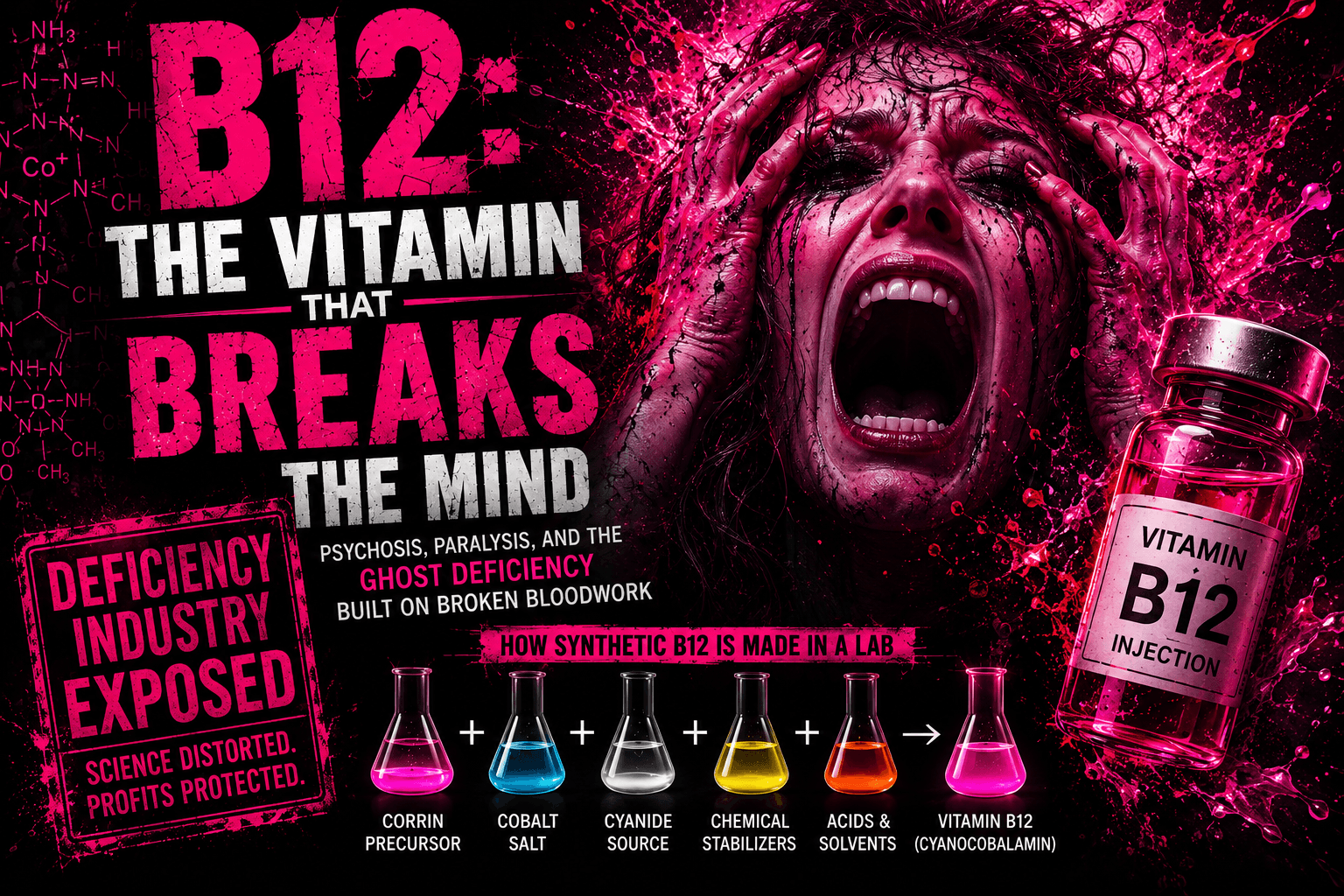
Vitamin B12 is not harvested from pristine natural foods or delicately extracted from healthy soil. Commercial B12 production relies on massive industrial fermentation systems using specialized bacteria grown in enormous stainless-steel vats filled with sugar substrates and cobalt salts. Because the B12 molecule is one of the most chemically complex compounds, total synthetic chemical production is commercially impractical. Instead, bacteria are used as microscopic manufacturing tools.
The most common commercial form, cyanocobalamin, is then stabilized using cyanide chemistry to make the molecule shelf-stable and resistant to heat- and light-induced breakdown. Although defenders correctly point out that the cyanide amount is extremely small, the process itself still reveals how industrialized modern vitamin production actually is. Cyanide builds up in the body and causes the neurological symptoms the vitamin is supposed to relieve. Just like prescriptions.
B12 is produced from activated sewage sludge because municipal wastewater systems were rich in B12-producing bacteria. Patents were filed in the mid-20th century describing methods for extracting vitamin compounds from sewage-treatment byproducts before “cleaner” bacterial fermentation systems became commercially dominant.
Then comes one of the largest contradictions in the entire nutritional narrative:
the livestock loophole.
The public is constantly told that meat and animal products are the “natural” sources of Vitamin B12 and that humans must consume them to maintain healthy levels. But modern industrial livestock production has become so disconnected from natural grazing systems that many factory-farmed animals themselves require cobalt and synthetic B12 supplementation as a way to fatten the animal and increase weight prior to slaughter, masking true illness.
In other words, many people consuming “natural” dietary B12 are already participating in a synthetic supplementation loop routed through industrial feed systems. The modern B12 economy no longer resembles a naturally functioning nutritional ecosystem. It is a system layered onto industrial agriculture, pharmaceutical intervention, altered digestion, and feedlot farmingr reflecting how modern nutrition is incentivized into an artificial environment. The financial incentives surrounding that system are enormous.
The Strange Economics of Vitamin B12
One of the strangest discoveries in this investigation is that Vitamin B12 — the vitamin associated with paralysis, psychosis, spinal cord degeneration, dementia, hallucinations, anemia, nerve destruction, fatigue, methylation, and neurological collapse — is actually a relatively small market compared to other synthetic vitamins.
The global B12 industry sits around a few hundred million dollars annually, depending on how the market is measured. Meanwhile, synthetic folic acid and broader fortification industries exploded into multi-billion-dollar empires embedded directly into flour systems, processed foods, prenatal programs, cereals, livestock feed, and government nutritional policy. That discrepancy matters.
If B12 deficiency truly represents one of the most catastrophic and widespread nutritional threats in modern medicine, why did the real industrial money flow so aggressively toward folic acid and mandatory fortification instead?
B12 is difficult to industrialize for universal food fortification. It is biologically fragile, fermentation-dependent, chemically complex, sensitive to heat and processing conditions, and expensive to stabilize at a massive scale. Folic acid, on the other hand, is cheap, shelf-stable, petroleum-derived, easy to synthesize, easy to patent through manufacturing methods, and almost perfectly designed for processed grain systems.
In other words, folic acid became the ideal industrial vitamin to force onto the public. It was just dollars and cents.
That means the very vitamin aggressively pushed into fortified foods may partially obscure recognition patterns tied to the much more neurologically dangerous states people recognize after it is to late…MS dementia, Alzheimer’s Parkinson’s etc.
Pernicious Madness and the Psychiatric Disaster
One of the darkest and least discussed chapters in the history of Vitamin B12 involves psychiatry. And in many cases, nobody realized the nervous system was failing.
Patients were institutionalized, sedated and diagnosed as insane. They were committed to psychiatric hospitals, often permanently.
This was not rare fringe medicine buried in forgotten archives. It was a recognized clinical problem that modern medicine quietly moved past once liver therapy and later B12 injections became available. Historians and medical researchers have since revisited famous historical cases, including Mary Todd Lincoln, questioning whether some individuals labeled mentally unstable may actually have suffered from untreated pernicious anemia or broader nutritional neurological disease.
What makes this section of the B12 story so uncomfortable is how closely it mirrors modern controversies surrounding testing itself.
Even today, patients with neurological symptoms are often told their bloodwork is “normal” despite numbness, cognitive decline, burning feet, balance problems, memory issues, severe fatigue, psychiatric symptoms, or white matter abnormalities. Some spend years inside psychiatric systems before a doctor seriously investigates B12 metabolism or absorption disorders.
And this is where the B12 narrative becomes uniquely dangerous compared to the other vitamins in this series.
Because, unlike vague wellness claims about “energy” or “immune support,” severe B12 dysfunction can involve irreversible neurological injury. Once spinal cord degeneration progresses far enough, damage may become permanent even after supplementation begins.
Then comes nitrous oxide.
Nitrous oxide, used in dentistry and recreationally, can inactivate B12 rapidly, leading to severe neurological decline in vulnerable individuals. Cases of paralysis, psychiatric collapse, and spinal cord injury after nitrous oxide exposure are well documented.
What makes this especially disturbing is that many patients never knew they were vulnerable in the first place.
The deeper the B12 story goes, the less it resembles a simple vitamin deficiency and the more it resembles a fragile neurological balancing act resting on inconsistent testing, incomplete diagnostics, and decades of medical overconfidence.
Conclusion
And despite all of that uncertainty, the medical and industrial systems expanded aggressively around the diagnosis anyway.
That is the real story hidden underneath the B12 industry.
Not simply whether B12 has biological importance. Clearly, it does. Not whether severe neurological collapse can occur. It absolutely can. The real controversy is how quickly modern medicine transformed a complicated, poorly understood, metabolically unstable collection of neurological and digestive problems into a seemingly simple deficiency narrative supported by laboratory systems that still cannot consistently define the condition itself.
The farther this series went, the more obvious another pattern became:
Modern industrial society keeps creating conditions the body struggles to adapt to, then builds massive chemical and pharmaceutical markets around managing the breakdown.
And B12 may be the clearest example of all.
Disclaimer
The views expressed in this article are the author’s opinions based on clinical experience, historical sources, public records, regulatory documents, scientific literature, and secondary reporting. References to peer-reviewed publications, government materials, archival records, and publicly available data are included where applicable to support discussion surrounding physiology, supplementation, toxicology, industrial manufacturing, and public health policy.
The author is a licensed Registered Nurse (RN) who is no longer practicing clinically or acting in any medical capacity through this publication. This article reflects personal analysis, commentary, investigative research, and opinion and is not intended as individualized medical advice, diagnosis, or treatment. Readers should consult their own licensed healthcare professionals regarding personal medical decisions, medications, supplements, or health concerns.
This publication is presented for informational, educational, commentary, and entertainment purposes only. It does not allege criminal conduct or proven legal wrongdoing by any named company, institution, regulatory agency, manufacturer, or individual. Statements regarding vitamins, pharmaceuticals, fortification policies, manufacturing processes, market incentives, toxicology, and historical events reflect interpretation and opinion based on publicly available information and cited materials.
Discussion of nutritional deficiencies, supplementation, neural tube defects, pregnancy, toxic exposures, industrial food systems, neurological symptoms, and public health interventions involves ongoing scientific debate and evolving research. Readers are encouraged to review primary source materials, consult qualified professionals, and conduct an independent investigation before forming medical or legal conclusions.
If you believe this article contains a factual inaccuracy, or if you represent an entity discussed and wish to provide documentation, clarification, or request a correction, please contact robin@purifywithin.com. Corrections will be reviewed and made where appropriate.
Nothing in this publication should be construed as medical or legal advice. Readers seeking legal guidance regarding publishing, liability, or defamation matters should consult a qualified attorney.



![The Great Vitamin Liars Vitamins [Part 1 By Medicine Girl]](https://dropinblog.net/cdn-cgi/image/fit=scale-down,format=auto,width=700/34264201/files/featured/0c2c0703-aac4-4a09-8bbb-aa55f98bf33e.png)